Short answer
Wayne Dalton is the one brand where the counterbalance is genuinely unlike everyone else's. Instead of springs sitting on an open shaft above the door, a TorqueMaster system hides them inside a steel tube. You cannot see a broken Wayne Dalton spring, which is why so many owners are told nothing is wrong right up until the door will not lift. If your door is suddenly very heavy and there is no visible break anywhere, a TorqueMaster spring is the first thing to check. Wayne Dalton is part of Overhead Door Corporation.
What makes Wayne Dalton different
On a conventional door, torsion springs are wound onto a bar you can see, and a break announces itself with a bang and a visible gap in the coil. TorqueMaster puts the spring inside the tube, wound from a bracket at the end, with the whole assembly enclosed. The design has real advantages: the spring is contained if it fails, the hardware looks clean, and the winding is done with a drill rather than with bars. The consequence for diagnosis is significant. There is no gap to point at and no noise to go on. The door simply becomes heavy, the tube may spin more freely than it should, and the cables may go slack on one side. Wayne Dalton also made the iDrive, an opener that mounts directly on the torsion shaft rather than on a ceiling rail, which is another design almost nobody else built.
How to identify which Wayne Dalton you have
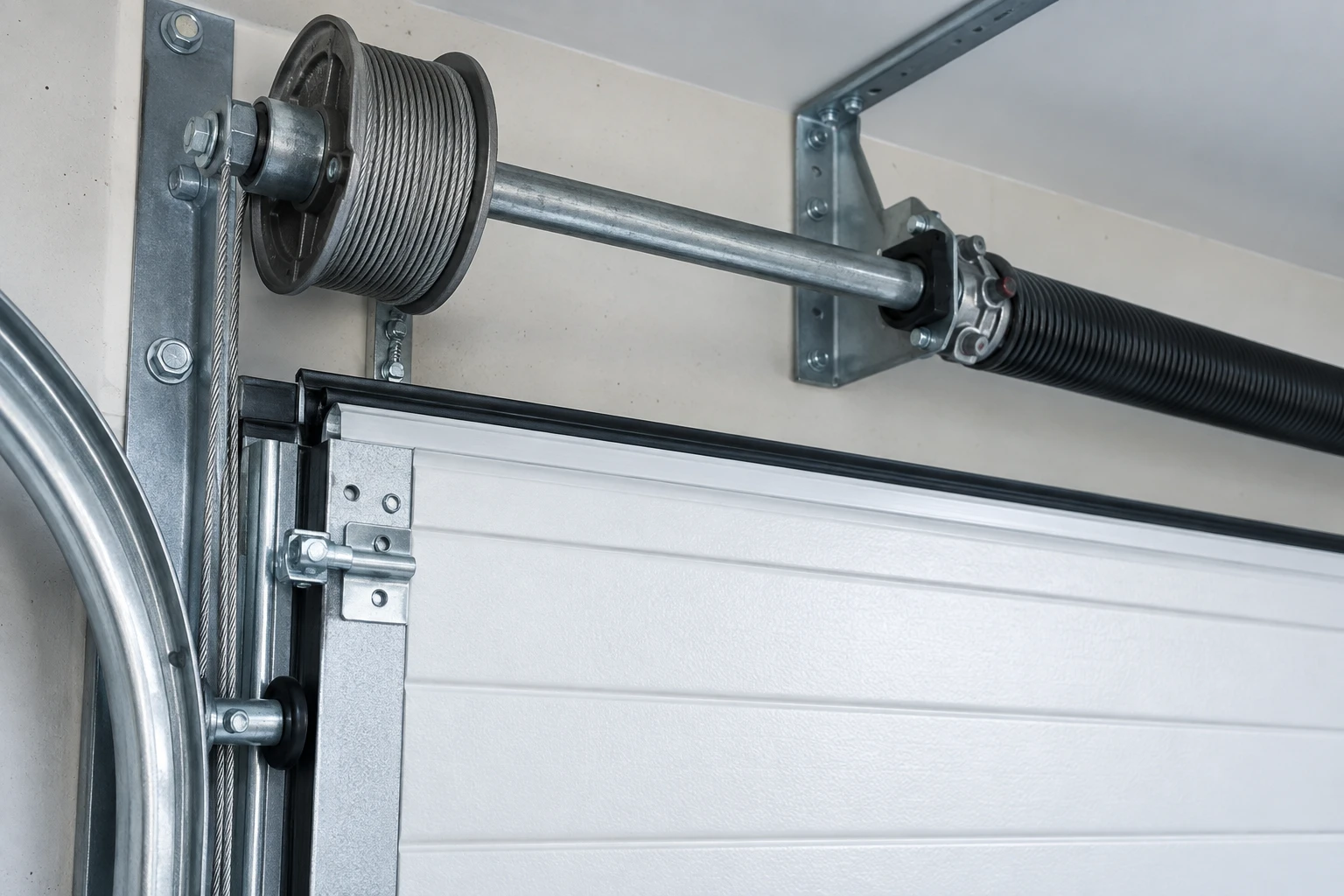
Look above the door. A standard system shows springs wound on an exposed shaft with visible winding cones. A TorqueMaster shows a smooth steel tube with no spring in sight and a winding bracket at one end or at both. One bracket means a single spring system, two means a dual. The door itself carries a label, usually on the inside of a section near the hinge line or on the bottom section, giving model and series. If there is an opener mounted on the shaft beside the door rather than on a rail running to the ceiling, that is an iDrive, and it has its own parts and its own limitations. Knowing which of these you have matters before anyone orders anything, because the systems are not interchangeable and a standard torsion conversion is a different job from a like for like repair.
The failures we see on Wayne Dalton
The defining Wayne Dalton failure is a TorqueMaster spring that has broken silently. The door goes heavy, the opener strains or stops, and there is nothing to see. A second common one is the winding bracket or the internal winding shaft stripping, which prevents the spring being tensioned even when the spring itself is intact. Cables come off the drums when tension is lost and the door then sits crooked. On TorqueMaster Plus systems there is a brake mechanism intended to catch a break, and it can seize or fail on its own. The iDrive opener has become the hardest part of the line to support, with limited availability, and owners are increasingly better served converting to a conventional rail opener than chasing parts.
Parts, and what actually interchanges
TorqueMaster springs, winding brackets, internal winding shafts, end bearings, cables, drums and the brake assembly on Plus systems are all obtainable, but they are Wayne Dalton specific and cannot be substituted with standard torsion components. A spring has to be matched to the door's actual weight and the tube configuration, not guessed. Sections and panels are matched by series and profile, and Wayne Dalton has produced enough distinct panel designs over the years that an exact match needs the model from the door label. Where a homeowner wants out of the system entirely, a conversion to conventional torsion is a legitimate option: it uses standard parts from then on, but it is a rebuild of the counterbalance rather than a repair and should be quoted as one.
Repair or replace
The question on a Wayne Dalton is usually whether to repair the TorqueMaster or convert to conventional torsion. Repairing keeps the enclosed system, uses brand specific parts, and is the right answer when the tube, brackets and door are all in good order. Converting puts the door onto standard springs on an open shaft, which makes every future repair cheaper and faster and every future part easier to source, and it is worth considering when the system has already failed more than once or when the brackets are worn. Neither is wrong. What is wrong is fitting standard torsion parts to a TorqueMaster tube, or sizing a replacement spring by eye. On the iDrive opener specifically, the parts situation now favours converting to a conventional opener.
What the visit looks like
Because a broken TorqueMaster gives no visual sign, the visit begins with a weight and balance assessment rather than an inspection. The opener is released and the door is lifted by hand to establish how much of its weight the counterbalance is actually carrying. The tube is then checked for clear rotation, the winding brackets and internal shaft are examined, and both cables are checked at the drums for slack and correct seating. The door label is read to establish series and configuration. Findings are explained before parts are ordered, including whether repair or conversion is the better path and why. After the work, the door is cycled by hand through full travel and checked for balance at several heights before the opener is reconnected and its limits and reversal tested.
Wayne Dalton problem in Dallas Fort Worth?
Tell us the model number off the label and what the door and opener is doing, and you will get a straight read on what is likely wrong and whether the part is still made.
Call (214) 271-8110Wayne Dalton questions we get asked
My Wayne Dalton door is suddenly very heavy but I cannot see a broken spring. What happened?
That is the classic TorqueMaster presentation. The springs sit inside the steel tube above the door, so a break is completely hidden. There is no gap to see and often no bang to hear. What you get instead is a door that has become far heavier than it was, an opener that strains or gives up, and sometimes a cable gone slack on one side. Do not keep operating it, because an unbalanced door can come down hard. The counterbalance needs assessing by weight and by feel rather than by looking for damage.
Can a regular torsion spring be fitted to my Wayne Dalton?
Not into the TorqueMaster tube. The system uses springs made for it, wound from a bracket at the end, and standard torsion components are not compatible with that assembly. What can be done is a full conversion, replacing the TorqueMaster with a conventional torsion setup on an open shaft. That is a rebuild of the counterbalance, not a swap, and it changes the hardware permanently. It is a reasonable choice if you want cheaper and more available parts in future, but it should be quoted and understood as a conversion rather than a repair.
How do I tell if I have TorqueMaster or a standard system?
Look at the shaft above the door. If you can see springs wound onto an exposed bar with winding cones on them, it is a standard torsion system. If you see a smooth steel tube with no springs visible and a winding bracket at one or both ends, it is TorqueMaster. One bracket means a single spring, two brackets means a dual spring system. The door will also carry a label, generally on the inside of a section, with the model and series, which is what any parts order needs.
My Wayne Dalton iDrive opener has failed. What are my options?
The iDrive mounts on the torsion shaft rather than on a ceiling rail, which was a clever design, but parts availability for it has become the hardest in the Wayne Dalton line. Repairing one is sometimes possible and increasingly difficult. For most owners the practical route now is converting to a conventional rail mounted opener, or to a wall mounted jackshaft unit if you want to keep the ceiling clear, which is the closest modern equivalent to what the iDrive was doing. Either conversion needs the torsion hardware assessed first.
Other brands we work on
Where we cover
Repair and parts for this brand for Wayne Dalton across the whole Dallas Fort Worth metroplex. Pick your city below to see what brand work in that part of the metroplex actually involves.
Every job we do
Test the door by hand: Wayne Dalton Garage Door And Opener Repair in Dallas-Fort Worth
The visible symptom is only the first clue. For Wayne Dalton Garage Door And Opener Repair in Dallas-Fort Worth, the local context includes a mix of property ages, operating patterns, weather exposure, shared access, and equipment histories. The working scope centers on inspection, diagnosis, scope, safe work, operational testing, and a documented handoff. Under test the door by hand, the review covers door balance, spring assistance, roller movement, hinge condition, track alignment, and resistance through the full travel. A property manager may first report that the photo-eye circuit needs a documented baseline, but that statement is a starting point rather than a diagnosis. The inspection should establish what changed, which parts still function, what can be tested safely, and what result the customer expects. The result is easier to test and easier to document. Conditions across Dallas-Fort Worth influence materials, access, weather exposure, and scheduling, so the final recommendation should follow the actual property. 24/7 Dallas Garage Door Repair explains the work, records important limitations, and asks the customer to verify the finished operation before the visit closes.
Good service starts by separating cause from coincidence. For Wayne Dalton Garage Door And Opener Repair in Dallas-Fort Worth, the local context includes a mix of property ages, operating patterns, weather exposure, shared access, and equipment histories. The working scope centers on inspection, diagnosis, scope, safe work, operational testing, and a documented handoff. Under test the door by hand, the review covers door balance, spring assistance, roller movement, hinge condition, track alignment, and resistance through the full travel. A homeowner may first report that the bottom fixture behaves differently under load, but that statement is a starting point rather than a diagnosis. The inspection should establish what changed, which parts still function, what can be tested safely, and what result the customer expects. That distinction matters when several people share responsibility for the property. Conditions across Dallas-Fort Worth influence materials, access, weather exposure, and scheduling, so the final recommendation should follow the actual property. 24/7 Dallas Garage Door Repair explains the work, records important limitations, and asks the customer to verify the finished operation before the visit closes.
Plan for weather: Wayne Dalton Garage Door And Opener Repair in Dallas-Fort Worth
Good service starts by separating cause from coincidence. For Wayne Dalton Garage Door And Opener Repair in Dallas-Fort Worth, the local context includes a mix of property ages, operating patterns, weather exposure, shared access, and equipment histories. The working scope centers on inspection, diagnosis, scope, safe work, operational testing, and a documented handoff. Under plan for weather, the review covers heat, cold, wind, moisture, seal condition, material movement, lubrication needs, and exposed metal. A homeowner may first report that the spring shaft shows uneven wear, but that statement is a starting point rather than a diagnosis. The inspection should establish what changed, which parts still function, what can be tested safely, and what result the customer expects. That distinction matters when several people share responsibility for the property. Conditions across Dallas-Fort Worth influence materials, access, weather exposure, and scheduling, so the final recommendation should follow the actual property. 24/7 Dallas Garage Door Repair explains the work, records important limitations, and asks the customer to verify the finished operation before the visit closes.
The visible symptom is only the first clue. For Wayne Dalton Garage Door And Opener Repair in Dallas-Fort Worth, the local context includes a mix of property ages, operating patterns, weather exposure, shared access, and equipment histories. The working scope centers on inspection, diagnosis, scope, safe work, operational testing, and a documented handoff. Under plan for weather, the review covers heat, cold, wind, moisture, seal condition, material movement, lubrication needs, and exposed metal. A building owner may first report that the cable drum has been exposed to moisture, but that statement is a starting point rather than a diagnosis. The inspection should establish what changed, which parts still function, what can be tested safely, and what result the customer expects. The result is easier to test and easier to document. Conditions across Dallas-Fort Worth influence materials, access, weather exposure, and scheduling, so the final recommendation should follow the actual property. 24/7 Dallas Garage Door Repair explains the work, records important limitations, and asks the customer to verify the finished operation before the visit closes.
A useful question before approving this step
Ask what observation supports the recommendation, which parts are included, which parts are outside the scope, how the result will be tested, and what documentation you will receive. Call (214) 271-8110 to describe the property and schedule work within Dallas-Fort Worth.
Explain the quote: Wayne Dalton Garage Door And Opener Repair in Dallas-Fort Worth
The final test matters as much as the first inspection. For Wayne Dalton Garage Door And Opener Repair in Dallas-Fort Worth, the local context includes a mix of property ages, operating patterns, weather exposure, shared access, and equipment histories. The working scope centers on inspection, diagnosis, scope, safe work, operational testing, and a documented handoff. Under explain the quote, the review covers diagnosis, parts, labor, optional work, approval, testing, and what would change the scope. A building owner may first report that the opener rail has an uncertain service history, but that statement is a starting point rather than a diagnosis. The inspection should establish what changed, which parts still function, what can be tested safely, and what result the customer expects. The technician can then explain what belongs in the current job and what can wait. Conditions across Dallas-Fort Worth influence materials, access, weather exposure, and scheduling, so the final recommendation should follow the actual property. 24/7 Dallas Garage Door Repair explains the work, records important limitations, and asks the customer to verify the finished operation before the visit closes.
Clear documentation makes a technical job easier to judge. For Wayne Dalton Garage Door And Opener Repair in Dallas-Fort Worth, the local context includes a mix of property ages, operating patterns, weather exposure, shared access, and equipment histories. The working scope centers on inspection, diagnosis, scope, safe work, operational testing, and a documented handoff. Under explain the quote, the review covers diagnosis, parts, labor, optional work, approval, testing, and what would change the scope. A warehouse lead may first report that the spring shaft shows uneven wear, but that statement is a starting point rather than a diagnosis. The inspection should establish what changed, which parts still function, what can be tested safely, and what result the customer expects. The same check helps rule out work that would not solve the complaint. Conditions across Dallas-Fort Worth influence materials, access, weather exposure, and scheduling, so the final recommendation should follow the actual property. 24/7 Dallas Garage Door Repair explains the work, records important limitations, and asks the customer to verify the finished operation before the visit closes.
Trace uneven movement: Wayne Dalton Garage Door And Opener Repair in Dallas-Fort Worth
A reliable plan begins with a physical check. For Wayne Dalton Garage Door And Opener Repair in Dallas-Fort Worth, the local context includes a mix of property ages, operating patterns, weather exposure, shared access, and equipment histories. The working scope centers on inspection, diagnosis, scope, safe work, operational testing, and a documented handoff. Under trace uneven movement, the review covers cable seating, drums, bottom fixtures, track spacing, rollers, and obstructions around the opening. A warehouse lead may first report that the spring shaft shows uneven wear, but that statement is a starting point rather than a diagnosis. The inspection should establish what changed, which parts still function, what can be tested safely, and what result the customer expects. This prevents one worn part from hiding a larger operating problem. Conditions across Dallas-Fort Worth influence materials, access, weather exposure, and scheduling, so the final recommendation should follow the actual property. 24/7 Dallas Garage Door Repair explains the work, records important limitations, and asks the customer to verify the finished operation before the visit closes.
The most useful decision follows the system, not a sales package. For Wayne Dalton Garage Door And Opener Repair in Dallas-Fort Worth, the local context includes a mix of property ages, operating patterns, weather exposure, shared access, and equipment histories. The working scope centers on inspection, diagnosis, scope, safe work, operational testing, and a documented handoff. Under trace uneven movement, the review covers cable seating, drums, bottom fixtures, track spacing, rollers, and obstructions around the opening. A property manager may first report that the opener rail has an uncertain service history, but that statement is a starting point rather than a diagnosis. The inspection should establish what changed, which parts still function, what can be tested safely, and what result the customer expects. A written scope also reduces surprises after work begins. Conditions across Dallas-Fort Worth influence materials, access, weather exposure, and scheduling, so the final recommendation should follow the actual property. 24/7 Dallas Garage Door Repair explains the work, records important limitations, and asks the customer to verify the finished operation before the visit closes.
Review everyday use: Wayne Dalton Garage Door And Opener Repair in Dallas-Fort Worth
Small alignment and maintenance details often explain large symptoms. For Wayne Dalton Garage Door And Opener Repair in Dallas-Fort Worth, the local context includes a mix of property ages, operating patterns, weather exposure, shared access, and equipment histories. The working scope centers on inspection, diagnosis, scope, safe work, operational testing, and a documented handoff. Under review everyday use, the review covers vehicles, storage, children, pets, deliveries, work schedules, noise, and the need for backup entry. A property manager may first report that the opener rail has an uncertain service history, but that statement is a starting point rather than a diagnosis. The inspection should establish what changed, which parts still function, what can be tested safely, and what result the customer expects. That sequence keeps the recommendation tied to evidence. Conditions across Dallas-Fort Worth influence materials, access, weather exposure, and scheduling, so the final recommendation should follow the actual property. 24/7 Dallas Garage Door Repair explains the work, records important limitations, and asks the customer to verify the finished operation before the visit closes.
The safest next step comes from controlled testing. For Wayne Dalton Garage Door And Opener Repair in Dallas-Fort Worth, the local context includes a mix of property ages, operating patterns, weather exposure, shared access, and equipment histories. The working scope centers on inspection, diagnosis, scope, safe work, operational testing, and a documented handoff. Under review everyday use, the review covers vehicles, storage, children, pets, deliveries, work schedules, noise, and the need for backup entry. A warehouse lead may first report that the spring shaft shows uneven wear, but that statement is a starting point rather than a diagnosis. The inspection should establish what changed, which parts still function, what can be tested safely, and what result the customer expects. A complete handoff shows what changed and how to verify it. Conditions across Dallas-Fort Worth influence materials, access, weather exposure, and scheduling, so the final recommendation should follow the actual property. 24/7 Dallas Garage Door Repair explains the work, records important limitations, and asks the customer to verify the finished operation before the visit closes.
A useful question before approving this step
Ask what observation supports the recommendation, which parts are included, which parts are outside the scope, how the result will be tested, and what documentation you will receive. Call (214) 271-8110 to describe the property and schedule work within Dallas-Fort Worth.
Separate door and opener: Wayne Dalton Garage Door And Opener Repair in Dallas-Fort Worth
A careful scope protects both the equipment and the customer. For Wayne Dalton Garage Door And Opener Repair in Dallas-Fort Worth, the local context includes a mix of property ages, operating patterns, weather exposure, shared access, and equipment histories. The working scope centers on inspection, diagnosis, scope, safe work, operational testing, and a documented handoff. Under separate door and opener, the review covers manual movement, trolley release, motor effort, travel settings, force settings, and the symptom that started the call. A warehouse lead may first report that the spring shaft shows uneven wear, but that statement is a starting point rather than a diagnosis. The inspection should establish what changed, which parts still function, what can be tested safely, and what result the customer expects. It also gives the customer a clear way to compare the available options. Conditions across Dallas-Fort Worth influence materials, access, weather exposure, and scheduling, so the final recommendation should follow the actual property. 24/7 Dallas Garage Door Repair explains the work, records important limitations, and asks the customer to verify the finished operation before the visit closes.
Every property adds a different operating pattern. For Wayne Dalton Garage Door And Opener Repair in Dallas-Fort Worth, the local context includes a mix of property ages, operating patterns, weather exposure, shared access, and equipment histories. The working scope centers on inspection, diagnosis, scope, safe work, operational testing, and a documented handoff. Under separate door and opener, the review covers manual movement, trolley release, motor effort, travel settings, force settings, and the symptom that started the call. A installer may first report that the photo-eye circuit needs a documented baseline, but that statement is a starting point rather than a diagnosis. The inspection should establish what changed, which parts still function, what can be tested safely, and what result the customer expects. This approach keeps safety, function, and cost in the same conversation. Conditions across Dallas-Fort Worth influence materials, access, weather exposure, and scheduling, so the final recommendation should follow the actual property. 24/7 Dallas Garage Door Repair explains the work, records important limitations, and asks the customer to verify the finished operation before the visit closes.
Match parts to the door: Wayne Dalton Garage Door And Opener Repair in Dallas-Fort Worth
Every property adds a different operating pattern. For Wayne Dalton Garage Door And Opener Repair in Dallas-Fort Worth, the local context includes a mix of property ages, operating patterns, weather exposure, shared access, and equipment histories. The working scope centers on inspection, diagnosis, scope, safe work, operational testing, and a documented handoff. Under match parts to the door, the review covers weight, height, track radius, headroom, shaft layout, manufacturer details, and compatible replacement hardware. A property manager may first report that the photo-eye circuit needs a documented baseline, but that statement is a starting point rather than a diagnosis. The inspection should establish what changed, which parts still function, what can be tested safely, and what result the customer expects. This approach keeps safety, function, and cost in the same conversation. Conditions across Dallas-Fort Worth influence materials, access, weather exposure, and scheduling, so the final recommendation should follow the actual property. 24/7 Dallas Garage Door Repair explains the work, records important limitations, and asks the customer to verify the finished operation before the visit closes.
A careful scope protects both the equipment and the customer. For Wayne Dalton Garage Door And Opener Repair in Dallas-Fort Worth, the local context includes a mix of property ages, operating patterns, weather exposure, shared access, and equipment histories. The working scope centers on inspection, diagnosis, scope, safe work, operational testing, and a documented handoff. Under match parts to the door, the review covers weight, height, track radius, headroom, shaft layout, manufacturer details, and compatible replacement hardware. A technician may first report that the sectional door serves several users, but that statement is a starting point rather than a diagnosis. The inspection should establish what changed, which parts still function, what can be tested safely, and what result the customer expects. It also gives the customer a clear way to compare the available options. Conditions across Dallas-Fort Worth influence materials, access, weather exposure, and scheduling, so the final recommendation should follow the actual property. 24/7 Dallas Garage Door Repair explains the work, records important limitations, and asks the customer to verify the finished operation before the visit closes.
Complete the handoff: Wayne Dalton Garage Door And Opener Repair in Dallas-Fort Worth
The safest next step comes from controlled testing. For Wayne Dalton Garage Door And Opener Repair in Dallas-Fort Worth, the local context includes a mix of property ages, operating patterns, weather exposure, shared access, and equipment histories. The working scope centers on inspection, diagnosis, scope, safe work, operational testing, and a documented handoff. Under complete the handoff, the review covers manual release, remote controls, keypad access, safety tests, maintenance notes, and ownership of connected accounts. A warehouse lead may first report that the sectional door serves several users, but that statement is a starting point rather than a diagnosis. The inspection should establish what changed, which parts still function, what can be tested safely, and what result the customer expects. A complete handoff shows what changed and how to verify it. Conditions across Dallas-Fort Worth influence materials, access, weather exposure, and scheduling, so the final recommendation should follow the actual property. 24/7 Dallas Garage Door Repair explains the work, records important limitations, and asks the customer to verify the finished operation before the visit closes.
Small alignment and maintenance details often explain large symptoms. For Wayne Dalton Garage Door And Opener Repair in Dallas-Fort Worth, the local context includes a mix of property ages, operating patterns, weather exposure, shared access, and equipment histories. The working scope centers on inspection, diagnosis, scope, safe work, operational testing, and a documented handoff. Under complete the handoff, the review covers manual release, remote controls, keypad access, safety tests, maintenance notes, and ownership of connected accounts. A building owner may first report that the cable drum has been exposed to moisture, but that statement is a starting point rather than a diagnosis. The inspection should establish what changed, which parts still function, what can be tested safely, and what result the customer expects. That sequence keeps the recommendation tied to evidence. Conditions across Dallas-Fort Worth influence materials, access, weather exposure, and scheduling, so the final recommendation should follow the actual property. 24/7 Dallas Garage Door Repair explains the work, records important limitations, and asks the customer to verify the finished operation before the visit closes.
A useful question before approving this step
Ask what observation supports the recommendation, which parts are included, which parts are outside the scope, how the result will be tested, and what documentation you will receive. Call (214) 271-8110 to describe the property and schedule work within Dallas-Fort Worth.