Short answer
Most calls about a broken opener turn out to be about something else. An opener guides a door the springs have already balanced, so a heavy or binding door will destroy a perfectly good motor and keep destroying its replacement. Before any part gets ordered the door comes off the opener and gets lifted by hand. If it does not hold position at waist height, the opener is a victim rather than the fault.
What the job actually is
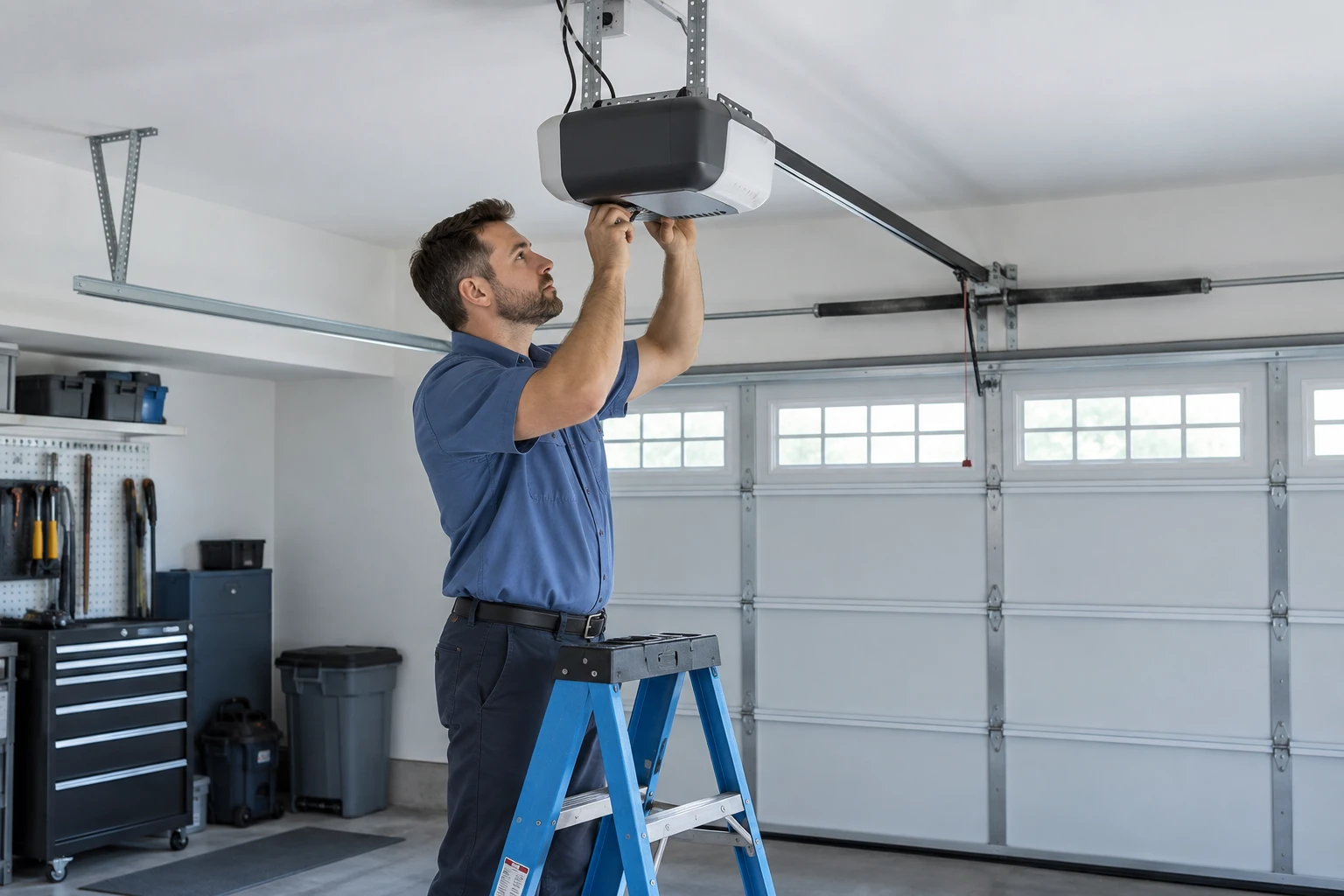
A garage door opener is a small motor, a drive mechanism and a control board. The motor turns a chain, a belt or a threaded screw, which pulls a trolley along a rail, which pushes and pulls the door through an arm bolted to the top section. A wall mounted jackshaft opener does the same job differently, driving the torsion shaft directly and leaving the ceiling clear. Around all of that sits the control system: travel limits that tell it where open and closed are, a force setting that decides how much resistance means stop, photo eye sensors near the floor that reverse the door if the beam breaks, and a radio receiver paired to your remotes and keypad. Understanding which of those layers has failed is most of the diagnosis, because they fail in completely different ways and cost completely different amounts.
What makes this different in Dallas Fort Worth
Heat is the factor people underestimate here. An opener spends July and August in an uninsulated garage under a roof, and control boards and capacitors are the two components least tolerant of sustained high temperature. Storm season adds power surges that take boards and transformers out with no warning at all. In the growth corridors, construction dust coats photo eye lenses evenly enough that nothing looks dirty while the beam weakens to the point of failure. Across the metroplex, expansive clay pushes slabs and openings out of square, so a door starts contacting the floor early on one corner and the opener reads that as an obstruction, which owners almost always diagnose as faulty sensors. And in two storey suburbs like Coppell where a bedroom sits directly above the garage, an opener that is merely noisy becomes a household problem rather than a garage one.
Warning signs
A motor that runs while the door stays still is usually a stripped gear or a broken belt, and on an older unit you will often hear grinding and find plastic shavings inside the housing. A motor that hums without turning points at a capacitor or a mechanical seizure. Clicking with no movement suggests a relay or board. A door that reverses just before closing is reading resistance or a broken beam, and in this region the resistance is frequently the floor rather than an obstruction. Reversal that happens only from the remote, while the wall button works, is the sensors every time, because holding the wall button overrides them. Remotes that work close up but not from the drive point at the receiver or antenna. Burning smell, visible scorching, a hot housing or repeated breaker trips mean stop immediately.
What actually causes it
Openers fail from age, from heat, from surge and from overload, and overload is the one that is preventable. When springs no longer balance the door, the gear set, trolley, rail and top bracket absorb weight they were never rated for, and the failure that follows looks like an opener problem. Bent track, dragging rollers, seized bearings and clay driven movement in the opening all produce the same effect. Beyond that, the ordinary causes: gears and belts wear through normal cycling, capacitors dry out with thermal cycling, control boards degrade in heat and die in storms, travel limits drift as magnets shift or cams wear, and sensor wiring stapled along a jamb years ago cuts through its own insulation and goes intermittent. Sunlight striking a receiver eye on a west facing opening in the afternoon causes faults that appear and disappear on a daily schedule.
What the visit looks like
The door is assessed before the opener is judged at all. The unit is released at the emergency cord, the door lifted by hand and checked for balance and smooth travel through its full range, and any counterbalance or track problem is dealt with first because everything downstream depends on it. Then the opener: model and serial recorded, drive type identified, rail checked for flex and secure mounting, trolley and gear set inspected, supply voltage measured at the unit, wall control and remote response tested, photo eye alignment and wiring traced from the eyes back to the terminals. Stored fault codes are read as evidence rather than treated as the answer. The specific failure is explained before any part is fitted. After the work, open and close limits are set so the door seats without straining into the floor, force response is set to the door as it now runs, and the safety reversal is tested by deliberately interrupting the beam and by obstructing the door.
The parts that matter
The parts that matter are the motor, control board, capacitor, gear and sprocket assembly, belt or chain, trolley, rail, travel module, photo eyes, wall station, receiver, antenna and emergency release. Gear kits and boards are model specific and must be matched to the number on the housing, not to the look of the unit. Remotes and keypads match by radio generation instead, which on the most common brand is indicated by the colour of the learn button on the motor head. Rails come in lengths matched to door height, so a seven foot rail on an eight foot opening needs an extension kit rather than a longer chain. A wall mounted jackshaft opener needs adequate side clearance and a sound torsion shaft. And on any new unit, the motor is chosen for door size, cycle frequency and noise requirements, not for a horsepower figure, because the springs carry the weight regardless.
Before you call, what to check
- Disconnect the opener and lift the door by handPull the emergency release with the door closed, then raise the door to about waist height and let go. It should hold position. If it sinks or feels heavy, the springs are the problem and no opener repair will fix it. This one test separates the two halves of the diagnosis and takes a minute.
- Wipe both photo eye lensesThe two small units about six inches off the floor stop the door closing when the beam between them breaks. Construction dust, pollen and road grit build an even film that weakens the beam without looking dirty. Use a dry cloth on both, then check the indicator light on each. Most brands show steady for a clear beam and blinking or dark for a broken one.
- Try closing with the wall button held downHolding the wall button overrides the safety sensors on most units. If the door closes that way but refuses from the remote, you have confirmed the sensors are the fault and the opener is fine. If it refuses both ways, the problem is mechanical or in the control system.
- Check whether the door meets the floor evenlyLook at the gap under the closed door across its full width. Ground movement in this region lifts slabs unevenly, so one corner contacts early and the opener senses resistance before it expects to. That reads as a sensor fault and is not one. If the gap is uneven or the same rub mark appears each time, the floor has moved.
- Note whether every remote failed or only oneOne remote failing is a battery or that unit. Every remote failing together points at the receiver, the antenna, or programming lost after a power event. Check whether the wall button still works, because that separates the radio side from everything else immediately.
Repair or replace
Repair
Repair is usually right, and the parts are inexpensive relative to a new unit. Gear and sprocket kits, capacitors, belts, chains, trolleys, wall controls and sensor pairs are all modest jobs that add years to a working opener. Older units from the major manufacturers are better supported than most people assume, and being told a unit is unserviceable because a retailer no longer exists is frequently wrong. If the motor runs, the rail is straight, the safety system works and one component has failed, replace that component.
Replace
Replacement earns its place in three situations. A control board on an older head can cost enough that a new opener with a warranty is the better spend, particularly when the rail and trolley have also done their time. A unit without working photo eye sensors near the floor cannot be brought up to current safety practice by adjustment, because the sensing hardware simply is not there, and that is a safety decision rather than an economic one. And a lightly specified retail model fitted to a wide insulated door in a household that opens it eight times a day will keep failing whatever is replaced, in which case the honest answer is a unit rated for the door rather than another repair on the wrong machine.
What it costs
Nothing is quoted over the phone on a guess. What follows is what actually moves the number.
| Job | What it covers | What pushes it up |
|---|---|---|
| Gear and sprocket kit | the most common opener repair, motor runs but door stays still | opener model, whether rail and trolley are also worn, mounting height |
| Capacitor replacement | motor hums but will not start | unit model, whether the motor windings are also affected |
| Photo eye sensor pair and wiring | the most common cause of a door that will not close | whether wiring needs replacing, bracket damage, run length |
| Control board replacement | flashing codes, clicking, no response | model availability, age of unit, whether a new opener is the better value |
| Belt or chain and trolley | noise, slap, visible wear | drive type, rail length matched to door height |
| New opener installation | chain, belt or wall mounted jackshaft | door size and weight, noise requirements, side clearance for a jackshaft, accessories |
Need this looked at?
Describe what the door is doing and you will get a straight read on what is likely wrong, whether it is safe to leave until tomorrow, and what the repair involves.
Call (214) 271-8110Questions we get asked
My opener runs but the door does not move. What is that?
On most units that is the gear and sprocket assembly. A plastic gear drives the sprocket, and once its teeth strip the motor turns freely while nothing reaches the chain or belt. You will usually hear grinding rather than the normal drive sound and may find plastic shavings in the housing. It is an inexpensive repair. Before fitting one the door should be checked for balance, because a door the springs are no longer holding is what wore the gear out, and a new gear behind the same heavy door strips just as fast.
The door closes with the wall button but not with the remote.
That exact combination points straight at the photo eyes near the floor, because holding the wall button overrides them. Either the beam is broken, the lenses have filmed over, or the two units no longer aim at each other. Afternoon sun striking the receiver eye does it as well. Wipe both lenses with a dry cloth and check the brackets sit square. If it persists, the wiring is next, particularly where staples along the jamb have cut into the insulation over the years.
How long should a garage door opener last?
Ten to fifteen years is typical, but that number moves a long way depending on the door rather than the opener. A unit guiding a properly balanced door on good rollers lasts at the top of that range. The same unit fighting worn springs, dragging rollers or an opening pushed out of square by ground movement ages fast, because it is carrying weight it was never rated for. Keeping the door balanced does more for opener life than anything you can do to the opener itself.
Should I get a belt drive or a chain drive?
Belt is quieter and worth it where the garage adjoins living space, which describes most two storey homes in this region. Chain is more tolerant of heavy doors and generally cheaper. But before choosing either, understand that most of the noise on an older setup comes from worn steel rollers, loose hinges and a flexing top section rather than from the drive. Fix those first, then choose. A quiet motor bolted to a loud door disappoints everyone. If the garage sits under a bedroom, a wall mounted jackshaft unit is worth pricing too.
My opener is twenty years old. Is it worth repairing?
It comes down to one thing more than any other: whether it has working photo eye sensors near the floor. If it does, and the motor, rail and trolley are sound, then a gear kit or a capacitor is money well spent. If it does not have photo eyes, no repair brings it up to current safety practice, and replacement is the right answer regardless of what else works. Duty rating matters too. A light unit under a heavy insulated door will keep failing whatever you spend.
The opener works fine but the door is so loud it wakes the house.
Almost all of that is mechanical and none of it is the motor. Worn steel rollers running in steel track produce the rumble, loose hinges add a sharp knock at the curve, and a top section that flexes transmits everything into the framing and the floor above. Replace the rollers with quality nylon ones on sealed bearings, deal with the hinges, correct track spacing and reset the balance. If it is still loud after that, a belt drive or wall mounted opener finishes the job. Done in that order the difference is dramatic.
Other garage door work we do
Brands we repair
Electric gates
Cities we cover
Match parts to the door: Garage Door Opener Repair in Dallas Fort Worth in Dallas-Fort Worth
The final test matters as much as the first inspection. For Garage Door Opener Repair in Dallas Fort Worth in Dallas-Fort Worth, the local context includes a mix of property ages, operating patterns, weather exposure, shared access, and equipment histories. The working scope centers on inspection, diagnosis, scope, safe work, operational testing, and a documented handoff. Under match parts to the door, the review covers weight, height, track radius, headroom, shaft layout, manufacturer details, and compatible replacement hardware. A installer may first report that the photo-eye circuit needs a documented baseline, but that statement is a starting point rather than a diagnosis. The inspection should establish what changed, which parts still function, what can be tested safely, and what result the customer expects. The technician can then explain what belongs in the current job and what can wait. Conditions across Dallas-Fort Worth influence materials, access, weather exposure, and scheduling, so the final recommendation should follow the actual property. 24/7 Dallas Garage Door Repair explains the work, records important limitations, and asks the customer to verify the finished operation before the visit closes.
A careful scope protects both the equipment and the customer. For Garage Door Opener Repair in Dallas Fort Worth in Dallas-Fort Worth, the local context includes a mix of property ages, operating patterns, weather exposure, shared access, and equipment histories. The working scope centers on inspection, diagnosis, scope, safe work, operational testing, and a documented handoff. Under match parts to the door, the review covers weight, height, track radius, headroom, shaft layout, manufacturer details, and compatible replacement hardware. A technician may first report that the bottom fixture behaves differently under load, but that statement is a starting point rather than a diagnosis. The inspection should establish what changed, which parts still function, what can be tested safely, and what result the customer expects. It also gives the customer a clear way to compare the available options. Conditions across Dallas-Fort Worth influence materials, access, weather exposure, and scheduling, so the final recommendation should follow the actual property. 24/7 Dallas Garage Door Repair explains the work, records important limitations, and asks the customer to verify the finished operation before the visit closes.
Complete the handoff: Garage Door Opener Repair in Dallas Fort Worth in Dallas-Fort Worth
A reliable plan begins with a physical check. For Garage Door Opener Repair in Dallas Fort Worth in Dallas-Fort Worth, the local context includes a mix of property ages, operating patterns, weather exposure, shared access, and equipment histories. The working scope centers on inspection, diagnosis, scope, safe work, operational testing, and a documented handoff. Under complete the handoff, the review covers manual release, remote controls, keypad access, safety tests, maintenance notes, and ownership of connected accounts. A homeowner may first report that the sectional door serves several users, but that statement is a starting point rather than a diagnosis. The inspection should establish what changed, which parts still function, what can be tested safely, and what result the customer expects. This prevents one worn part from hiding a larger operating problem. Conditions across Dallas-Fort Worth influence materials, access, weather exposure, and scheduling, so the final recommendation should follow the actual property. 24/7 Dallas Garage Door Repair explains the work, records important limitations, and asks the customer to verify the finished operation before the visit closes.
Small alignment and maintenance details often explain large symptoms. For Garage Door Opener Repair in Dallas Fort Worth in Dallas-Fort Worth, the local context includes a mix of property ages, operating patterns, weather exposure, shared access, and equipment histories. The working scope centers on inspection, diagnosis, scope, safe work, operational testing, and a documented handoff. Under complete the handoff, the review covers manual release, remote controls, keypad access, safety tests, maintenance notes, and ownership of connected accounts. A building owner may first report that the photo-eye circuit needs a documented baseline, but that statement is a starting point rather than a diagnosis. The inspection should establish what changed, which parts still function, what can be tested safely, and what result the customer expects. That sequence keeps the recommendation tied to evidence. Conditions across Dallas-Fort Worth influence materials, access, weather exposure, and scheduling, so the final recommendation should follow the actual property. 24/7 Dallas Garage Door Repair explains the work, records important limitations, and asks the customer to verify the finished operation before the visit closes.
A useful question before approving this step
Ask what observation supports the recommendation, which parts are included, which parts are outside the scope, how the result will be tested, and what documentation you will receive. Call (214) 271-8110 to describe the property and schedule work within Dallas-Fort Worth.
Check safety reversal: Garage Door Opener Repair in Dallas Fort Worth in Dallas-Fort Worth
Small alignment and maintenance details often explain large symptoms. For Garage Door Opener Repair in Dallas Fort Worth in Dallas-Fort Worth, the local context includes a mix of property ages, operating patterns, weather exposure, shared access, and equipment histories. The working scope centers on inspection, diagnosis, scope, safe work, operational testing, and a documented handoff. Under check safety reversal, the review covers photo-eye position, wiring, obstruction response, closing force, travel limits, and testing after adjustment. A property manager may first report that the photo-eye circuit needs a documented baseline, but that statement is a starting point rather than a diagnosis. The inspection should establish what changed, which parts still function, what can be tested safely, and what result the customer expects. That sequence keeps the recommendation tied to evidence. Conditions across Dallas-Fort Worth influence materials, access, weather exposure, and scheduling, so the final recommendation should follow the actual property. 24/7 Dallas Garage Door Repair explains the work, records important limitations, and asks the customer to verify the finished operation before the visit closes.
The safest next step comes from controlled testing. For Garage Door Opener Repair in Dallas Fort Worth in Dallas-Fort Worth, the local context includes a mix of property ages, operating patterns, weather exposure, shared access, and equipment histories. The working scope centers on inspection, diagnosis, scope, safe work, operational testing, and a documented handoff. Under check safety reversal, the review covers photo-eye position, wiring, obstruction response, closing force, travel limits, and testing after adjustment. A warehouse lead may first report that the sectional door serves several users, but that statement is a starting point rather than a diagnosis. The inspection should establish what changed, which parts still function, what can be tested safely, and what result the customer expects. A complete handoff shows what changed and how to verify it. Conditions across Dallas-Fort Worth influence materials, access, weather exposure, and scheduling, so the final recommendation should follow the actual property. 24/7 Dallas Garage Door Repair explains the work, records important limitations, and asks the customer to verify the finished operation before the visit closes.
Protect panels and hardware: Garage Door Opener Repair in Dallas Fort Worth in Dallas-Fort Worth
A careful scope protects both the equipment and the customer. For Garage Door Opener Repair in Dallas Fort Worth in Dallas-Fort Worth, the local context includes a mix of property ages, operating patterns, weather exposure, shared access, and equipment histories. The working scope centers on inspection, diagnosis, scope, safe work, operational testing, and a documented handoff. Under protect panels and hardware, the review covers cracks, loose hinges, roller stems, fasteners, struts, weather seal, and early signs of fatigue. A technician may first report that the sectional door serves several users, but that statement is a starting point rather than a diagnosis. The inspection should establish what changed, which parts still function, what can be tested safely, and what result the customer expects. It also gives the customer a clear way to compare the available options. Conditions across Dallas-Fort Worth influence materials, access, weather exposure, and scheduling, so the final recommendation should follow the actual property. 24/7 Dallas Garage Door Repair explains the work, records important limitations, and asks the customer to verify the finished operation before the visit closes.
Every property adds a different operating pattern. For Garage Door Opener Repair in Dallas Fort Worth in Dallas-Fort Worth, the local context includes a mix of property ages, operating patterns, weather exposure, shared access, and equipment histories. The working scope centers on inspection, diagnosis, scope, safe work, operational testing, and a documented handoff. Under protect panels and hardware, the review covers cracks, loose hinges, roller stems, fasteners, struts, weather seal, and early signs of fatigue. A property manager may first report that the photo-eye circuit needs a documented baseline, but that statement is a starting point rather than a diagnosis. The inspection should establish what changed, which parts still function, what can be tested safely, and what result the customer expects. This approach keeps safety, function, and cost in the same conversation. Conditions across Dallas-Fort Worth influence materials, access, weather exposure, and scheduling, so the final recommendation should follow the actual property. 24/7 Dallas Garage Door Repair explains the work, records important limitations, and asks the customer to verify the finished operation before the visit closes.
Treat spring tension with respect: Garage Door Opener Repair in Dallas Fort Worth in Dallas-Fort Worth
Every property adds a different operating pattern. For Garage Door Opener Repair in Dallas Fort Worth in Dallas-Fort Worth, the local context includes a mix of property ages, operating patterns, weather exposure, shared access, and equipment histories. The working scope centers on inspection, diagnosis, scope, safe work, operational testing, and a documented handoff. Under treat spring tension with respect, the review covers door weight, spring size, shaft condition, winding hardware, cable position, and safe control of stored energy. A building owner may first report that the cable drum has been exposed to moisture, but that statement is a starting point rather than a diagnosis. The inspection should establish what changed, which parts still function, what can be tested safely, and what result the customer expects. This approach keeps safety, function, and cost in the same conversation. Conditions across Dallas-Fort Worth influence materials, access, weather exposure, and scheduling, so the final recommendation should follow the actual property. 24/7 Dallas Garage Door Repair explains the work, records important limitations, and asks the customer to verify the finished operation before the visit closes.
Good service starts by separating cause from coincidence. For Garage Door Opener Repair in Dallas Fort Worth in Dallas-Fort Worth, the local context includes a mix of property ages, operating patterns, weather exposure, shared access, and equipment histories. The working scope centers on inspection, diagnosis, scope, safe work, operational testing, and a documented handoff. Under treat spring tension with respect, the review covers door weight, spring size, shaft condition, winding hardware, cable position, and safe control of stored energy. A homeowner may first report that the spring shaft shows uneven wear, but that statement is a starting point rather than a diagnosis. The inspection should establish what changed, which parts still function, what can be tested safely, and what result the customer expects. That distinction matters when several people share responsibility for the property. Conditions across Dallas-Fort Worth influence materials, access, weather exposure, and scheduling, so the final recommendation should follow the actual property. 24/7 Dallas Garage Door Repair explains the work, records important limitations, and asks the customer to verify the finished operation before the visit closes.
A useful question before approving this step
Ask what observation supports the recommendation, which parts are included, which parts are outside the scope, how the result will be tested, and what documentation you will receive. Call (214) 271-8110 to describe the property and schedule work within Dallas-Fort Worth.