Short answer
A commercial door is not a bigger version of a residential one. It cycles far more often, it is usually powered by an operator rather than a consumer opener, and when it stops, something behind it stops as well. That last part is what actually drives the decisions: the cost of a commercial door being down is rarely the repair, it is the dock that cannot load or the shop that cannot open. Specification and maintenance are worth more here than they ever are on a house.
What the job actually is
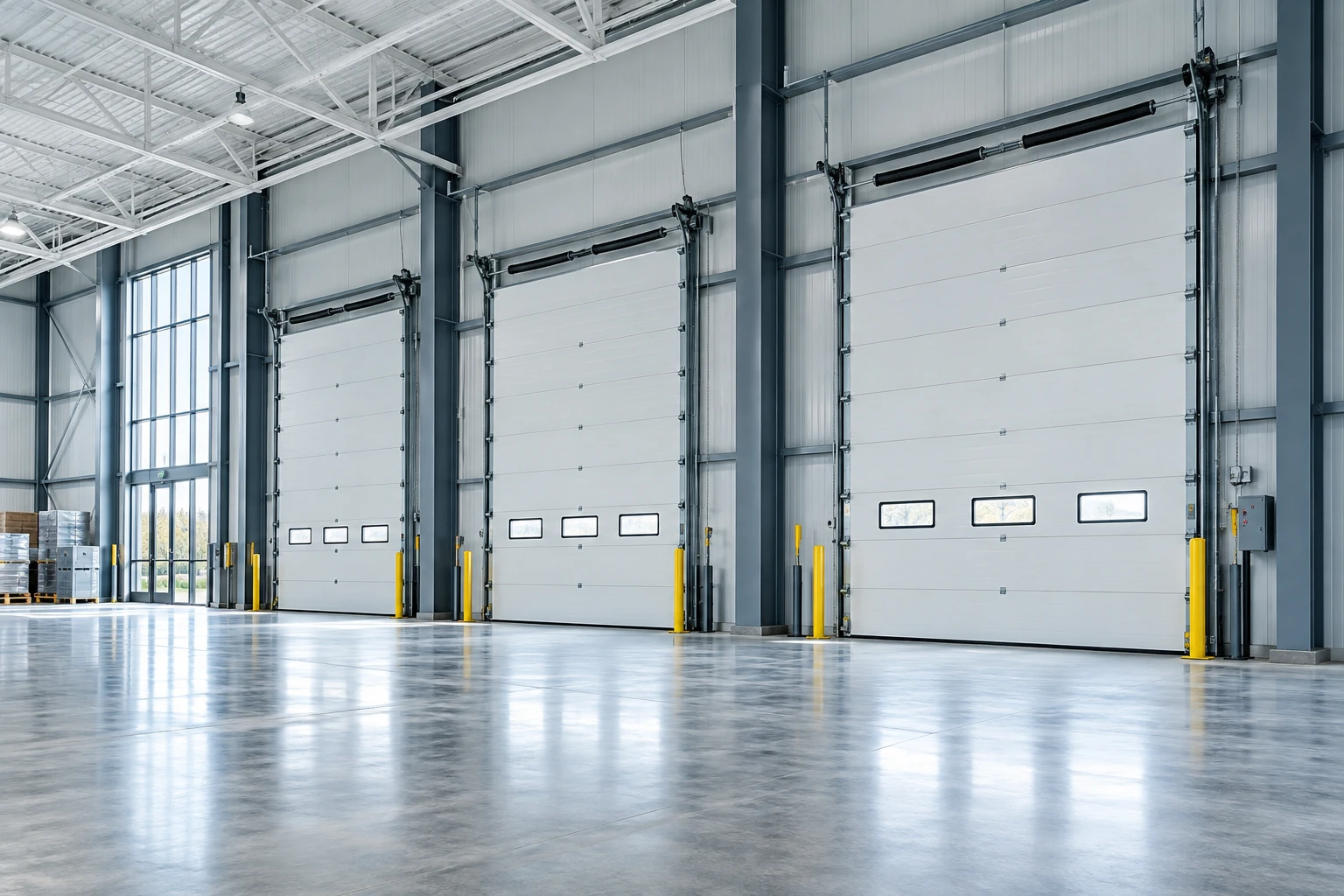
Commercial openings are served by several different door types and they fail in different ways. A rolling steel door is a curtain of interlocking slats that coils around a barrel above the opening, held in guides either side, counterbalanced by a spring inside the barrel. It suits openings where there is no room for horizontal track and it is the standard on retail frontages, storage and many loading positions. A commercial sectional door works like a residential one but in heavier gauge, with heavier hardware and much higher cycle springs, and it suits docks and warehouses where insulation or a flat interior ceiling matters. A grille or shutter is a rolling door with an open curtain used where visibility or airflow is needed. High speed doors are a separate category built for openings that cycle constantly. Fire rated rolling doors look like ordinary rolling steel but carry a release mechanism designed to close the opening in a fire, and they are governed by inspection and testing requirements that ordinary doors are not.
What makes this different in Dallas Fort Worth
The industrial geography of the metroplex sets the pattern. The distribution corridors through Garland, Mesquite, Grand Prairie, Irving and out along the freight routes near the airport run dock doors at cycle counts that residential hardware would not survive for a month, and those doors are almost always on the wrong side of a maintenance schedule rather than the wrong side of a design. Retail frontage in Deep Ellum, along Jefferson in Oak Cliff and through the older commercial stretches of Fort Worth relies heavily on rolling steel that has been in place for decades, where the curtain is sound but the barrel spring inside it has never been re tensioned. Heat is the same enemy it is on houses but with more consequence, because an operator mounted high in an uninsulated warehouse runs hot all summer and the electrical components in it fail first. And the same expansive clay that moves residential openings moves commercial slabs, which shows up as guides going out of plumb and curtains binding at one edge.
Warning signs
On a rolling steel door the earliest sign is effort. A curtain that used to run smoothly and now needs the operator to work visibly harder has lost barrel spring tension, and that is a scheduled adjustment rather than a fault. A curtain that lifts unevenly, so that the bottom bar sits out of level, is binding in one guide. Slats that have begun to separate at the ends, or a bottom bar that is bowed, mean the curtain has taken an impact. On commercial sectional doors, the signs are the residential ones amplified: cracked hinges, seized rollers, cables fraying at the bottom fittings, sections bowing where struts are missing. Across both types, the operator gives its own warnings, including a motor that hums before it moves, a door that creeps after stopping, limits that have started to drift so the door no longer seats or no longer opens fully, and safety edges or photo eyes that have to be triggered twice. On a fire rated door, the signal that matters most is a release mechanism that has never been drop tested, and the absence of a record is itself the finding.
What actually causes it
Cycle count is the underlying cause of most commercial failures, and it is the thing most often left out of the specification. A door installed with standard cycle springs on a dock that cycles fifty times a day will consume its rating in a fraction of the time anyone expected, and the resulting failures get blamed on quality rather than on arithmetic. Impact is the second cause and it is endemic around loading positions, where forklifts and pallet corners find bottom bars, guides and lower slats. Contamination is third: dust and debris in the guides of a rolling door acts exactly like grit in a residential track, and in a warehouse environment there is a great deal of it. Heat degrades operator electronics. Ground movement takes guides and jambs out of plumb. And deferred maintenance is the cause behind all of the above, because commercial doors are usually maintained reactively, which means every adjustment that should have been made under a schedule is instead made after a failure, at the worst possible moment.
What the visit looks like
Commercial work starts with establishing what the door actually is, because the type determines everything: rolling steel, sectional, grille, high speed or fire rated, along with the manufacturer, the opening size, the curtain or section construction and the operator model. Power is isolated before anyone works near an operator, and on a rolling door the barrel is treated with the same caution as a torsion spring on a house, because the spring inside it stores the same kind of energy at a larger scale. The curtain or door is inspected through its full travel, guides checked for plumb and for debris, bottom bar checked for straightness, and slat ends or section stiles checked for wear. Barrel spring tension is measured against the door rather than guessed, and adjusted with the correct tooling. The operator is tested separately from the door, including limits, brake, safety edge, photo eyes and manual release, and the manual release is tested rather than assumed, since it is the thing a business relies on when the power goes. On a fire rated door, the drop test and its record are part of the work rather than an extra.
The parts that matter
Rolling steel parts are barrel springs, slats, bottom bars, bottom bar astragals, guides, guide wear strips, end brackets, barrel bearings and hood. Individual slats can be replaced on many curtains without replacing the whole curtain, which is the repair that most often saves a business real money after a forklift strike. Commercial sectional parts mirror residential ones in heavier grades: high cycle torsion springs, heavy gauge hinges, sealed bearing steel rollers, reinforced struts, heavier track and commercial grade bottom brackets. Operators are the other half of the parts list and they are specified by duty rather than by horsepower alone, meaning standard duty, heavy duty or continuous duty depending on cycles per hour, along with the drive type and the mounting position the opening allows. Safety devices are parts in their own right and they are not optional: monitored photo eyes, safety edges on the bottom bar, and on some installations light curtains. Cycle rating is the specification decision that changes the economics most, because high cycle springs on a high cycle door cost more once and less over three years.
Before you call, what to check
- Isolate power before anyone goes near the operatorCommercial operators are hardwired more often than plugged in, and a door that has stopped mid travel may still be live and may still be under command from a control that is faulty. Lock off the supply rather than switching it at the wall button. This is the single most important difference in habit between commercial and residential work and it is the one most often skipped.
- Know where the manual release is before you need itMost commercial operators have a hand chain or a release mechanism that allows the door to be operated without power. Businesses discover during an outage that nobody currently on site knows where it is or how it works. Find it, try it, and make sure more than one person knows. It turns a closed business into an inconvenience.
- Stop using a rolling door that lifts crookedA curtain that comes up with the bottom bar out of level is binding in one guide, and every further cycle drags slats against the guide edge and works them out of the coil. It is the rolling door equivalent of running a sectional door that has come off cable. The damage compounds quickly and it turns a guide adjustment into a curtain repair.
- Log the cycles before specifying anythingThe most useful number in commercial door work is how many times the door runs in a day, and almost nobody knows it. Count it for a week. That figure determines the spring cycle rating, the operator duty class and the maintenance interval, and specifying without it is how a door ends up failing every few months while everyone blames the door.
- Treat a fire rated door as a compliance item, not a doorA fire rated rolling door has a release mechanism intended to close the opening in a fire, and it is subject to periodic drop testing with a record kept. It is a common finding that a door has been in place for years, has been painted, has had guides adjusted, and has never been tested. That is a compliance exposure as much as a maintenance one, and it is worth resolving before an inspection raises it.
Repair or replace
Repair
Commercial doors are built to be repaired, and most of what goes wrong on them is a component rather than a door. Barrel springs can be re tensioned and replaced. Individual slats can be swapped where a curtain has been struck. Guides can be straightened and re plumbed, and wear strips renewed. Bottom bars and astragals are consumables. Operators can be rebuilt or replaced independently of the door. The judgement worth making is whether to repair like for like or to correct the original specification at the same time, because a door that has failed three times in two years is usually not a failing door, it is a door specified for a duty it does not have. Upgrading spring cycle rating and operator duty class at the point of repair is the decision that stops the cycle.
Replace
Replacement makes sense when the curtain or the sections themselves are finished rather than the hardware on them. On rolling steel that means widespread slat damage, slat ends worn to the point that the curtain no longer tracks in the guides, or corrosion through the curtain. On commercial sectional doors it means sections that no longer hold fasteners, structural rust, or damage across several sections. Beyond condition, there are two operational cases for replacement. The first is a door that is fundamentally too slow for the opening, where a high speed door removes a daily bottleneck and pays for itself in throughput rather than in maintenance. The second is a door that has been repeatedly damaged in the same way, where the answer is often a different door type and better protection around the opening rather than another repair of the same design.
What it costs
Nothing is quoted over the phone on a guess. What follows is what actually moves the number.
| Job | What it covers | What pushes it up |
|---|---|---|
| Barrel spring re tensioning on a rolling steel door | scheduled adjustment rather than a fault | door size and weight, barrel condition, how far tension has dropped |
| Barrel spring replacement | where re tensioning is no longer enough | curtain weight, opening size, cycle rating specified, barrel and bearing condition |
| Individual slat replacement after impact | avoids replacing a whole curtain | number of slats, position in the curtain, slat profile availability |
| Guide straightening, re plumbing and wear strips | binding curtains and uneven lift | one guide or both, extent of impact damage, whether the jamb has moved |
| Commercial operator repair or replacement | specified by duty class, not horsepower | cycles per hour, drive and mounting type, safety devices included |
| High cycle spring upgrade on a commercial sectional door | matches the spring to the actual duty | door size and weight, measured cycle count, shaft and headroom available |
Need this looked at?
Describe what the door is doing and you will get a straight read on what is likely wrong, whether it is safe to leave until tomorrow, and what the repair involves.
Call (214) 271-8110Questions we get asked
How is a commercial door different from a residential one?
Three ways that matter. It cycles far more, often by a factor of ten or more, which means every consumable part is on a much shorter clock. It is driven by an operator specified by duty class rather than a consumer opener, and that operator has different safety devices and a manual release that people actually need to know how to use. And the consequence of failure is different, because a house with a broken door is inconvenient while a dock with a broken door stops work. Those three differences drive every specification decision.
Our rolling steel door has got very heavy to operate. Is the spring broken?
Usually not broken, just tired. A rolling door is counterbalanced by a spring inside the barrel above the opening, and that spring loses tension gradually over years of cycling rather than failing suddenly the way a residential torsion spring does. The door getting progressively heavier, and the operator visibly working harder, is the classic sign. Re tensioning is a scheduled adjustment, and doing it before the operator burns out is considerably cheaper than doing it afterwards.
A forklift hit our door and damaged some slats. Do we need a whole new curtain?
Often not. Rolling steel curtains are built from interlocking slats, and damaged ones can frequently be replaced individually without renewing the whole curtain, provided the profile is still available and the damage has not deformed the slats above and below. What has to be checked at the same time is the guides and the bottom bar, because an impact hard enough to damage slats has usually pushed a guide as well, and a curtain running in a bent guide will keep damaging itself.
Our doors keep breaking springs. Are we buying bad doors?
Almost certainly not. This is the most common commercial door problem and it is nearly always arithmetic rather than quality. Springs are rated in cycles, and a door fitted with a standard cycle rating on an opening that runs dozens of times a day will consume that rating in months rather than years. The fix is to count the actual cycles for a week and specify springs to that number. High cycle springs cost more once and stop the pattern, which is why they are usually the cheaper decision on a busy opening.
What is a drop test and does our door need one?
If you have a fire rated rolling door, yes. A fire rated door carries a mechanism designed to release and close the opening automatically in a fire, and that mechanism has to be tested periodically and the test recorded, then the door reset. It is a compliance requirement rather than a maintenance preference. It is common to find doors that have been in place for many years, sometimes painted over, that have never been tested, and that is worth resolving on your own schedule rather than during an inspection.
How often should commercial doors be serviced?
It follows cycles rather than the calendar, which is why a single answer is misleading. A retail rolling door that opens and closes twice a day is on a very different schedule from a dock door running fifty cycles. Count the cycles, and set the interval so that guides, springs, bearings, bottom seals, operator limits and safety devices are checked before they reach the point of failure rather than after. On high cycle openings, planned maintenance is not a luxury, it is the only thing that keeps the door out of the critical path of the business.
Can you work outside our operating hours?
On commercial work that is often the sensible arrangement rather than the exception, because the point of the door is that things move through it. Planned work on docks, retail frontages and warehouse openings is commonly scheduled outside trading or shipping hours so that the opening is available when it is needed. It is worth agreeing that at the point of scheduling rather than treating it as an emergency arrangement, since planned out of hours work is straightforward while unplanned out of hours work is not.
Should we repair the old operator or replace it?
The question to answer first is whether the operator is the right duty class for the opening, because repairing an under specified operator simply resets the clock on the same failure. If the duty class is right and the fault is a contactor, a limit assembly, a brake or a control, repair is usually straightforward and economical. If the unit is under specified, or old enough that parts are becoming difficult, or lacks monitored safety devices that current installations use, replacement is the better answer, and it is a good moment to correct the duty class rather than match what was there.
Other garage door work we do
Brands we repair
Electric gates
Cities we cover
Plan for weather: Commercial and Rolling Steel Door Repair in Dallas Fort Worth in Dallas-Fort Worth
The safest next step comes from controlled testing. For Commercial and Rolling Steel Door Repair in Dallas Fort Worth in Dallas-Fort Worth, the local context includes a mix of property ages, operating patterns, weather exposure, shared access, and equipment histories. The working scope centers on inspection, diagnosis, scope, safe work, operational testing, and a documented handoff. Under plan for weather, the review covers heat, cold, wind, moisture, seal condition, material movement, lubrication needs, and exposed metal. A warehouse lead may first report that the sectional door serves several users, but that statement is a starting point rather than a diagnosis. The inspection should establish what changed, which parts still function, what can be tested safely, and what result the customer expects. A complete handoff shows what changed and how to verify it. Conditions across Dallas-Fort Worth influence materials, access, weather exposure, and scheduling, so the final recommendation should follow the actual property. 24/7 Dallas Garage Door Repair explains the work, records important limitations, and asks the customer to verify the finished operation before the visit closes.
The visible symptom is only the first clue. For Commercial and Rolling Steel Door Repair in Dallas Fort Worth in Dallas-Fort Worth, the local context includes a mix of property ages, operating patterns, weather exposure, shared access, and equipment histories. The working scope centers on inspection, diagnosis, scope, safe work, operational testing, and a documented handoff. Under plan for weather, the review covers heat, cold, wind, moisture, seal condition, material movement, lubrication needs, and exposed metal. A installer may first report that the opener rail has an uncertain service history, but that statement is a starting point rather than a diagnosis. The inspection should establish what changed, which parts still function, what can be tested safely, and what result the customer expects. The result is easier to test and easier to document. Conditions across Dallas-Fort Worth influence materials, access, weather exposure, and scheduling, so the final recommendation should follow the actual property. 24/7 Dallas Garage Door Repair explains the work, records important limitations, and asks the customer to verify the finished operation before the visit closes.
Explain the quote: Commercial and Rolling Steel Door Repair in Dallas Fort Worth in Dallas-Fort Worth
Every property adds a different operating pattern. For Commercial and Rolling Steel Door Repair in Dallas Fort Worth in Dallas-Fort Worth, the local context includes a mix of property ages, operating patterns, weather exposure, shared access, and equipment histories. The working scope centers on inspection, diagnosis, scope, safe work, operational testing, and a documented handoff. Under explain the quote, the review covers diagnosis, parts, labor, optional work, approval, testing, and what would change the scope. A property manager may first report that the photo-eye circuit needs a documented baseline, but that statement is a starting point rather than a diagnosis. The inspection should establish what changed, which parts still function, what can be tested safely, and what result the customer expects. This approach keeps safety, function, and cost in the same conversation. Conditions across Dallas-Fort Worth influence materials, access, weather exposure, and scheduling, so the final recommendation should follow the actual property. 24/7 Dallas Garage Door Repair explains the work, records important limitations, and asks the customer to verify the finished operation before the visit closes.
Good service starts by separating cause from coincidence. For Commercial and Rolling Steel Door Repair in Dallas Fort Worth in Dallas-Fort Worth, the local context includes a mix of property ages, operating patterns, weather exposure, shared access, and equipment histories. The working scope centers on inspection, diagnosis, scope, safe work, operational testing, and a documented handoff. Under explain the quote, the review covers diagnosis, parts, labor, optional work, approval, testing, and what would change the scope. A homeowner may first report that the spring shaft shows uneven wear, but that statement is a starting point rather than a diagnosis. The inspection should establish what changed, which parts still function, what can be tested safely, and what result the customer expects. That distinction matters when several people share responsibility for the property. Conditions across Dallas-Fort Worth influence materials, access, weather exposure, and scheduling, so the final recommendation should follow the actual property. 24/7 Dallas Garage Door Repair explains the work, records important limitations, and asks the customer to verify the finished operation before the visit closes.
A useful question before approving this step
Ask what observation supports the recommendation, which parts are included, which parts are outside the scope, how the result will be tested, and what documentation you will receive. Call (214) 271-8110 to describe the property and schedule work within Dallas-Fort Worth.
Trace uneven movement: Commercial and Rolling Steel Door Repair in Dallas Fort Worth in Dallas-Fort Worth
A careful scope protects both the equipment and the customer. For Commercial and Rolling Steel Door Repair in Dallas Fort Worth in Dallas-Fort Worth, the local context includes a mix of property ages, operating patterns, weather exposure, shared access, and equipment histories. The working scope centers on inspection, diagnosis, scope, safe work, operational testing, and a documented handoff. Under trace uneven movement, the review covers cable seating, drums, bottom fixtures, track spacing, rollers, and obstructions around the opening. A technician may first report that the bottom fixture behaves differently under load, but that statement is a starting point rather than a diagnosis. The inspection should establish what changed, which parts still function, what can be tested safely, and what result the customer expects. It also gives the customer a clear way to compare the available options. Conditions across Dallas-Fort Worth influence materials, access, weather exposure, and scheduling, so the final recommendation should follow the actual property. 24/7 Dallas Garage Door Repair explains the work, records important limitations, and asks the customer to verify the finished operation before the visit closes.
The final test matters as much as the first inspection. For Commercial and Rolling Steel Door Repair in Dallas Fort Worth in Dallas-Fort Worth, the local context includes a mix of property ages, operating patterns, weather exposure, shared access, and equipment histories. The working scope centers on inspection, diagnosis, scope, safe work, operational testing, and a documented handoff. Under trace uneven movement, the review covers cable seating, drums, bottom fixtures, track spacing, rollers, and obstructions around the opening. A property manager may first report that the cable drum has been exposed to moisture, but that statement is a starting point rather than a diagnosis. The inspection should establish what changed, which parts still function, what can be tested safely, and what result the customer expects. The technician can then explain what belongs in the current job and what can wait. Conditions across Dallas-Fort Worth influence materials, access, weather exposure, and scheduling, so the final recommendation should follow the actual property. 24/7 Dallas Garage Door Repair explains the work, records important limitations, and asks the customer to verify the finished operation before the visit closes.
Review everyday use: Commercial and Rolling Steel Door Repair in Dallas Fort Worth in Dallas-Fort Worth
Small alignment and maintenance details often explain large symptoms. For Commercial and Rolling Steel Door Repair in Dallas Fort Worth in Dallas-Fort Worth, the local context includes a mix of property ages, operating patterns, weather exposure, shared access, and equipment histories. The working scope centers on inspection, diagnosis, scope, safe work, operational testing, and a documented handoff. Under review everyday use, the review covers vehicles, storage, children, pets, deliveries, work schedules, noise, and the need for backup entry. A installer may first report that the cable drum has been exposed to moisture, but that statement is a starting point rather than a diagnosis. The inspection should establish what changed, which parts still function, what can be tested safely, and what result the customer expects. That sequence keeps the recommendation tied to evidence. Conditions across Dallas-Fort Worth influence materials, access, weather exposure, and scheduling, so the final recommendation should follow the actual property. 24/7 Dallas Garage Door Repair explains the work, records important limitations, and asks the customer to verify the finished operation before the visit closes.
A reliable plan begins with a physical check. For Commercial and Rolling Steel Door Repair in Dallas Fort Worth in Dallas-Fort Worth, the local context includes a mix of property ages, operating patterns, weather exposure, shared access, and equipment histories. The working scope centers on inspection, diagnosis, scope, safe work, operational testing, and a documented handoff. Under review everyday use, the review covers vehicles, storage, children, pets, deliveries, work schedules, noise, and the need for backup entry. A technician may first report that the bottom fixture behaves differently under load, but that statement is a starting point rather than a diagnosis. The inspection should establish what changed, which parts still function, what can be tested safely, and what result the customer expects. This prevents one worn part from hiding a larger operating problem. Conditions across Dallas-Fort Worth influence materials, access, weather exposure, and scheduling, so the final recommendation should follow the actual property. 24/7 Dallas Garage Door Repair explains the work, records important limitations, and asks the customer to verify the finished operation before the visit closes.