Short answer
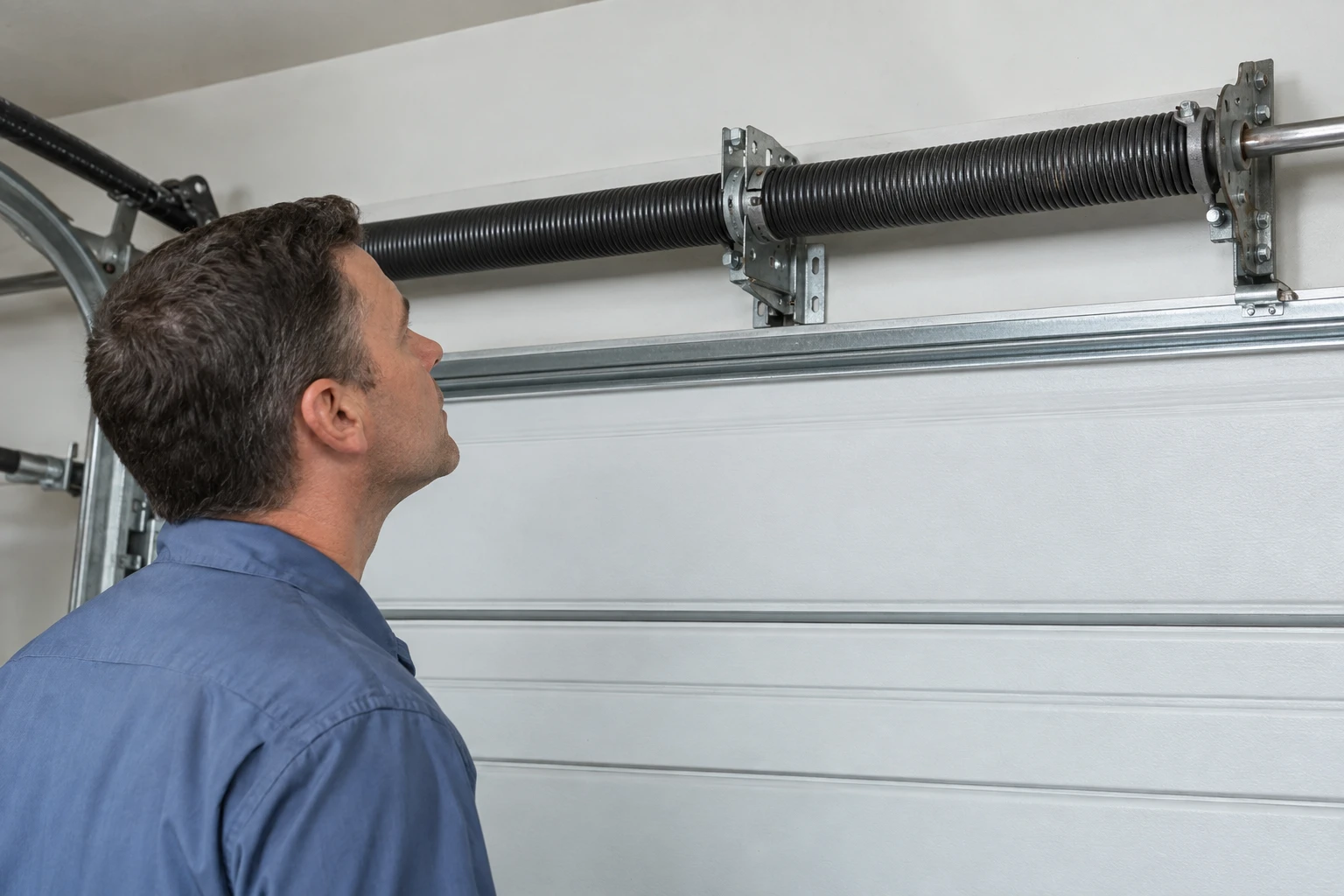
A broken garage door spring is the single most common reason a door stops working, and it is the one failure people most often mistake for a dead opener. The springs, not the motor, carry the weight of the door. When one breaks the opener is suddenly being asked to lift two hundred pounds it was never built to lift. Stop pressing the button, look at the shaft above the door for a gap in the coil, and leave the door where it is.
What the job actually is
A garage door weighs between about one hundred and four hundred pounds depending on its size and construction, and the opener does not lift that weight. The springs do. A torsion spring sits on a shaft above the opening and stores energy by twisting, and as the door comes down the cables wind onto drums and wind the spring tighter. Going back up, that stored torque does almost all the work and the opener simply guides the door. An extension spring system does the same job differently, stretching along the horizontal tracks either side. Either way the principle is the same: a correctly sprung door is nearly weightless by hand, and a motor rated in fractions of a horsepower can move it easily. Everything that goes wrong with springs comes back to that balance being lost.
What makes this different in Dallas Fort Worth
Dallas Fort Worth is unusual in how synchronised its spring failures are. Springs are rated in cycles rather than years, commonly around ten thousand for a standard residential coil, and a household using the garage as its main entrance reaches that in roughly seven years. Across the metroplex whole neighbourhoods were built and occupied within a narrow window, so streets in Watauga, Coppell and the growth corridor north of Frisco arrive at that threshold together. Homeowners see three neighbours with broken springs in a month and assume something unusual has happened. Nothing has. Add the regional expansive clay, which shifts openings out of square and makes a door bind, and heavy insulated doors in the newer suburbs that were fitted with builder specification springs, and the metroplex produces spring failures earlier and in tighter clusters than most markets.
Warning signs
The clearest sign is a visible gap in a torsion coil, usually a couple of inches wide, with the two halves separated. On extension systems, one spring hanging longer than the other or detached near its pulley says the same thing. Before a full break there are warnings. The door feels heavy by hand. It drifts down when stopped partway instead of holding. It rises unevenly or lurches. The opener strains, slows, hums or reverses under load. The rail flexes visibly as the motor pulls. A loud bang from the garage, often mistaken for something falling, is frequently the moment a spring lets go. On a two spring door, one broken spring leaves the other carrying everything and the door will usually still move, badly, which is how people keep operating a door that should have been stopped.
What actually causes it
Steel fatigues. A torsion spring winds and unwinds through its full range on every cycle, and metal has a finite number of those in it before it fails. That is the ordinary cause and it is not a defect. What shortens the count is mismatch. A spring sized for a lighter door than the one it is lifting works harder every cycle. Adding insulation, glass, cladding or applied hardware after installation changes the weight without changing the spring. Rust from a failed bottom seal or a damp garage under tree cover eats into coil surface and creates the stress point where it eventually breaks. A dragging roller, a seized bearing, a bent track or an opening pushed out of square by ground movement all add resistance the spring has to overcome. And a previous repair that fitted whatever was on the truck rather than what the door calculated to is the quiet cause behind a great many second failures.
What the visit looks like
The door is left where it is and nothing is operated. The spring system is identified, torsion or extension, single or dual, and the cables, drums, shaft, bearings and end plates are inspected before anything is touched. The door itself is checked for section damage, bent track and loose brackets, since a spring failure often takes other parts with it. The door is then weighed or calculated rather than guessed at, because the correct spring follows from the actual weight, the drum size and the door height, not from the colour of the old one. The door is secured so stored energy cannot move it. Failed springs are removed with proper winding bars, replacements installed, and cables seated correctly on the drums. Tension is set to the measured door. Then the opener stays disconnected while the door is moved by hand through full travel and checked for balance at several heights. Only when it holds position by hand is the opener reconnected, and its travel limits, force response and safety reversal tested separately.
The parts that matter
A torsion job involves the spring wire diameter, inside diameter, relaxed length and wind direction, plus the shaft, centre bearing plate, end bearings, cable drums, lift cables and winding cones. A small change in wire diameter changes lifting capacity substantially, which is why a spring cannot be matched by eye. Longer springs can deliver the same torque with greater cycle life where the shaft and headroom allow it, which is the practical route to a door that lasts twice as long. Two spring systems need a calculated pair. Extension systems use springs rated to door weight along with pulleys, lift cables, anchor points and containment cables, and the containment cable is the safety item that matters most because it holds the pieces if a spring breaks. Doors with insulation, full width glass, wood overlay or added struts must be calculated on real weight rather than on a catalogue figure for that size.
Before you call, what to check
- Stop operating the doorEvery additional press with a broken spring pushes damage into something else. The opener gear set, the rail, the top bracket and the section it bolts to all absorb force they were not designed for. One attempt tells you the door will not move. Repeated attempts turn a spring replacement into a spring, gear and panel replacement.
- Look at the shaft above the doorA broken torsion spring is visible from the floor. Look for a clear gap in the coil with the two ends separated, often a couple of inches. If your springs run back along the horizontal tracks instead, look for one stretched noticeably longer than the other, or hanging loose near its pulley.
- Do not pull the emergency release on a raised doorThe red cord disconnects the opener so the door can be moved by hand. Pulled while the door is up, with the springs no longer holding the weight, the door can come down hard and fast. Only use the release with the door fully closed, and if it feels heavy when you lift, put it back down and leave it.
- Check whether the door is sitting levelLook at the gap along the bottom of the closed door. A triangle of daylight at one corner, or one side clearly higher, means a cable has come off its drum or one side has lost tension. Do not try to lever it straight and do not run the opener to pull it level. Sections crease permanently once they fold against the track.
- If a car is trapped inside, say so when you callIt changes how the visit is handled. A door can often be secured and raised safely by hand as the first action on site, before any parts work begins, so a vehicle can be moved out. Trying to achieve the same thing yourself with a broken spring is how people get hurt.
Repair or replace
Repair
Spring replacement is a repair, not a reason to replace a door, and on a sound door it is straightforward. The decision worth making is what goes back in. A standard residential spring rated around ten thousand cycles will bring you back here in about seven years at four cycles a day, and considerably sooner in a busy household. A high cycle spring costs more up front because it uses more steel, and it lasts proportionally longer. On a door that will keep cycling at the same rate for the life of the house, that is usually the cheaper decision rather than the more expensive one. On a two spring door where one has broken from fatigue, replacing the pair is normally right, because the survivor has done the same work and has little left.
Replace
The spring almost never justifies replacing the door. What does is what a spring failure sometimes reveals. Corrosion through the bottom section, which starts where a failed seal has let water sit against bare steel, is structural. Two or more sections creased after the door came off track and folded is usually more expensive to piece back together than to replace. And an opener old enough to lack working photo eye sensors near the floor is a safety question that a new spring does not answer. Those are the findings that change the conversation. A broken spring on its own does not.
What it costs
Nothing is quoted over the phone on a guess. What follows is what actually moves the number.
| Job | What it covers | What pushes it up |
|---|---|---|
| Torsion spring replacement, single spring | most common on lighter single doors | door weight, wire size, cycle rating chosen, condition of drums and cables |
| Torsion spring replacement, matched pair | standard on a sixteen foot double door | door weight and construction, cycle rating, whether the shaft or bearings also need work |
| High cycle spring upgrade | more steel, proportionally longer life | door weight, available headroom and shaft length for a longer spring |
| Extension spring replacement | older installations, springs along the horizontal tracks | door weight, pulley condition, whether containment cables need fitting |
| Cable and drum replacement alongside springs | frequently needed after a break | whether the door came off track, drum wear, shaft alignment |
| Bearing and shaft work | where a seized bearing caused the failure | number of bearings, centre plate condition, shaft straightness |
Need this looked at?
Describe what the door is doing and you will get a straight read on what is likely wrong, whether it is safe to leave until tomorrow, and what the repair involves.
Call (214) 271-8110Questions we get asked
My garage door spring broke. Can I still open the door by hand?
You should not try. Without the spring the full weight of the door is uncontrolled, and a wide insulated door can weigh several hundred pounds. It may lift and then come down faster than you can react. Do not stand under the opening, do not pull the emergency release while the door is raised, and do not attempt it alone. If a vehicle is trapped inside, mention that when you call, because the door can usually be secured and raised safely on site before any parts work starts.
One of my two springs broke. Do I need to replace both?
Usually yes, when both were installed together. They have lifted the same door through the same number of cycles, so the unbroken one has little useful life remaining and will typically fail within a year. A matched pair also makes balance easier to set accurately. The exception is a spring fitted recently that failed from damage rather than fatigue. A technician should be able to tell you which situation yours is by looking at the springs themselves rather than quoting a general rule.
How long should garage door springs last?
They are rated in cycles, not years, and one cycle is the door going up once and coming back down once. A standard residential spring is commonly rated near ten thousand cycles. A household using the garage as its main entrance runs four cycles a day, which is about fourteen hundred a year, reaching ten thousand in roughly seven years. A busy family opening it eight or ten times a day gets there in three. That is why two identical doors on the same street fail years apart, and why cycle rating matters more than any warranty length.
Why did my spring break in cold weather?
Cold does not usually cause the break, it exposes one that was already near the end. Steel contracts slightly and lubricant stiffens, so the first hard freeze demands marginally more from a spring that has been quietly running out of life all year. The underlying cause is still cycle fatigue. That is also why spring calls cluster on the first genuinely cold morning of the season across the whole metroplex, which looks like a weather event and is really a calendar one.
Can I replace a garage door spring myself?
A torsion spring holds a great deal of stored energy and it is released through winding bars in a controlled sequence. Done wrong, the bar or the spring moves with enough force to break bones. Extension springs under tension are no safer, and on systems without containment cables a break sends the halves across the garage. Beyond the safety question, the spring has to be sized to the door's measured weight, drum diameter and height, and fitting the wrong one produces a door that works badly and destroys the opener slowly. This is the one job on a garage door where the answer is genuinely no.
Three of my neighbours have had broken springs this year. Is something wrong with our doors?
Nothing is wrong, and it is not coincidence. Springs are rated in cycles, and across Dallas Fort Worth whole neighbourhoods were built and occupied inside a narrow window. Streets that went up together, used the same way, reach the same cycle threshold at roughly the same time. If your door is the same age and has never been serviced, a balance check now is reasonable rather than waiting. It is also the moment to ask about a higher cycle spring, since your household clearly runs the door at a rate the standard part was not sized for.
Other garage door work we do
Brands we repair
Electric gates
Cities we cover
Test the door by hand: Garage Door Spring Repair in Dallas Fort Worth in Dallas-Fort Worth
The visible symptom is only the first clue. For Garage Door Spring Repair in Dallas Fort Worth in Dallas-Fort Worth, the local context includes a mix of property ages, operating patterns, weather exposure, shared access, and equipment histories. The working scope centers on inspection, diagnosis, scope, safe work, operational testing, and a documented handoff. Under test the door by hand, the review covers door balance, spring assistance, roller movement, hinge condition, track alignment, and resistance through the full travel. A installer may first report that the cable drum has been exposed to moisture, but that statement is a starting point rather than a diagnosis. The inspection should establish what changed, which parts still function, what can be tested safely, and what result the customer expects. The result is easier to test and easier to document. Conditions across Dallas-Fort Worth influence materials, access, weather exposure, and scheduling, so the final recommendation should follow the actual property. 24/7 Dallas Garage Door Repair explains the work, records important limitations, and asks the customer to verify the finished operation before the visit closes.
A careful scope protects both the equipment and the customer. For Garage Door Spring Repair in Dallas Fort Worth in Dallas-Fort Worth, the local context includes a mix of property ages, operating patterns, weather exposure, shared access, and equipment histories. The working scope centers on inspection, diagnosis, scope, safe work, operational testing, and a documented handoff. Under test the door by hand, the review covers door balance, spring assistance, roller movement, hinge condition, track alignment, and resistance through the full travel. A warehouse lead may first report that the spring shaft shows uneven wear, but that statement is a starting point rather than a diagnosis. The inspection should establish what changed, which parts still function, what can be tested safely, and what result the customer expects. It also gives the customer a clear way to compare the available options. Conditions across Dallas-Fort Worth influence materials, access, weather exposure, and scheduling, so the final recommendation should follow the actual property. 24/7 Dallas Garage Door Repair explains the work, records important limitations, and asks the customer to verify the finished operation before the visit closes.
Plan for weather: Garage Door Spring Repair in Dallas Fort Worth in Dallas-Fort Worth
Good service starts by separating cause from coincidence. For Garage Door Spring Repair in Dallas Fort Worth in Dallas-Fort Worth, the local context includes a mix of property ages, operating patterns, weather exposure, shared access, and equipment histories. The working scope centers on inspection, diagnosis, scope, safe work, operational testing, and a documented handoff. Under plan for weather, the review covers heat, cold, wind, moisture, seal condition, material movement, lubrication needs, and exposed metal. A technician may first report that the bottom fixture behaves differently under load, but that statement is a starting point rather than a diagnosis. The inspection should establish what changed, which parts still function, what can be tested safely, and what result the customer expects. That distinction matters when several people share responsibility for the property. Conditions across Dallas-Fort Worth influence materials, access, weather exposure, and scheduling, so the final recommendation should follow the actual property. 24/7 Dallas Garage Door Repair explains the work, records important limitations, and asks the customer to verify the finished operation before the visit closes.
Small alignment and maintenance details often explain large symptoms. For Garage Door Spring Repair in Dallas Fort Worth in Dallas-Fort Worth, the local context includes a mix of property ages, operating patterns, weather exposure, shared access, and equipment histories. The working scope centers on inspection, diagnosis, scope, safe work, operational testing, and a documented handoff. Under plan for weather, the review covers heat, cold, wind, moisture, seal condition, material movement, lubrication needs, and exposed metal. A building owner may first report that the opener rail has an uncertain service history, but that statement is a starting point rather than a diagnosis. The inspection should establish what changed, which parts still function, what can be tested safely, and what result the customer expects. That sequence keeps the recommendation tied to evidence. Conditions across Dallas-Fort Worth influence materials, access, weather exposure, and scheduling, so the final recommendation should follow the actual property. 24/7 Dallas Garage Door Repair explains the work, records important limitations, and asks the customer to verify the finished operation before the visit closes.
A useful question before approving this step
Ask what observation supports the recommendation, which parts are included, which parts are outside the scope, how the result will be tested, and what documentation you will receive. Call (214) 271-8110 to describe the property and schedule work within Dallas-Fort Worth.
Explain the quote: Garage Door Spring Repair in Dallas Fort Worth in Dallas-Fort Worth
The final test matters as much as the first inspection. For Garage Door Spring Repair in Dallas Fort Worth in Dallas-Fort Worth, the local context includes a mix of property ages, operating patterns, weather exposure, shared access, and equipment histories. The working scope centers on inspection, diagnosis, scope, safe work, operational testing, and a documented handoff. Under explain the quote, the review covers diagnosis, parts, labor, optional work, approval, testing, and what would change the scope. A property manager may first report that the photo-eye circuit needs a documented baseline, but that statement is a starting point rather than a diagnosis. The inspection should establish what changed, which parts still function, what can be tested safely, and what result the customer expects. The technician can then explain what belongs in the current job and what can wait. Conditions across Dallas-Fort Worth influence materials, access, weather exposure, and scheduling, so the final recommendation should follow the actual property. 24/7 Dallas Garage Door Repair explains the work, records important limitations, and asks the customer to verify the finished operation before the visit closes.
A reliable plan begins with a physical check. For Garage Door Spring Repair in Dallas Fort Worth in Dallas-Fort Worth, the local context includes a mix of property ages, operating patterns, weather exposure, shared access, and equipment histories. The working scope centers on inspection, diagnosis, scope, safe work, operational testing, and a documented handoff. Under explain the quote, the review covers diagnosis, parts, labor, optional work, approval, testing, and what would change the scope. A homeowner may first report that the spring shaft shows uneven wear, but that statement is a starting point rather than a diagnosis. The inspection should establish what changed, which parts still function, what can be tested safely, and what result the customer expects. This prevents one worn part from hiding a larger operating problem. Conditions across Dallas-Fort Worth influence materials, access, weather exposure, and scheduling, so the final recommendation should follow the actual property. 24/7 Dallas Garage Door Repair explains the work, records important limitations, and asks the customer to verify the finished operation before the visit closes.
Trace uneven movement: Garage Door Spring Repair in Dallas Fort Worth in Dallas-Fort Worth
A reliable plan begins with a physical check. For Garage Door Spring Repair in Dallas Fort Worth in Dallas-Fort Worth, the local context includes a mix of property ages, operating patterns, weather exposure, shared access, and equipment histories. The working scope centers on inspection, diagnosis, scope, safe work, operational testing, and a documented handoff. Under trace uneven movement, the review covers cable seating, drums, bottom fixtures, track spacing, rollers, and obstructions around the opening. A warehouse lead may first report that the sectional door serves several users, but that statement is a starting point rather than a diagnosis. The inspection should establish what changed, which parts still function, what can be tested safely, and what result the customer expects. This prevents one worn part from hiding a larger operating problem. Conditions across Dallas-Fort Worth influence materials, access, weather exposure, and scheduling, so the final recommendation should follow the actual property. 24/7 Dallas Garage Door Repair explains the work, records important limitations, and asks the customer to verify the finished operation before the visit closes.
The final test matters as much as the first inspection. For Garage Door Spring Repair in Dallas Fort Worth in Dallas-Fort Worth, the local context includes a mix of property ages, operating patterns, weather exposure, shared access, and equipment histories. The working scope centers on inspection, diagnosis, scope, safe work, operational testing, and a documented handoff. Under trace uneven movement, the review covers cable seating, drums, bottom fixtures, track spacing, rollers, and obstructions around the opening. A property manager may first report that the photo-eye circuit needs a documented baseline, but that statement is a starting point rather than a diagnosis. The inspection should establish what changed, which parts still function, what can be tested safely, and what result the customer expects. The technician can then explain what belongs in the current job and what can wait. Conditions across Dallas-Fort Worth influence materials, access, weather exposure, and scheduling, so the final recommendation should follow the actual property. 24/7 Dallas Garage Door Repair explains the work, records important limitations, and asks the customer to verify the finished operation before the visit closes.
Review everyday use: Garage Door Spring Repair in Dallas Fort Worth in Dallas-Fort Worth
Every property adds a different operating pattern. For Garage Door Spring Repair in Dallas Fort Worth in Dallas-Fort Worth, the local context includes a mix of property ages, operating patterns, weather exposure, shared access, and equipment histories. The working scope centers on inspection, diagnosis, scope, safe work, operational testing, and a documented handoff. Under review everyday use, the review covers vehicles, storage, children, pets, deliveries, work schedules, noise, and the need for backup entry. A installer may first report that the opener rail has an uncertain service history, but that statement is a starting point rather than a diagnosis. The inspection should establish what changed, which parts still function, what can be tested safely, and what result the customer expects. This approach keeps safety, function, and cost in the same conversation. Conditions across Dallas-Fort Worth influence materials, access, weather exposure, and scheduling, so the final recommendation should follow the actual property. 24/7 Dallas Garage Door Repair explains the work, records important limitations, and asks the customer to verify the finished operation before the visit closes.
Clear documentation makes a technical job easier to judge. For Garage Door Spring Repair in Dallas Fort Worth in Dallas-Fort Worth, the local context includes a mix of property ages, operating patterns, weather exposure, shared access, and equipment histories. The working scope centers on inspection, diagnosis, scope, safe work, operational testing, and a documented handoff. Under review everyday use, the review covers vehicles, storage, children, pets, deliveries, work schedules, noise, and the need for backup entry. A homeowner may first report that the bottom fixture behaves differently under load, but that statement is a starting point rather than a diagnosis. The inspection should establish what changed, which parts still function, what can be tested safely, and what result the customer expects. The same check helps rule out work that would not solve the complaint. Conditions across Dallas-Fort Worth influence materials, access, weather exposure, and scheduling, so the final recommendation should follow the actual property. 24/7 Dallas Garage Door Repair explains the work, records important limitations, and asks the customer to verify the finished operation before the visit closes.
A useful question before approving this step
Ask what observation supports the recommendation, which parts are included, which parts are outside the scope, how the result will be tested, and what documentation you will receive. Call (214) 271-8110 to describe the property and schedule work within Dallas-Fort Worth.