Short answer
Rollers, hinges and track are the quiet parts of a garage door. Nobody thinks about them until the door starts making a noise like gravel in a tin, or begins to catch at the same point in its travel every time. These parts are cheap individually and they carry the whole door, so ignoring them is how a small grinding noise becomes a door that binds hard enough to pull itself out of alignment.
What the job actually is
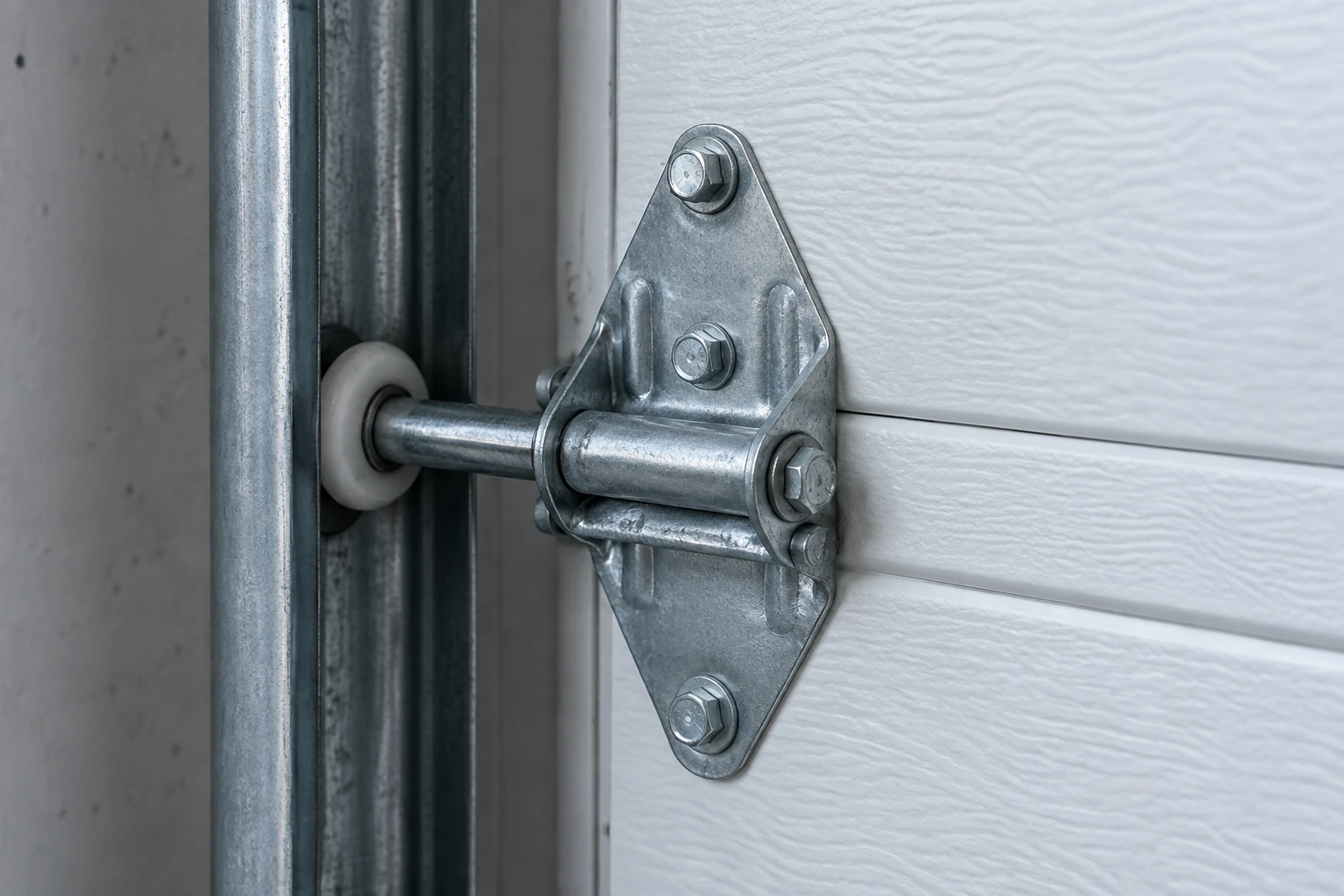
A sectional garage door is a series of rigid panels joined by hinges, and it only bends where those hinges allow it to. Each hinge carries a roller stem, and each roller runs inside the track. Going up, the door travels vertically until the rollers reach the radius curve, then turns and runs back horizontally under the ceiling. That transition is the whole point of the design and it is where all the load concentrates. Hinges are numbered by position, one through five and sometimes higher, and the number sets the offset of the roller stem so that each section sits at the right depth in the track as the door curves. Put a number three hinge where a number four belongs and the door binds. The rollers themselves come in steel, nylon over steel, and moulded plastic, with or without sealed bearings, and the difference between them is almost entirely about how much noise they make and how long they last.
What makes this different in Dallas Fort Worth
Two things about this region are hard on rollers. The first is heat. A Dallas garage in August is an oven, and the unsealed nylon and plastic wheels that come as builder standard soften, deform slightly under load, and then set out of round when they cool. That out of round wheel is the thump you hear once per revolution as the door travels. Over several summers the wheels flat spot badly enough to start climbing the track. The second is grit. The growth corridors north through Frisco, Little Elm, Prosper and Anna, and the constant roadwork through Arlington and Grand Prairie, put fine construction dust in the air for years at a time. That dust settles into open roller bearings, mixes with whatever lubricant is there, and turns into a grinding paste. Add the alley entry garages of older East Dallas, where doors get clipped and tracks get knocked, and the region produces roller and track wear noticeably faster than a milder, cleaner climate would.
Warning signs
Noise is the first and most useful signal, and the type of noise says a lot. A rhythmic thump that repeats at a steady interval is a flat spotted or out of round roller. A continuous grinding or crunching is dry or contaminated bearings. A sharp bang at one point in the travel, always the same point, is usually a roller reaching a damaged section of track or a hinge that has cracked. A squeal is a dry stem in a worn hinge barrel. Beyond noise, look for a door that has begun to catch or hesitate at the radius curve, a door that shudders as it changes direction, or a door that will not sit flat against the floor across its full width. Visually, cracked hinge plates around the roller barrel are common and easy to spot, as is a roller wheel with pieces missing from its rim, or a stem that has worn a visible slot into the hinge. Gaps opening between sections at the hinge line mean the hinge is failing rather than the door.
What actually causes it
Most roller wear is simply cycles multiplied by load, but three things accelerate it sharply. Contamination is first, because an open bearing roller in a dusty garage is running on abrasive. Heat is second, softening cheap wheel material until it deforms. Misalignment is third, and it is the one that does structural damage, because a track that is out of plumb or a section that has been bent forces the roller stem to run at an angle it was not designed for, which wears the hinge barrel oval and eventually cracks the plate. Hinges fail from the same misalignment, from corrosion where a garage takes water, and from being asked to carry weight the door was never specified for after insulation or cladding was added. Track problems begin with impact, and in a domestic garage that almost always means a vehicle, a ladder, or a bicycle. A track knocked even slightly out of plane at the radius curve creates a pinch point that every single cycle then runs through. And the wrong lubricant is a real cause rather than a technicality: heavy greases and general purpose sprays collect dust and accelerate exactly the wear they were meant to prevent.
What the visit looks like
The door is run once, slowly, and watched rather than listened to from another room, because the location of a catch tells you more than the sound of it. Each roller is checked for a wheel that no longer turns freely, a flat on the rim, play in the bearing, and a stem that has worn. Hinges are checked plate by plate for cracks radiating from the barrel, for elongated stem holes, and for fasteners that have pulled in the section skin. Track is checked for plumb on the vertical, for the shape of the radius curve, for dents and for bracket tightness, and the two sides are measured against each other rather than eyeballed, since a track that is parallel but out of square still binds. Sections are checked for straightness across the width, because a bowed section pushes its rollers outward regardless of how good the track is. Then the work is done in the right order: track brought back to plumb and shape first, then hinges, then rollers, because fitting new rollers into bad track simply damages the new rollers. Fasteners go back into sound steel, and where a screw has stripped the section, the fixing is relocated rather than driven harder. The door is cycled by hand with the opener disconnected and checked for smooth travel through the curve before the opener goes back on.
The parts that matter
Rollers are specified by stem diameter, stem length and wheel diameter, and the practical decision is material and bearing type. Moulded plastic on a plain stem is the cheapest and the noisiest and has the shortest life. Steel wheels are durable and are the loudest of all, and they transmit every imperfection in the track into the structure of the house. Nylon wheels on sealed ball bearings are the upgrade that most owners actually notice, because they run quietly, they do not soften in summer heat the way unsealed nylon does, and the sealed bearing keeps construction dust out. Hinges are numbered by position and must be replaced like for like, in the correct gauge for the door weight, and heavier insulated doors need heavier gauge hinges than the builder grade that often came with them. End hinges carry the roller at the outer edge and take more load than centre hinges, so they wear first. Track comes in weight ratings and radius sizes, and a low headroom garage uses a different radius from a standard one, which matters when a section is replaced rather than the whole set. Track brackets, lag fixings and the structural backing they land in are part of the assembly and are worth as much attention as the track itself.
Before you call, what to check
- Note exactly where in the travel it happensA door that catches always catches somewhere specific. Watch it from inside and note whether the noise or the hesitation happens near the floor, halfway up, or right at the curve where the track turns horizontal. That one detail narrows the cause from the whole assembly to a few inches of track or one hinge, and it saves a lot of guessing.
- Do not spray grease into the trackThis is the most common well meant mistake. The track is a guide, not a bearing surface, and it is supposed to be dry. Grease and heavy oil in the track collect dust and grit until the rollers are running through paste, which is far worse than the original noise. If anything is lubricated, it is the roller bearings, the hinge barrels and the spring, with a light garage door lubricant, and the track is wiped clean instead.
- Look for cracks around the roller barrel on the hingesStand inside with the door closed and look along the hinge line between sections. You are looking for hairline cracks radiating out from the round barrel that the roller stem sits in, and for holes that have worn from round into oval. A cracked hinge will hold for a while and then let go all at once, and when it does the roller leaves the track at that corner.
- Check whether a roller has stopped turningWith the door closed, look at each roller where it sits in the track. A wheel with a flat worn onto one side is being dragged rather than rolled, which means its bearing has seized. One seized roller drags the whole door and puts side load into every hinge on that side, so it is not a part to leave until the next thing goes wrong.
- Stop using the door if it is jumping at the curveA door that visibly lifts or jumps as it goes through the radius curve is close to coming out of the track. The curve is the point of highest load and least tolerance, and a door that leaves the track there tends to fold rather than simply drop. If it is doing that, stop cycling it and leave it closed.
Repair or replace
Repair
This is repair territory in almost every case, and it is the maintenance that most changes how a door behaves for the least money. Replacing a full set of rollers on a door that has been running on builder grade plastic transforms the noise level immediately and takes load off the hinges and the opener at the same time. Replacing individual cracked hinges is sensible when the rest are sound, and replacing the full set is sensible when the door is at the age where they are all cracking. Track can be brought back to plumb, and a dented section can often be worked back or swapped for a single length rather than the whole run. The one judgement worth making carefully is not to fit good rollers into bad track, because the track will chew them and the money is wasted.
Replace
Very little about rollers and hinges argues for a new door, but the inspection sometimes uncovers things that do. Hinges cracking at every position at once, on a door where the section steel around the fixings has begun to tear, means the sections are no longer holding fasteners and there is nothing solid left to bolt to. Sections bowed across their width, so that the rollers are pushed out of the track no matter how the track is set, cannot be straightened. Rust through the bottom section is structural. And a door heavy enough to be destroying builder grade hardware repeatedly, because insulation or cladding was added after it was installed, is a door that was never specified for its own weight, which is a conversation about the whole assembly rather than about hinges.
What it costs
Nothing is quoted over the phone on a guess. What follows is what actually moves the number.
| Job | What it covers | What pushes it up |
|---|---|---|
| Full roller replacement set | the single most effective quieting upgrade | number of rollers, wheel material and bearing type chosen, stem length required |
| Nylon sealed bearing roller upgrade | quiet running and resistant to dust and heat | door size, whether hinges also need replacing to take the new stems |
| Individual hinge replacement | cracked plates and elongated stem holes | number of hinges, position numbers required, gauge needed for door weight |
| Full hinge set replacement | where cracking has reached most positions | door size and section count, gauge required, condition of the section steel |
| Vertical and horizontal track realignment | bringing track back to plumb and shape | how far out of alignment, bracket condition, whether the backing needs repair |
| Radius curve section replacement | the highest load point in the assembly | one side or both, radius size, headroom available |
Need this looked at?
Describe what the door is doing and you will get a straight read on what is likely wrong, whether it is safe to leave until tomorrow, and what the repair involves.
Call (214) 271-8110Questions we get asked
My garage door has got very loud. Is that dangerous or just annoying?
On its own it is mostly annoying, but it is a reliable early warning. Noise means something is no longer rolling freely, and anything that is being dragged instead of rolled is putting side load into hinges and track that were designed for straight line movement. Left long enough that side load cracks hinge plates, and a cracked hinge is how doors come out of the track. So the noise is not the danger. The wear it is reporting eventually is.
Are nylon rollers actually worth the extra over the ones that came with the door?
In this climate, yes, and the reason is the sealed bearing rather than the nylon itself. Builder grade rollers usually run on an open bearing, and an open bearing in a garage that gets construction dust and summer heat fills with abrasive and then grinds. A sealed bearing keeps that out. The nylon wheel adds the quietness people notice first, but the bearing is what makes them last. On a door used as the main entrance to the house, it is the difference between replacing rollers every few years and largely forgetting about them.
Can I replace rollers myself?
The middle rollers are genuinely simple. The bottom rollers are not, and that distinction matters. The bottom roller sits in the bottom bracket, and the bottom bracket is the anchor point for the lift cable, which is under full spring tension. Undoing it releases that tension with the door closed and the spring wound. People have been badly hurt doing exactly this. The middle and upper rollers can be swapped by unbolting a hinge with the door closed and supported, but the bottom ones are not a homeowner job.
The door catches at the same spot every time. What is that?
A repeatable catch at a fixed point in the travel is almost always the track rather than the door, because the door presents a different roller at that point on every cycle and they all catch. Look at the track at that height for a dent, a seam that has opened, a bracket that has loosened and let the track twist, or a splice between sections that is no longer flush. The other common cause at exactly one point is the radius curve, where a small deformation creates a pinch that everything has to squeeze through.
What lubricant should I use, and how often?
A light garage door lubricant, applied to the roller bearings, the hinge barrels and the torsion spring, roughly twice a year. Not the track. Not general purpose penetrating spray, which is a solvent and washes out what little lubrication is there. Not heavy grease, which collects dust. Wipe the inside of the track clean with a dry cloth instead. In this region, doing this at the start of summer and again in late autumn tracks the two conditions that actually cause the wear here, which are heat and airborne grit.
One hinge is cracked. Do they all need doing?
Not necessarily, but it is worth understanding why that one cracked before deciding. If it cracked because a roller beside it seized and put side load through it, replacing that hinge and that roller solves it. If it cracked from age and the others are showing the same hairline pattern around the barrels, doing them one at a time over the next year costs more in visits than doing the set. End hinges take more load than centre hinges and fail first, so a cracked end hinge with sound centre hinges is a normal and localised repair.
Why does my door sound worse in summer?
Heat softens the wheel material on unsealed nylon and plastic rollers, and a softened wheel deforms slightly under the weight of the door while it sits closed all day. When it cools it holds some of that deformation, and an out of round wheel thumps once per revolution. Metal track also expands and contracts, which can tighten a clearance that was marginal to begin with. If a door is quiet in February and loud in August, the rollers are telling you what they are made of.
Can bad rollers damage the opener?
They can shorten its life considerably. An opener is sized to guide a balanced door, not to drag a binding one. When rollers seize or track binds, the motor draws harder on every cycle, the gear set takes the extra load, and the travel and force settings get pushed up over time to compensate, which hides the problem while making it worse. A surprising number of openers replaced as failed were actually healthy motors that had spent years fighting twelve dollars worth of seized rollers.
Other garage door work we do
Brands we repair
Electric gates
Cities we cover
Complete the handoff: Garage Door Roller, Hinge and Track Repair in Dallas Fort Worth in Dallas-Fort Worth
Clear documentation makes a technical job easier to judge. For Garage Door Roller, Hinge and Track Repair in Dallas Fort Worth in Dallas-Fort Worth, the local context includes a mix of property ages, operating patterns, weather exposure, shared access, and equipment histories. The working scope centers on inspection, diagnosis, scope, safe work, operational testing, and a documented handoff. Under complete the handoff, the review covers manual release, remote controls, keypad access, safety tests, maintenance notes, and ownership of connected accounts. A homeowner may first report that the sectional door serves several users, but that statement is a starting point rather than a diagnosis. The inspection should establish what changed, which parts still function, what can be tested safely, and what result the customer expects. The same check helps rule out work that would not solve the complaint. Conditions across Dallas-Fort Worth influence materials, access, weather exposure, and scheduling, so the final recommendation should follow the actual property. 24/7 Dallas Garage Door Repair explains the work, records important limitations, and asks the customer to verify the finished operation before the visit closes.
Every property adds a different operating pattern. For Garage Door Roller, Hinge and Track Repair in Dallas Fort Worth in Dallas-Fort Worth, the local context includes a mix of property ages, operating patterns, weather exposure, shared access, and equipment histories. The working scope centers on inspection, diagnosis, scope, safe work, operational testing, and a documented handoff. Under complete the handoff, the review covers manual release, remote controls, keypad access, safety tests, maintenance notes, and ownership of connected accounts. A property manager may first report that the cable drum has been exposed to moisture, but that statement is a starting point rather than a diagnosis. The inspection should establish what changed, which parts still function, what can be tested safely, and what result the customer expects. This approach keeps safety, function, and cost in the same conversation. Conditions across Dallas-Fort Worth influence materials, access, weather exposure, and scheduling, so the final recommendation should follow the actual property. 24/7 Dallas Garage Door Repair explains the work, records important limitations, and asks the customer to verify the finished operation before the visit closes.
Check safety reversal: Garage Door Roller, Hinge and Track Repair in Dallas Fort Worth in Dallas-Fort Worth
The most useful decision follows the system, not a sales package. For Garage Door Roller, Hinge and Track Repair in Dallas Fort Worth in Dallas-Fort Worth, the local context includes a mix of property ages, operating patterns, weather exposure, shared access, and equipment histories. The working scope centers on inspection, diagnosis, scope, safe work, operational testing, and a documented handoff. Under check safety reversal, the review covers photo-eye position, wiring, obstruction response, closing force, travel limits, and testing after adjustment. A property manager may first report that the opener rail has an uncertain service history, but that statement is a starting point rather than a diagnosis. The inspection should establish what changed, which parts still function, what can be tested safely, and what result the customer expects. A written scope also reduces surprises after work begins. Conditions across Dallas-Fort Worth influence materials, access, weather exposure, and scheduling, so the final recommendation should follow the actual property. 24/7 Dallas Garage Door Repair explains the work, records important limitations, and asks the customer to verify the finished operation before the visit closes.
The safest next step comes from controlled testing. For Garage Door Roller, Hinge and Track Repair in Dallas Fort Worth in Dallas-Fort Worth, the local context includes a mix of property ages, operating patterns, weather exposure, shared access, and equipment histories. The working scope centers on inspection, diagnosis, scope, safe work, operational testing, and a documented handoff. Under check safety reversal, the review covers photo-eye position, wiring, obstruction response, closing force, travel limits, and testing after adjustment. A warehouse lead may first report that the sectional door serves several users, but that statement is a starting point rather than a diagnosis. The inspection should establish what changed, which parts still function, what can be tested safely, and what result the customer expects. A complete handoff shows what changed and how to verify it. Conditions across Dallas-Fort Worth influence materials, access, weather exposure, and scheduling, so the final recommendation should follow the actual property. 24/7 Dallas Garage Door Repair explains the work, records important limitations, and asks the customer to verify the finished operation before the visit closes.
A useful question before approving this step
Ask what observation supports the recommendation, which parts are included, which parts are outside the scope, how the result will be tested, and what documentation you will receive. Call (214) 271-8110 to describe the property and schedule work within Dallas-Fort Worth.
Protect panels and hardware: Garage Door Roller, Hinge and Track Repair in Dallas Fort Worth in Dallas-Fort Worth
Good service starts by separating cause from coincidence. For Garage Door Roller, Hinge and Track Repair in Dallas Fort Worth in Dallas-Fort Worth, the local context includes a mix of property ages, operating patterns, weather exposure, shared access, and equipment histories. The working scope centers on inspection, diagnosis, scope, safe work, operational testing, and a documented handoff. Under protect panels and hardware, the review covers cracks, loose hinges, roller stems, fasteners, struts, weather seal, and early signs of fatigue. A homeowner may first report that the bottom fixture behaves differently under load, but that statement is a starting point rather than a diagnosis. The inspection should establish what changed, which parts still function, what can be tested safely, and what result the customer expects. That distinction matters when several people share responsibility for the property. Conditions across Dallas-Fort Worth influence materials, access, weather exposure, and scheduling, so the final recommendation should follow the actual property. 24/7 Dallas Garage Door Repair explains the work, records important limitations, and asks the customer to verify the finished operation before the visit closes.
Small alignment and maintenance details often explain large symptoms. For Garage Door Roller, Hinge and Track Repair in Dallas Fort Worth in Dallas-Fort Worth, the local context includes a mix of property ages, operating patterns, weather exposure, shared access, and equipment histories. The working scope centers on inspection, diagnosis, scope, safe work, operational testing, and a documented handoff. Under protect panels and hardware, the review covers cracks, loose hinges, roller stems, fasteners, struts, weather seal, and early signs of fatigue. A installer may first report that the opener rail has an uncertain service history, but that statement is a starting point rather than a diagnosis. The inspection should establish what changed, which parts still function, what can be tested safely, and what result the customer expects. That sequence keeps the recommendation tied to evidence. Conditions across Dallas-Fort Worth influence materials, access, weather exposure, and scheduling, so the final recommendation should follow the actual property. 24/7 Dallas Garage Door Repair explains the work, records important limitations, and asks the customer to verify the finished operation before the visit closes.
Treat spring tension with respect: Garage Door Roller, Hinge and Track Repair in Dallas Fort Worth in Dallas-Fort Worth
The visible symptom is only the first clue. For Garage Door Roller, Hinge and Track Repair in Dallas Fort Worth in Dallas-Fort Worth, the local context includes a mix of property ages, operating patterns, weather exposure, shared access, and equipment histories. The working scope centers on inspection, diagnosis, scope, safe work, operational testing, and a documented handoff. Under treat spring tension with respect, the review covers door weight, spring size, shaft condition, winding hardware, cable position, and safe control of stored energy. A installer may first report that the opener rail has an uncertain service history, but that statement is a starting point rather than a diagnosis. The inspection should establish what changed, which parts still function, what can be tested safely, and what result the customer expects. The result is easier to test and easier to document. Conditions across Dallas-Fort Worth influence materials, access, weather exposure, and scheduling, so the final recommendation should follow the actual property. 24/7 Dallas Garage Door Repair explains the work, records important limitations, and asks the customer to verify the finished operation before the visit closes.
A careful scope protects both the equipment and the customer. For Garage Door Roller, Hinge and Track Repair in Dallas Fort Worth in Dallas-Fort Worth, the local context includes a mix of property ages, operating patterns, weather exposure, shared access, and equipment histories. The working scope centers on inspection, diagnosis, scope, safe work, operational testing, and a documented handoff. Under treat spring tension with respect, the review covers door weight, spring size, shaft condition, winding hardware, cable position, and safe control of stored energy. A warehouse lead may first report that the bottom fixture behaves differently under load, but that statement is a starting point rather than a diagnosis. The inspection should establish what changed, which parts still function, what can be tested safely, and what result the customer expects. It also gives the customer a clear way to compare the available options. Conditions across Dallas-Fort Worth influence materials, access, weather exposure, and scheduling, so the final recommendation should follow the actual property. 24/7 Dallas Garage Door Repair explains the work, records important limitations, and asks the customer to verify the finished operation before the visit closes.