Short answer
Most people choose a garage door on how it looks and then live with how it performs. In this climate that order is backwards. The door is the largest single opening in the building envelope, it faces the afternoon sun on a great many Dallas houses, and it is the part of the exterior that moves several thousand times a year. Insulation, construction and hardware decide whether it stays quiet and stays square. The style decides how it looks on the first day.
What the job actually is
A garage door installation is really the fitting of an assembly, and the door itself is only the visible part. There is the door, made of sections in a chosen material and construction. There is the counterbalance, which is the torsion or extension spring system calculated to the finished weight of that specific door. There is the track set, sized to the headroom and the radius the garage allows. There is the hardware, meaning hinges, rollers, brackets and struts specified to the door's weight and width. There is the sealing package at the bottom, sides and top. And there is the opener, which has to suit the door rather than the other way round. These parts are interdependent, which is the single most useful thing to understand: a heavier insulated door needs heavier hinges, a longer or larger spring, and often a different opener from the one that was driving the light door it replaced.
What makes this different in Dallas Fort Worth
Heat is the design constraint here, and it is routinely underestimated. An uninsulated steel door on a west facing Dallas garage will run far above outside air temperature through a summer afternoon and radiate that into the garage and into whatever room sits above or behind it. In houses across Plano, Allen, Frisco and Southlake where the garage is attached and often has living space over it, that is a real comfort and energy cost rather than a theoretical one. Insulated construction is the change that matters most in this market, and the practical measure is the door's rated thermal value together with whether it is a genuine sandwich construction with steel on both faces or a single skin with a panel of foam glued behind it. Wind is the second local factor, since North Texas storms are strong enough that wind rating on a large door is worth asking about rather than assuming. Ground movement is the third: on clay soils an opening can move over the years, so a door and track set that were installed plumb in a slab that has since shifted will need adjustment later, and choosing hardware with some adjustment range built in pays for itself. And in the newer master planned communities, appearance is often not a clear choice, because the neighbourhood has rules about door style and colour.
Warning signs
There is no diagnosis here in the usual sense, but there are recognisable points at which replacement stops being optional. A door with rust through the bottom section is structurally finished. A door that has folded across two or more sections after coming off track will not run true again. A door whose sections no longer hold fasteners, where hinge screws have torn the steel around them, has nothing left to bolt to. A door on a profile that has been discontinued, needing a panel that cannot be sourced, has effectively reached the end of its supportable life. Beyond those, there are the reasons that are about performance rather than failure: a single skin door on a garage that is now a workshop or a gym, a door heavy enough that it has destroyed successive sets of builder grade hardware, or a door with no photo eye sensors near the floor because it predates them, which is a safety gap that no repair closes.
What actually causes it
Doors reach replacement by three routes. The first is accumulated age, where the sections have been cycling for two decades, the hardware has been replaced piecemeal, and the cost of the next repair is no longer sensible against the value of what is left. The second is a single event, most often a vehicle impact or a door coming off track and folding, where the damage crosses the line described above in one afternoon. The third is a change in what the building is being asked to do, and this is the one that is most often ignored. A garage that becomes conditioned space, a bonus room built over it, or an owner who is simply tired of a garage that is unusable in July, all make an uninsulated door the wrong component regardless of whether it still works. Doors also arrive at replacement through the back door of specification, where insulation or cladding was added to a builder grade door after installation, the weight went up, and everything from spring to hinges has been failing early ever since.
What the visit looks like
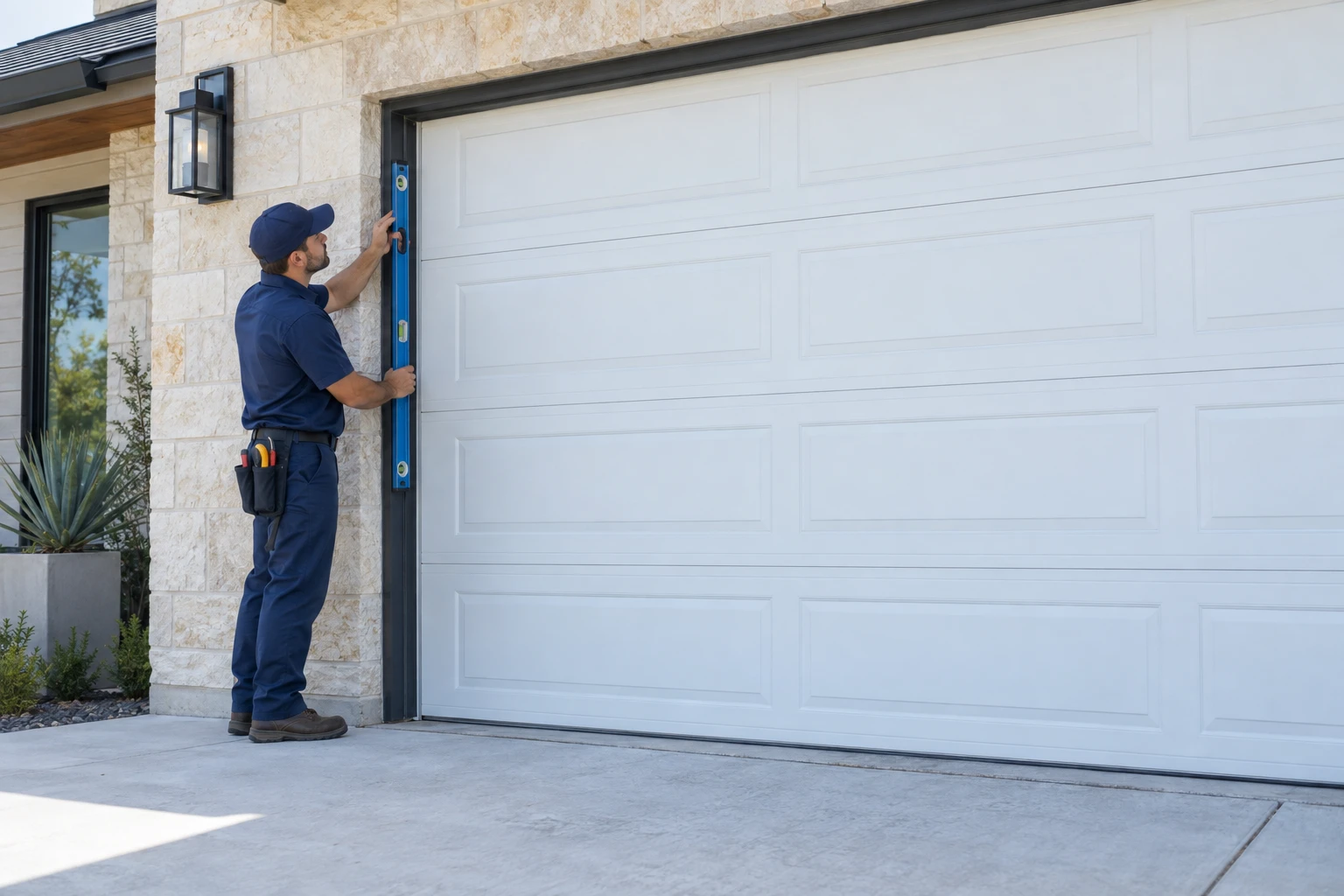
The opening is measured before anything is chosen, and that means width and height at several points rather than once, plus the headroom above the opening, the backroom depth into the garage, and the side room either side. Those measurements determine which track and radius are possible and whether a low headroom configuration is needed, and they are also where an opening that has moved with the slab reveals itself. The existing door and track come out, and the opening is inspected: jambs checked for rot or damage, the header checked for the fixing it will have to carry, the floor checked for level across the width. New jamb material goes on where needed, because a new door hung on a compromised jamb is a short term installation. Track is set plumb and square rather than to the existing holes. The door goes in section by section from the bottom, with each one checked for level before the next goes on, and hinges and rollers fitted as it rises. The spring system is calculated to the finished door, not selected from a chart by door size, and wound to that calculation. Sealing goes on at bottom, sides and top. Then the door is balanced and tested entirely by hand before the opener is introduced, and the opener is set up last, with travel limits, force settings, photo eye alignment and safety reversal all tested against the finished door.
The parts that matter
The choices that matter are construction, insulation, gauge, hardware grade and opener pairing. Construction runs from single skin steel, which is the lightest and the least expensive and has no thermal value, through insulated with a foam backing, to a full sandwich with steel skins both sides and foam bonded between, which is stiffer, quieter and the only version that holds its thermal rating properly. Steel gauge determines dent resistance, and the difference between a light builder gauge and a heavier one is very noticeable on a door that faces an alley or a basketball hoop. Windows change weight distribution and always change the spring calculation. Hardware grade should follow the finished weight, meaning heavier hinges and sealed bearing rollers on heavier doors rather than the standard set. Springs should be specified with cycle life as a deliberate decision, since a high cycle spring on a door that will be the household's main entrance is a cheaper decision over the life of the door than the standard one. Openers pair by drive type, and the practical division in this market is between chain drive, which is the most robust and the loudest, belt drive, which is much quieter and suits a door with rooms above it, and direct drive wall mounted units, which open up ceiling space and suit low headroom garages and heavier doors.
Before you call, what to check
- Measure the headroom before falling in love with a doorHeadroom is the distance from the top of the opening to the ceiling or the nearest obstruction, and it decides which track and spring configuration are possible. A standard installation wants a reasonable amount of it. Less than that means a low headroom kit, a different radius and sometimes a wall mounted opener. Measuring it first prevents a choice that has to be unwound later.
- Ask what the insulation rating actually refers toTwo doors can both be described as insulated and perform very differently. A single steel skin with foam bonded to the back of it is not the same as a sandwich panel with steel on both faces, and the difference shows in stiffness and noise as well as heat. Ask whether the door is two sided construction and what the rated value is for the complete section rather than for the foam.
- Check what your neighbourhood requires before orderingIn much of the newer development north and west of Dallas, garage door style and colour are covered by community rules, and doors have had to come off again because nobody checked. It takes one phone call or one look at the community documents, and it is much easier before an order is placed than after a door is hanging.
- Do not assume the existing opener will suit the new doorAn opener that has spent ten years lifting a light single skin door may be undersized for an insulated sandwich door, and it will show that by struggling, by wearing its gear set, or by failing to reverse correctly. A door and an opener are a matched pair. If the door is getting substantially heavier, the opener needs to be part of the conversation rather than an afterthought.
- Look at the jambs and the floor while the old door is offThe moment the old door is out is the only easy opportunity to see the opening properly. Wood jambs that have taken years of water at the bottom, a header that has been repaired badly, or a floor that has dropped at one end are all much cheaper to deal with then than after a new door is hung on them. It is worth asking to see the opening rather than having it covered over.
Repair or replace
Repair
Repair is the better answer more often than people expect, and the test is whether the door's structure is sound. Sections that are straight, holding fasteners and without rust can carry new hardware indefinitely. A door that is noisy, sagging or binding because it has been running on builder grade rollers and undersized springs is not worn out, it is under specified, and correcting the hardware transforms it for a fraction of a replacement. Even an uninsulated door in a garage nobody spends time in is doing its job. The point of replacement is not age. It is the moment when the sections themselves stop being sound or the profile stops being supportable.
Replace
Replacement makes sense when the sections are structurally finished, when a needed panel no longer exists, when a folded door will never run true, or when the door is fundamentally the wrong component for how the space is now used. It is also the right answer when repair spending has become repetitive: three visits in two years on an old door, each of them reasonable on its own, generally means the door has passed the point where individual parts are the problem. The one genuine argument for replacing a working door is thermal, and it is a stronger argument here than in most of the country, because an uninsulated door on a west facing Texas garage with living space attached is costing something every summer whether or not it ever breaks.
What it costs
Nothing is quoted over the phone on a guess. What follows is what actually moves the number.
| Job | What it covers | What pushes it up |
|---|---|---|
| New insulated sectional door, single car opening | the common replacement for builder grade | door construction and gauge, insulation rating, window and hardware choices |
| New insulated sectional door, double car opening | wider doors need heavier hardware and struts | width, construction, insulation rating, spring cycle rating chosen |
| Full sandwich construction upgrade | steel both faces, stiffer and quieter | door size, rated thermal value, colour and finish selected |
| Low headroom track configuration | where ceiling clearance is limited | headroom available, radius required, whether a wall mounted opener is needed |
| Opener supplied and paired with a new door | drive type matched to door weight and location | chain, belt or wall mounted, horsepower needed, accessories included |
| Jamb, header and opening repair before installation | found once the old door is off | extent of rot or damage, material required, whether the floor needs levelling |
Need this looked at?
Describe what the door is doing and you will get a straight read on what is likely wrong, whether it is safe to leave until tomorrow, and what the repair involves.
Call (214) 271-8110Questions we get asked
How long does a new garage door installation take?
A straightforward replacement in a sound opening is normally completed in a single visit, covering removal of the old door and track, fitting the new assembly, calculating and winding the spring, and setting up the opener. What extends it is what is found behind the old door. Rotten jambs, a damaged header, a floor that has dropped on one side, or an opening that has moved with the slab all need attention before the new door goes on, because hanging a new door on a compromised opening simply moves the problem forward.
Is an insulated door worth it in Texas?
In most attached garages here, yes, and the reason is the west facing afternoon sun rather than winter. An uninsulated steel door absorbs that heat and radiates it into the garage and into any room sharing a wall or floor with it. Insulated construction reduces that noticeably, and it has two side effects people appreciate as much as the temperature: the door is considerably quieter because a sandwich panel does not drum, and it is stiffer, so it resists denting and bowing better than a single skin of the same gauge.
Can I keep my existing opener?
Sometimes, and it depends on the weight change and the opener's condition. If the new door is similar in weight and the opener is sound and has working photo eye sensors near the floor, keeping it is reasonable. If the new door is substantially heavier, which it will be if you are moving from single skin to insulated sandwich, the old opener may be undersized and will show it by straining. And an opener old enough to lack photo eye sensors should be replaced regardless of the door, because that is a safety feature rather than a convenience.
What size opener do I need?
It follows from the door rather than from the garage. Weight, width and height all matter, and so does how the door is used, because a door that cycles several times a day is asking for more than one that opens twice. The other half of the question is drive type. Chain drive is the most robust and the loudest. Belt drive is much quieter and is the sensible choice where there are bedrooms above or beside the garage. A wall mounted unit sits beside the door rather than on the ceiling, which suits low headroom garages and heavier doors and clears the ceiling entirely.
Do you have to replace the track as well?
On a new door, yes, and it is not an upsell. Track is matched to the door's weight, height and the radius the garage allows, and old track has usually been shaped by years of a different door running through it. Reusing it puts a new door into a guide that is no longer true, which shows up as binding and premature roller wear. Setting new track plumb to the opening is also what allows the installation to be square in an opening that may have moved.
My neighbourhood has rules about what the door can look like. Does that limit the options?
It narrows style, colour and sometimes window configuration, but it rarely limits the things that matter mechanically. Construction, insulation rating, gauge, hardware grade and spring cycle life are almost never covered by community rules, and those are the choices that determine how the door performs and how long it lasts. It is worth confirming the requirements before ordering rather than after, because a door that has to come back off is an expensive way to learn the rules.
How long should a new garage door last?
The sections themselves, on a decent quality door in this climate, will comfortably outlast the hardware attached to them. What determines the real answer is the consumable parts. Springs are rated in cycles rather than years, and a standard spring on a busy household door reaches its rating in several years while a high cycle spring lasts proportionally longer. Rollers, hinges and seals are maintenance items. So the honest answer is that the door is a long term component and the hardware on it is a schedule, and choosing the hardware deliberately at installation is what sets that schedule.
Should I choose windows in the door?
They change three things. They let light into a garage that is otherwise dark, which matters if the space is used for anything besides parking. They add weight and they change where that weight sits, which means the spring calculation has to account for them rather than being taken from a size chart. And on a west facing door in this climate they add a heat path, which partly offsets an insulated door's advantage unless the glazing is specified accordingly. None of those rule them out. They just make the specification of the rest of the door matter more.
Other garage door work we do
Brands we repair
Electric gates
Cities we cover
Explain the quote: New Garage Door Installation in Dallas Fort Worth in Dallas-Fort Worth
The visible symptom is only the first clue. For New Garage Door Installation in Dallas Fort Worth in Dallas-Fort Worth, the local context includes a mix of property ages, operating patterns, weather exposure, shared access, and equipment histories. The working scope centers on inspection, diagnosis, scope, safe work, operational testing, and a documented handoff. Under explain the quote, the review covers diagnosis, parts, labor, optional work, approval, testing, and what would change the scope. A installer may first report that the photo-eye circuit needs a documented baseline, but that statement is a starting point rather than a diagnosis. The inspection should establish what changed, which parts still function, what can be tested safely, and what result the customer expects. The result is easier to test and easier to document. Conditions across Dallas-Fort Worth influence materials, access, weather exposure, and scheduling, so the final recommendation should follow the actual property. 24/7 Dallas Garage Door Repair explains the work, records important limitations, and asks the customer to verify the finished operation before the visit closes.
Good service starts by separating cause from coincidence. For New Garage Door Installation in Dallas Fort Worth in Dallas-Fort Worth, the local context includes a mix of property ages, operating patterns, weather exposure, shared access, and equipment histories. The working scope centers on inspection, diagnosis, scope, safe work, operational testing, and a documented handoff. Under explain the quote, the review covers diagnosis, parts, labor, optional work, approval, testing, and what would change the scope. A homeowner may first report that the sectional door serves several users, but that statement is a starting point rather than a diagnosis. The inspection should establish what changed, which parts still function, what can be tested safely, and what result the customer expects. That distinction matters when several people share responsibility for the property. Conditions across Dallas-Fort Worth influence materials, access, weather exposure, and scheduling, so the final recommendation should follow the actual property. 24/7 Dallas Garage Door Repair explains the work, records important limitations, and asks the customer to verify the finished operation before the visit closes.
Trace uneven movement: New Garage Door Installation in Dallas Fort Worth in Dallas-Fort Worth
Good service starts by separating cause from coincidence. For New Garage Door Installation in Dallas Fort Worth in Dallas-Fort Worth, the local context includes a mix of property ages, operating patterns, weather exposure, shared access, and equipment histories. The working scope centers on inspection, diagnosis, scope, safe work, operational testing, and a documented handoff. Under trace uneven movement, the review covers cable seating, drums, bottom fixtures, track spacing, rollers, and obstructions around the opening. A warehouse lead may first report that the spring shaft shows uneven wear, but that statement is a starting point rather than a diagnosis. The inspection should establish what changed, which parts still function, what can be tested safely, and what result the customer expects. That distinction matters when several people share responsibility for the property. Conditions across Dallas-Fort Worth influence materials, access, weather exposure, and scheduling, so the final recommendation should follow the actual property. 24/7 Dallas Garage Door Repair explains the work, records important limitations, and asks the customer to verify the finished operation before the visit closes.
The visible symptom is only the first clue. For New Garage Door Installation in Dallas Fort Worth in Dallas-Fort Worth, the local context includes a mix of property ages, operating patterns, weather exposure, shared access, and equipment histories. The working scope centers on inspection, diagnosis, scope, safe work, operational testing, and a documented handoff. Under trace uneven movement, the review covers cable seating, drums, bottom fixtures, track spacing, rollers, and obstructions around the opening. A property manager may first report that the opener rail has an uncertain service history, but that statement is a starting point rather than a diagnosis. The inspection should establish what changed, which parts still function, what can be tested safely, and what result the customer expects. The result is easier to test and easier to document. Conditions across Dallas-Fort Worth influence materials, access, weather exposure, and scheduling, so the final recommendation should follow the actual property. 24/7 Dallas Garage Door Repair explains the work, records important limitations, and asks the customer to verify the finished operation before the visit closes.
A useful question before approving this step
Ask what observation supports the recommendation, which parts are included, which parts are outside the scope, how the result will be tested, and what documentation you will receive. Call (214) 271-8110 to describe the property and schedule work within Dallas-Fort Worth.
Review everyday use: New Garage Door Installation in Dallas Fort Worth in Dallas-Fort Worth
The most useful decision follows the system, not a sales package. For New Garage Door Installation in Dallas Fort Worth in Dallas-Fort Worth, the local context includes a mix of property ages, operating patterns, weather exposure, shared access, and equipment histories. The working scope centers on inspection, diagnosis, scope, safe work, operational testing, and a documented handoff. Under review everyday use, the review covers vehicles, storage, children, pets, deliveries, work schedules, noise, and the need for backup entry. A property manager may first report that the photo-eye circuit needs a documented baseline, but that statement is a starting point rather than a diagnosis. The inspection should establish what changed, which parts still function, what can be tested safely, and what result the customer expects. A written scope also reduces surprises after work begins. Conditions across Dallas-Fort Worth influence materials, access, weather exposure, and scheduling, so the final recommendation should follow the actual property. 24/7 Dallas Garage Door Repair explains the work, records important limitations, and asks the customer to verify the finished operation before the visit closes.
A reliable plan begins with a physical check. For New Garage Door Installation in Dallas Fort Worth in Dallas-Fort Worth, the local context includes a mix of property ages, operating patterns, weather exposure, shared access, and equipment histories. The working scope centers on inspection, diagnosis, scope, safe work, operational testing, and a documented handoff. Under review everyday use, the review covers vehicles, storage, children, pets, deliveries, work schedules, noise, and the need for backup entry. A technician may first report that the spring shaft shows uneven wear, but that statement is a starting point rather than a diagnosis. The inspection should establish what changed, which parts still function, what can be tested safely, and what result the customer expects. This prevents one worn part from hiding a larger operating problem. Conditions across Dallas-Fort Worth influence materials, access, weather exposure, and scheduling, so the final recommendation should follow the actual property. 24/7 Dallas Garage Door Repair explains the work, records important limitations, and asks the customer to verify the finished operation before the visit closes.
Separate door and opener: New Garage Door Installation in Dallas Fort Worth in Dallas-Fort Worth
Clear documentation makes a technical job easier to judge. For New Garage Door Installation in Dallas Fort Worth in Dallas-Fort Worth, the local context includes a mix of property ages, operating patterns, weather exposure, shared access, and equipment histories. The working scope centers on inspection, diagnosis, scope, safe work, operational testing, and a documented handoff. Under separate door and opener, the review covers manual movement, trolley release, motor effort, travel settings, force settings, and the symptom that started the call. A technician may first report that the sectional door serves several users, but that statement is a starting point rather than a diagnosis. The inspection should establish what changed, which parts still function, what can be tested safely, and what result the customer expects. The same check helps rule out work that would not solve the complaint. Conditions across Dallas-Fort Worth influence materials, access, weather exposure, and scheduling, so the final recommendation should follow the actual property. 24/7 Dallas Garage Door Repair explains the work, records important limitations, and asks the customer to verify the finished operation before the visit closes.
The final test matters as much as the first inspection. For New Garage Door Installation in Dallas Fort Worth in Dallas-Fort Worth, the local context includes a mix of property ages, operating patterns, weather exposure, shared access, and equipment histories. The working scope centers on inspection, diagnosis, scope, safe work, operational testing, and a documented handoff. Under separate door and opener, the review covers manual movement, trolley release, motor effort, travel settings, force settings, and the symptom that started the call. A building owner may first report that the cable drum has been exposed to moisture, but that statement is a starting point rather than a diagnosis. The inspection should establish what changed, which parts still function, what can be tested safely, and what result the customer expects. The technician can then explain what belongs in the current job and what can wait. Conditions across Dallas-Fort Worth influence materials, access, weather exposure, and scheduling, so the final recommendation should follow the actual property. 24/7 Dallas Garage Door Repair explains the work, records important limitations, and asks the customer to verify the finished operation before the visit closes.