Short answer
Most Colleyville garage door problems trace back to one number nobody has measured: the actual weight of the door. Wood overlay, applied hardware, arched glass and cladding all add mass, and springs sized for the door as originally built stop matching it. The door still opens, because the opener quietly carries the difference, and that is what strips gears, flexes rails and works the top bracket loose. Weigh the door before replacing anything on it.
The housing in Colleyville and what it means for your door
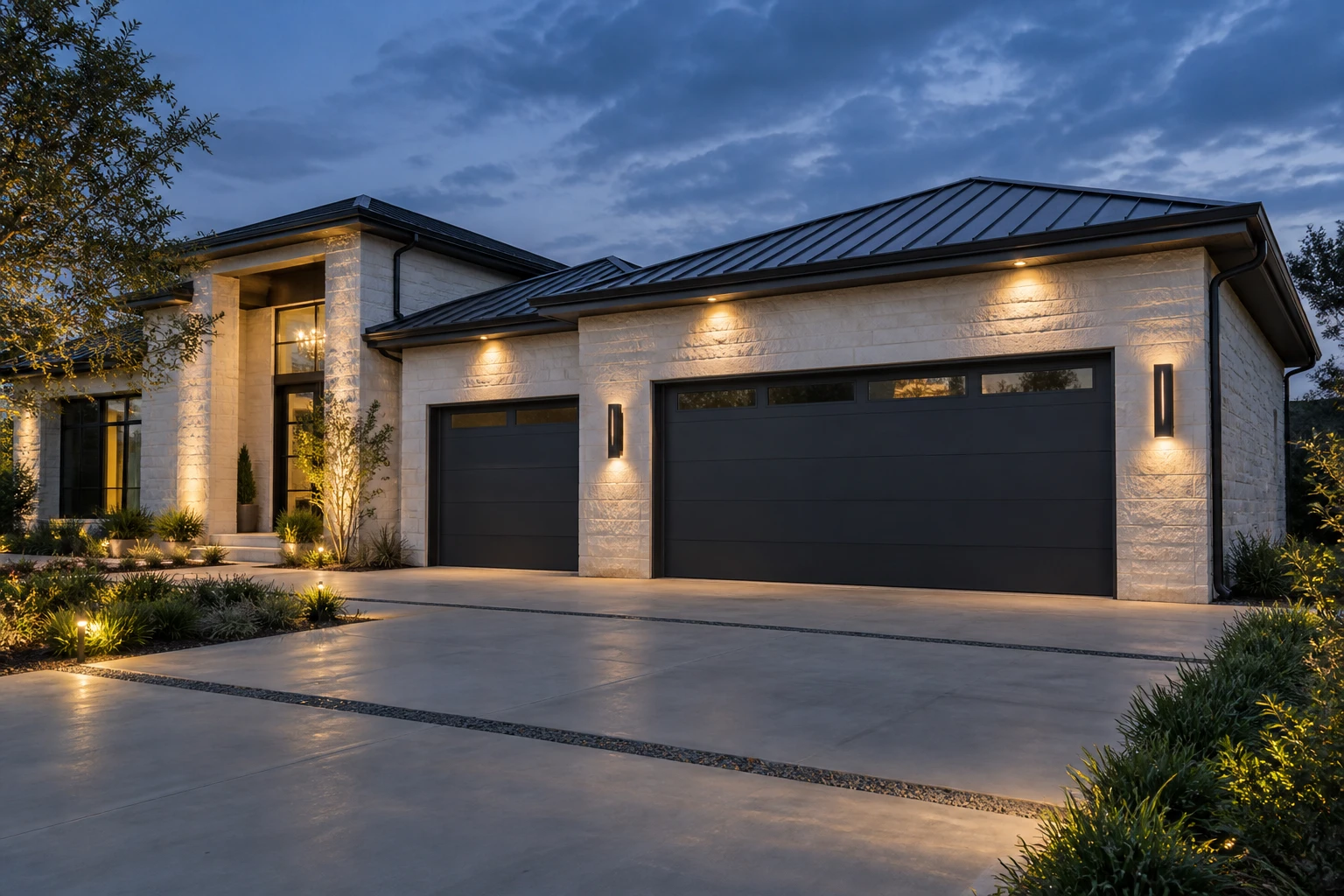
Colleyville developed on former farmland and kept the large lot pattern as it filled in, which is why the city covers just over thirteen square miles for a population of roughly twenty six thousand. Most homes sit on lots measured in fractions of an acre rather than in feet of frontage, with side entry and courtyard entry garages set back behind circular or curving drives. Three car garages are the norm rather than the exception, and four car configurations appear regularly along Bransford Road and the older estate sections. Doors here are frequently carriage house style with wood overlay, applied hardware, arched glass, or insulated steel dressed to look like stained timber. Original construction quality is high, but the doors themselves are heavy, and weight is the single fact that governs almost every repair in this city.
The door population in Colleyville skews heavy, decorative, and custom sized. Wood overlay on an insulated steel core is common, as are full wood doors, arched top sections, and doors with three or four rows of insulated glass. Widths run past the standard sixteen feet on estate homes, and side entry garages often use two or three separate single doors rather than one double. Openers are usually belt drive or wall mounted jackshaft units, chosen for quiet operation because garages frequently share a wall with a living space or a bedroom. High lift and low headroom conversions turn up in homes with finished garage ceilings or storage lifts. None of that hardware is interchangeable with builder stock. A repair here begins by weighing or calculating the actual door rather than reading a paint mark on an old spring.
We work across Colleyville Boulevard, Glade Road, Bransford Road, Pleasant Run Road and Cheek Sparger Road, and the practical difference between those areas is larger than the map suggests. Colleyville has a population of about 26,000, and the garage doors in it range across several decades of construction standards.
What causes garage door problems in Colleyville
Colleyville sits at roughly six hundred fourteen feet of elevation on the northeastern Tarrant County uplands, where the underlying clay expands in wet months and contracts hard through the summer. Large lots mean long driveway slabs, and a slab that lifts even slightly at the apron changes how a door meets the floor. Mature tree canopy across the older sections keeps garages shaded and damp longer after rain, which is good for the wood on a door face and bad for the steel behind it. Wind driven storms move across open ground between neighborhoods with little to break them, and hail is a recurring cause of panel damage on west facing elevations.
What we get called out for most in Colleyville
The most common Colleyville call is a door that has grown noticeably heavy or started to hesitate, on a house where nobody expected trouble because everything else is well maintained. Wood overlay and applied hardware add real weight, and springs sized for the door when it was new do not stay adequate once panels absorb moisture or a previous repair swapped in a lighter coil. The second most common call is cosmetic, a single damaged section on a decorative door where the owner wants the panel matched rather than the whole door replaced.
Colleyville was originally called Bransford and took its present name in 1914, honoring Dr. Lilburn Howard Colley, who had settled in the area in 1880. That farmland origin is why the city never platted itself into small lots, and why its garages sit further from the street than in almost any neighboring community.
Before you call, five things worth checking
- Do the halfway test before anything elseClose the door, pull the emergency release cord to disconnect the opener, then lift the door by hand to about waist height and let go. A correctly balanced door stays where you put it. If it sinks toward the floor, the springs no longer hold the weight. If it climbs, it is over sprung. On a heavy decorative Colleyville door this single test explains most complaints, and it takes under a minute.
- Listen for where the noise actually comes fromStand inside the garage rather than in the house and run the door once. A rhythmic thump that follows each roller through the curve is roller bearings. A sharp knock at one point is a hinge. A rumble that you feel through the floor above is the top section flexing into the header. A slap that keeps time with the motor is the chain. Owners almost always blame the opener, and the opener is almost always the quietest thing in that list.
- Look at the joints between sections with the door half openStop the door mid travel and look along the horizontal lines where the panels meet. Those joints should stay tight and parallel. A gap that opens on one side, or a joint that visibly works as the door moves, means a hinge has fatigued or its fasteners have pulled. On a wood overlay door the extra weight concentrates exactly there, and a cracked hinge left in service will eventually let a section shift out of line.
- Check whether decorative hardware has been added since installationWalk the outside face and note anything that was not part of the original door. Applied straps, handles, cladding, window inserts. Each adds weight the counterbalance was never calculated for. If the answer is yes and the springs were never revisited, that is very likely the whole explanation for whatever brought you to this page.
- Look for leaf litter and seed debris in the tracksMature canopy across the older sections drops material directly into the vertical track, and under shade it stays damp rather than blowing out. Run a dry rag down the inside of both tracks. Debris there makes a roller ride unevenly, which reads as noise or a door that hesitates at one spot, and it holds moisture against steel at the bottom of the track where corrosion starts.
Getting to your door in Colleyville
Driveways in Colleyville are long, and many curve or approach the garage from the side, so a service vehicle usually has room but may need to back out rather than turn around. Landscaping, gate columns, and low overhanging limbs are the real constraints, not width. Several neighborhoods maintain architectural standards that govern door style, color, and window pattern on any replacement, so a like for like match matters more here than in most cities. Colleyville Boulevard carries the bulk of local traffic and slows through the retail stretch. Clearing the driveway of vehicles and moving trash containers away from the opening makes the visit faster. Arrival depends on distance and traffic.
When garage doors fail in Colleyville
When Colleyville doors start to struggle The pattern in Colleyville follows moisture more than temperature. Through a wet spring, a wood overlay or full wood door takes on weight in the panels themselves, and a spring that was correctly sized in dry conditions can drift out of balance without anything breaking. Owners notice the door drifting down when stopped part way, or the opener working audibly harder. High summer reverses it, drying seals, shrinking timber, and opening gaps at the section joints where the door had been tight. Autumn brings leaf litter and seed debris into tracks under heavy canopy, and the first hard freeze of winter finds any spring that spent the year slightly overloaded. Twice yearly balance checks catch nearly all of it, and on a heavy decorative door they are worth more than they are on a light builder panel.
What drives the price of a Colleyville job
What moves the number on a Colleyville job Weight and matching drive the price here. A spring set calculated for a wood overlay door uses more steel than one for a standard insulated panel, and a correctly specified high cycle spring costs more than a builder grade coil because it is physically larger. Doors wider than sixteen feet, side entry configurations with two or three separate doors, and arched or custom top sections all move away from stock parts. On cosmetic work, the question is whether a single section can be matched to the existing door, which depends on the manufacturer, the finish, and whether that panel profile is still produced. Where it cannot be matched, replacing one section is not an option and the conversation changes entirely. Long driveways and finished garage interiors add setup time but rarely dominate the number.
What we see most in Colleyville
Why heavy decorative doors need their own spring math A wood overlay door can weigh half again what a plain insulated steel door of the same size weighs, and a full timber door more than that. The counterbalance system does not care how the door looks, only what it weighs, so every added pound of cladding, applied hardware, glass, and strut has to be answered with spring torque. The failure mode when it is not answered is slow and easy to miss. The door still opens, the opener still runs, but the motor is carrying weight the springs should be holding. Gears wear, the rail flexes, the top bracket works at its fasteners, and the sections begin to separate at the joints. By the time a homeowner in Colleyville calls, the original spring problem has often produced three or four secondary ones. The right approach is to weigh the door, calculate the required torque against the actual drum size, and size the springs to that number, then check that the opener has not already been damaged by carrying the difference.
Working on doors in Colleyville
Matching a single damaged section on a custom door Hail and vehicle contact damage individual panels far more often than they destroy a whole door, and on a decorative Colleyville door the owner almost always wants the one section replaced. Whether that is possible comes down to three questions. Is the manufacturer still producing that panel profile, is the finish still available in the same run, and has the rest of the door faded or weathered enough that a new section will stand out beside it. Wood overlay complicates all three, because the overlay is applied separately and may have been stained on site rather than at a factory. Where a match is possible, replacing one section is straightforward and preserves the door. Where it is not, the honest answer is that a mismatched panel on a five thousand dollar door looks worse than the dent did. That conversation should happen before any part is ordered, not after it arrives.
Repair or replace, and how to tell
Repair it
On a Colleyville door repair is nearly always right, because these are good doors and the failures are hardware. Springs recalculated to the door's real weight, quality nylon rollers with sealed bearings, fatigued hinges replaced with the correct numbered positions, track spacing corrected and balance reset will transform a door that has been fighting itself for years. A single damaged section on a recent door can often be matched and swapped without touching the other four. And a wall mounted jackshaft opener, fitted after the balance is right, is worth real money in a house where the primary bedroom sits above the garage.
Replace it
Replacement earns its place when a section cannot be matched. Wood overlay complicates that more than plain steel, because the overlay is applied separately and may have been stained on site, so a new panel beside four weathered ones can look worse than the damage did. Two or more damaged sections generally points the same way. And where an architectural standard has changed, or the profile is out of production, a whole door in the approved specification is cleaner than chasing a match that will never quite be one.
What a Colleyville job actually costs
Every job is quoted after the door is looked at, never over the phone on a guess. What follows is what actually moves the number on a Colleyville job.
| Job | What it covers | What pushes it up |
|---|---|---|
| Spring recalculation and replacement | sized to the door's measured weight, not the old spring | door weight, wood overlay or glass, single or dual spring, cycle rating |
| Quality roller and hinge renewal | the largest single improvement on noise | roller grade and bearing count, number of hinges fatigued, hinge positions involved |
| Track alignment and balance correction | what makes the rest of the work hold | how far out of square the opening is, whether jamb backing is sound |
| Wall mounted jackshaft opener | mounts beside the door, frees the ceiling, quietest option | side clearance available, torsion shaft condition, accessories chosen |
| Single section replacement | matching one panel on a decorative door | whether the profile is still produced, finish match, weathering on adjacent sections |
| Full door replacement in approved specification | where matching is not possible | size, construction, overlay or cladding, and springs sized to the new weight |
Garage door problem in Colleyville?
Describe what the door is doing and you will get an honest read on whether it needs a visit to Colleyville today, whether it is safe to leave until tomorrow, and roughly what is likely to be wrong with it.
Call (214) 271-8110Common questions from Colleyville
My Colleyville garage door looks perfect but feels much heavier than it used to. What changed?
Nothing visible has to change for a door to gain weight. Wood overlay and timber panels absorb moisture through a wet season and give it back through a dry one, and the swing can be significant on a large door. Springs lose torque gradually as they cycle, so the two effects compound. The door still opens because the opener makes up the difference, which is exactly the problem. A balance check answers it in a few minutes: disconnect the opener, raise the door halfway by hand, and see whether it holds position. If it sinks, the springs no longer match the door.
My neighborhood has rules about how the garage door looks. Does that limit my options?
It limits style, color, window pattern, and sometimes hardware, but it rarely limits the mechanical work behind the door. Springs, cables, rollers, hinges, tracks, and openers are all invisible from the street and unaffected by architectural standards. Where the rules matter is a full door replacement or a single panel swap, because the replacement has to match what was approved. Bring the existing door's manufacturer and model to the conversation if you have it, and check the standards before ordering rather than after. Most of the time a compliant match exists.
Should I replace the opener on a heavy wood door in Colleyville?
Only after the springs are correct. An opener does not lift a garage door, it guides a door that the springs have already balanced, so a more powerful unit on an unbalanced heavy door just fails more slowly. Once balance is right, a wall mounted jackshaft opener is worth considering here, because it mounts beside the door rather than on a ceiling rail, runs quietly next to a bedroom or living space, and frees the garage ceiling for storage. It also needs adequate side clearance and a sound torsion shaft, so the existing hardware has to be checked first.
One panel on my decorative door is dented. Can just that section be replaced?
Sometimes, and it is always worth asking before agreeing to a full replacement. It depends on whether the manufacturer still produces that panel profile, whether the finish can be matched, and how much the existing door has weathered. A new section beside four sun faded ones can look worse than the damage. On wood overlay doors the overlay may need to be fabricated and finished separately to match. The right sequence is to identify the door, confirm part availability, and see a finish sample before anything is ordered.
My bedroom is above the garage and the door wakes the house. What actually fixes that?
Not the opener, at least not first. The sound reaches the room through the structure rather than the air, and it comes from worn steel rollers running in steel track, hinges knocking at the curve, and a top section flexing into the header. Replace the rollers with quality nylon ones on sealed bearings, deal with the hinges, correct track spacing and reset balance. If it is still loud after that, a belt drive or wall mounted opener finishes the job. In that order the change is dramatic. In the other order you pay for a quiet motor bolted to a loud door.
Does my neighbourhood's architectural standard limit what can be repaired?
It limits what is visible from the street and nothing behind it. Springs, cables, rollers, hinges, track, bearings and openers are all invisible and unaffected. What the standard governs is panel style, colour and window pattern on a full replacement or a single panel swap. Bring the existing door's manufacturer and model to that conversation if you have it, and confirm the approved specification before anything is ordered rather than after. A compliant match almost always exists, but finding out afterwards means a door that has to go back.
Garage door services we provide in Colleyville
Brands we repair
Electric gates in Colleyville
Check safety reversal: Garage Door Repair in Colleyville, Texas in Dallas-Fort Worth
The most useful decision follows the system, not a sales package. For Garage Door Repair in Colleyville, Texas in Dallas-Fort Worth, the local context includes a mix of property ages, operating patterns, weather exposure, shared access, and equipment histories. The working scope centers on inspection, diagnosis, scope, safe work, operational testing, and a documented handoff. Under check safety reversal, the review covers photo-eye position, wiring, obstruction response, closing force, travel limits, and testing after adjustment. A installer may first report that the opener rail has an uncertain service history, but that statement is a starting point rather than a diagnosis. The inspection should establish what changed, which parts still function, what can be tested safely, and what result the customer expects. A written scope also reduces surprises after work begins. Conditions across Dallas-Fort Worth influence materials, access, weather exposure, and scheduling, so the final recommendation should follow the actual property. 24/7 Dallas Garage Door Repair explains the work, records important limitations, and asks the customer to verify the finished operation before the visit closes.
A careful scope protects both the equipment and the customer. For Garage Door Repair in Colleyville, Texas in Dallas-Fort Worth, the local context includes a mix of property ages, operating patterns, weather exposure, shared access, and equipment histories. The working scope centers on inspection, diagnosis, scope, safe work, operational testing, and a documented handoff. Under check safety reversal, the review covers photo-eye position, wiring, obstruction response, closing force, travel limits, and testing after adjustment. A warehouse lead may first report that the sectional door serves several users, but that statement is a starting point rather than a diagnosis. The inspection should establish what changed, which parts still function, what can be tested safely, and what result the customer expects. It also gives the customer a clear way to compare the available options. Conditions across Dallas-Fort Worth influence materials, access, weather exposure, and scheduling, so the final recommendation should follow the actual property. 24/7 Dallas Garage Door Repair explains the work, records important limitations, and asks the customer to verify the finished operation before the visit closes.
Protect panels and hardware: Garage Door Repair in Colleyville, Texas in Dallas-Fort Worth
Clear documentation makes a technical job easier to judge. For Garage Door Repair in Colleyville, Texas in Dallas-Fort Worth, the local context includes a mix of property ages, operating patterns, weather exposure, shared access, and equipment histories. The working scope centers on inspection, diagnosis, scope, safe work, operational testing, and a documented handoff. Under protect panels and hardware, the review covers cracks, loose hinges, roller stems, fasteners, struts, weather seal, and early signs of fatigue. A warehouse lead may first report that the bottom fixture behaves differently under load, but that statement is a starting point rather than a diagnosis. The inspection should establish what changed, which parts still function, what can be tested safely, and what result the customer expects. The same check helps rule out work that would not solve the complaint. Conditions across Dallas-Fort Worth influence materials, access, weather exposure, and scheduling, so the final recommendation should follow the actual property. 24/7 Dallas Garage Door Repair explains the work, records important limitations, and asks the customer to verify the finished operation before the visit closes.
Small alignment and maintenance details often explain large symptoms. For Garage Door Repair in Colleyville, Texas in Dallas-Fort Worth, the local context includes a mix of property ages, operating patterns, weather exposure, shared access, and equipment histories. The working scope centers on inspection, diagnosis, scope, safe work, operational testing, and a documented handoff. Under protect panels and hardware, the review covers cracks, loose hinges, roller stems, fasteners, struts, weather seal, and early signs of fatigue. A property manager may first report that the photo-eye circuit needs a documented baseline, but that statement is a starting point rather than a diagnosis. The inspection should establish what changed, which parts still function, what can be tested safely, and what result the customer expects. That sequence keeps the recommendation tied to evidence. Conditions across Dallas-Fort Worth influence materials, access, weather exposure, and scheduling, so the final recommendation should follow the actual property. 24/7 Dallas Garage Door Repair explains the work, records important limitations, and asks the customer to verify the finished operation before the visit closes.
A useful question before approving this step
Ask what observation supports the recommendation, which parts are included, which parts are outside the scope, how the result will be tested, and what documentation you will receive. Call (214) 271-8110 to describe the property and schedule work within Dallas-Fort Worth.
Treat spring tension with respect: Garage Door Repair in Colleyville, Texas in Dallas-Fort Worth
The visible symptom is only the first clue. For Garage Door Repair in Colleyville, Texas in Dallas-Fort Worth, the local context includes a mix of property ages, operating patterns, weather exposure, shared access, and equipment histories. The working scope centers on inspection, diagnosis, scope, safe work, operational testing, and a documented handoff. Under treat spring tension with respect, the review covers door weight, spring size, shaft condition, winding hardware, cable position, and safe control of stored energy. A property manager may first report that the cable drum has been exposed to moisture, but that statement is a starting point rather than a diagnosis. The inspection should establish what changed, which parts still function, what can be tested safely, and what result the customer expects. The result is easier to test and easier to document. Conditions across Dallas-Fort Worth influence materials, access, weather exposure, and scheduling, so the final recommendation should follow the actual property. 24/7 Dallas Garage Door Repair explains the work, records important limitations, and asks the customer to verify the finished operation before the visit closes.
A reliable plan begins with a physical check. For Garage Door Repair in Colleyville, Texas in Dallas-Fort Worth, the local context includes a mix of property ages, operating patterns, weather exposure, shared access, and equipment histories. The working scope centers on inspection, diagnosis, scope, safe work, operational testing, and a documented handoff. Under treat spring tension with respect, the review covers door weight, spring size, shaft condition, winding hardware, cable position, and safe control of stored energy. A technician may first report that the bottom fixture behaves differently under load, but that statement is a starting point rather than a diagnosis. The inspection should establish what changed, which parts still function, what can be tested safely, and what result the customer expects. This prevents one worn part from hiding a larger operating problem. Conditions across Dallas-Fort Worth influence materials, access, weather exposure, and scheduling, so the final recommendation should follow the actual property. 24/7 Dallas Garage Door Repair explains the work, records important limitations, and asks the customer to verify the finished operation before the visit closes.
Inspect the opening: Garage Door Repair in Colleyville, Texas in Dallas-Fort Worth
Good service starts by separating cause from coincidence. For Garage Door Repair in Colleyville, Texas in Dallas-Fort Worth, the local context includes a mix of property ages, operating patterns, weather exposure, shared access, and equipment histories. The working scope centers on inspection, diagnosis, scope, safe work, operational testing, and a documented handoff. Under inspect the opening, the review covers jamb condition, header clearance, floor level, side room, ceiling conflicts, and attachment points. A homeowner may first report that the sectional door serves several users, but that statement is a starting point rather than a diagnosis. The inspection should establish what changed, which parts still function, what can be tested safely, and what result the customer expects. That distinction matters when several people share responsibility for the property. Conditions across Dallas-Fort Worth influence materials, access, weather exposure, and scheduling, so the final recommendation should follow the actual property. 24/7 Dallas Garage Door Repair explains the work, records important limitations, and asks the customer to verify the finished operation before the visit closes.
The final test matters as much as the first inspection. For Garage Door Repair in Colleyville, Texas in Dallas-Fort Worth, the local context includes a mix of property ages, operating patterns, weather exposure, shared access, and equipment histories. The working scope centers on inspection, diagnosis, scope, safe work, operational testing, and a documented handoff. Under inspect the opening, the review covers jamb condition, header clearance, floor level, side room, ceiling conflicts, and attachment points. A building owner may first report that the photo-eye circuit needs a documented baseline, but that statement is a starting point rather than a diagnosis. The inspection should establish what changed, which parts still function, what can be tested safely, and what result the customer expects. The technician can then explain what belongs in the current job and what can wait. Conditions across Dallas-Fort Worth influence materials, access, weather exposure, and scheduling, so the final recommendation should follow the actual property. 24/7 Dallas Garage Door Repair explains the work, records important limitations, and asks the customer to verify the finished operation before the visit closes.