Short answer
This page exists to help you work out which job you are actually buying before anyone arrives. Most people call describing a symptom, and symptoms map to more than one cause. A door that will not open can be a spring, a cable, an opener or a sensor, and those four are very different pieces of work. What follows sorts the common symptoms into the repair each one usually belongs to, and sets out what a proper quote should contain.
Pick the job that fits what you are seeing
Spring repair and replacement
Choose this when the door is too heavy to lift by hand with the opener disconnected, when you heard a bang, or when you can see a gap in the coil above the opening.
Opener repair and replacement
Choose this when the door lifts easily by hand but the motor will not move it, hums without turning, runs and stops short, or reverses for no visible reason.
Cable, drum and off track repair
Choose this when one corner of the door is higher than the other, when a cable is hanging loose, or when the door has come out of its track.
Rollers, hinges and track work
Choose this when the door works but is loud, when it catches at the same height every time, or when you can see cracks around the roller barrels on the hinges.
Section and panel replacement
Choose this when the door has been struck or dented. Find the label inside the end stile first, because whether the profile is still made decides everything that follows.
New door installation
Choose this when sections have rusted through, when a needed panel no longer exists, or when an uninsulated door has made an attached garage unusable in summer.
Emergency and after hours repair
Choose this when the door is stuck open and the property is not secure, when a vehicle is trapped, or when the door is holding weight through something that should not be.
Commercial and rolling steel doors
Choose this for rolling steel curtains, dock and warehouse doors, grilles and fire rated doors, where cycle count rather than age sets the maintenance schedule.
Matching the symptom to the right job
A door that will not lift at all, with the opener straining or clicking, is a counterbalance problem until proven otherwise, which means springs. A door that lifts but sits visibly crooked belongs to the cable and drum family. A door that runs but sounds like it is full of gravel is rollers, hinges and track. A door that opens fine and refuses to close belongs to the opener, and specifically to its safety sensors. A door that has been reversed into is section work, and the first question there is whether the panel can still be sourced. A door that has stopped entirely with no noise at all is usually power or a control rather than anything mechanical. Getting this rough sorting right before the visit does not change what is wrong, but it does change how well prepared the visit is.
The parts of a door you should not work on
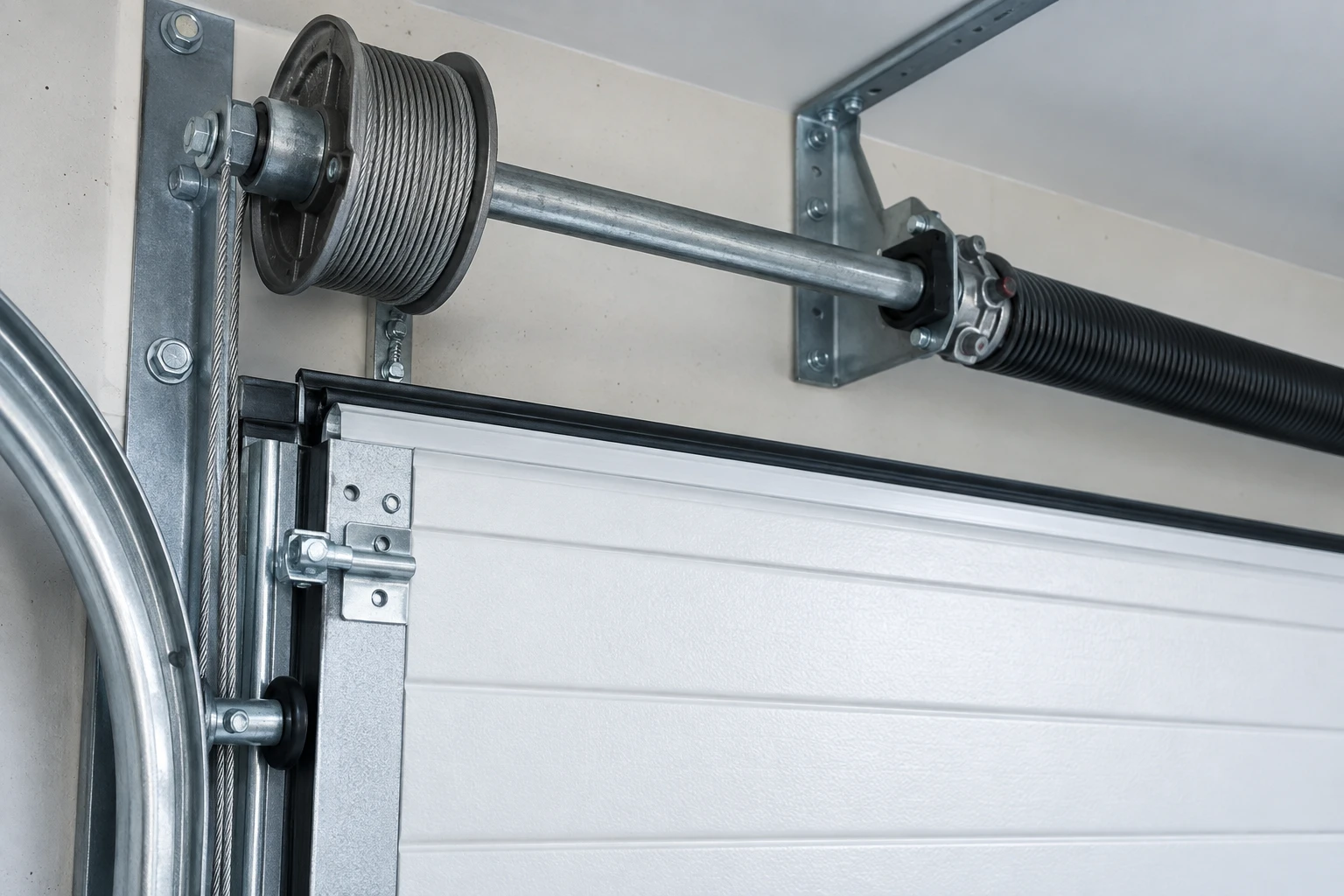
Two components on a residential door store enough energy to cause serious injury, and both of them look ordinary from the floor. The first is the torsion spring above the opening. It is wound under high tension and unwinding it without the correct bars is how people lose fingers. The second is the bottom bracket at each lower corner, because the lift cable anchors there and that bracket is under full spring load whenever the door is closed. Undoing it releases that load instantly. Everything else on a door is comparatively benign: middle and upper rollers, hinges above the bottom, seals, sensors, remotes and the opener itself can all be worked on safely by a competent owner with the door closed and the power off.
What a quote should actually contain
A quote worth accepting names the part rather than the category. On a spring it should state the wire diameter, the inside diameter, the length and the cycle rating, because those four numbers are the difference between a spring that lasts seven years and one that lasts twenty. On rollers it should state the material and whether the bearing is sealed. On an opener it should state the drive type and the horsepower. It should separate parts from labour, say what is included in the way of adjustment and testing, and be explicit about anything that is being deferred. A number on its own, with no specification attached, is not comparable to any other number and is usually the more expensive option in the end.
What moves the price on any of these jobs
Four things, in roughly this order. Door weight, because it determines the spring, the hardware grade and often the opener. Door size, because a double width door carries more hardware and more of everything. Access and headroom, because a low headroom garage needs a different track and spring configuration and takes longer. And how much of the assembly has been damaged by continuing to run the door after the first failure, which is the one variable entirely within the owner's control. A spring replacement caught early is a spring replacement. The same failure after twenty more attempts with the opener is a spring, a gear set and sometimes a section.
What is carried and what has to be ordered
Common torsion springs, lift cables, drums, bottom brackets, rollers, hinges, bearings, seals, safety sensors, remotes and wall controls are ordinary stock and rarely delay a repair. What has to be ordered is anything that must be matched or calculated to a specific door: a spring for an unusual weight, height or drum size, a section in a particular profile, a logic board for an older opener, or commercial parts specified to a duty class. It is worth knowing that in advance, because a job that needs an ordered part is better done properly on a second visit than approximated on the first.
Residential and commercial are different work
They share mechanical principles and almost nothing else in practice. A commercial opening cycles many times more often, which puts every consumable part on a much shorter schedule and makes cycle rating the central specification decision rather than an upgrade. It is driven by an operator classified by duty rather than a consumer opener, with different safety devices and a manual release that staff need to know how to use. And the cost of it being down is measured in stopped work rather than inconvenience, which is why planned maintenance genuinely pays on commercial doors and is optional on domestic ones.
Still not sure which one?
Describe the behaviour rather than the diagnosis. Whether the door moves, whether it is level, what it sounds like and where in the travel it happens will place it faster than any label.
Call (214) 271-8110Questions about booking work
I do not know what is wrong. Which service do I book?
You do not have to know. Describe what the door is doing, including whether it moves at all, whether it is level, what noise it makes and at what point in the travel, and the diagnosis happens on site. The sorting on this page is there to help you judge urgency and to arrive at the visit with the right expectations, not to make you diagnose your own door. Getting the category roughly right mainly helps in making sure the likely parts are on the vehicle.
Can I get a price over the phone?
You can get a realistic range and an honest description of what moves it, and that is worth having. What you should be suspicious of is a firm price given from a description, because the person quoting has not seen the door weight, the spring configuration, the drum size, the condition of the cables or how much collateral damage the failure caused. A number that is fixed before anyone has looked either gets revised on arrival or was padded to cover the unknowns.
Do you replace parts that do not need replacing?
The test we apply is whether the part will outlast the repair. A cable that is intact but the same age as one that has just failed will not, and replacing it now is cheaper than a second visit. A roller that is noisy but sound is a maintenance item rather than an emergency and gets flagged rather than swapped. Anything being replaced should come with a reason attached, and anything that does not yet need doing should be named as such so you can plan for it.
Is there a warranty on the work?
Parts carry their manufacturer's warranty and the labour is warranted separately. What matters more than the length of either is what the warranty is written against, because a spring warranted for a number of cycles is a meaningful commitment while a spring warranted for a period of time on an unspecified cycle rate is not. Ask for the specification of what is being fitted, and the warranty becomes something you can actually hold against it.
Do you work on doors you did not install?
Almost all of it is work on doors installed by somebody else, often a builder a decade or two ago. Sectional doors share common standards, so hardware, springs, cables, rollers and track are serviceable regardless of who fitted them. The only place origin genuinely matters is sections, because those are specific to a manufacturer's profile, and openers where a discontinued model may have parts that are no longer produced.
How quickly can someone come out?
It depends on what you are describing, and it should. A door holding weight badly, a trapped vehicle or a property that cannot be secured is treated differently from a door that is closed, safe and simply not working. When you call, say whether the door is open or closed, whether anything is trapped behind it, and whether the property is secure. Those three answers determine the priority far better than the words urgent or emergency do.
Can you service a door as maintenance rather than waiting for it to break?
Yes, and on a door used as the household's main entrance it is worth doing. A maintenance visit covers balance and spring tension, roller and hinge condition, cable and drum inspection, track alignment and fixings, seal condition, lubrication of the right components with the right product, and a full test of the opener including force settings and safety reversal. It catches the failures that are cheap now and expensive later, which is most of them.
What about electric gates?
Gates are a related but separate discipline and they are covered on their own pages. They share the general principle that the operator is usually reporting a problem rather than causing one, but the failure modes are different: posts move with the ground, the operator sits outside in full sun all year, and the safety devices stop the gate long before the motor ever does.
Brands we repair
Electric gates
Cities we cover
Test the door by hand: Garage Door Services in Dallas Fort Worth in Dallas-Fort Worth
The most useful decision follows the system, not a sales package. For Garage Door Services in Dallas Fort Worth in Dallas-Fort Worth, the local context includes a mix of property ages, operating patterns, weather exposure, shared access, and equipment histories. The working scope centers on inspection, diagnosis, scope, safe work, operational testing, and a documented handoff. Under test the door by hand, the review covers door balance, spring assistance, roller movement, hinge condition, track alignment, and resistance through the full travel. A property manager may first report that the opener rail has an uncertain service history, but that statement is a starting point rather than a diagnosis. The inspection should establish what changed, which parts still function, what can be tested safely, and what result the customer expects. A written scope also reduces surprises after work begins. Conditions across Dallas-Fort Worth influence materials, access, weather exposure, and scheduling, so the final recommendation should follow the actual property. 24/7 Dallas Garage Door Repair explains the work, records important limitations, and asks the customer to verify the finished operation before the visit closes.
The safest next step comes from controlled testing. For Garage Door Services in Dallas Fort Worth in Dallas-Fort Worth, the local context includes a mix of property ages, operating patterns, weather exposure, shared access, and equipment histories. The working scope centers on inspection, diagnosis, scope, safe work, operational testing, and a documented handoff. Under test the door by hand, the review covers door balance, spring assistance, roller movement, hinge condition, track alignment, and resistance through the full travel. A technician may first report that the bottom fixture behaves differently under load, but that statement is a starting point rather than a diagnosis. The inspection should establish what changed, which parts still function, what can be tested safely, and what result the customer expects. A complete handoff shows what changed and how to verify it. Conditions across Dallas-Fort Worth influence materials, access, weather exposure, and scheduling, so the final recommendation should follow the actual property. 24/7 Dallas Garage Door Repair explains the work, records important limitations, and asks the customer to verify the finished operation before the visit closes.
Plan for weather: Garage Door Services in Dallas Fort Worth in Dallas-Fort Worth
Clear documentation makes a technical job easier to judge. For Garage Door Services in Dallas Fort Worth in Dallas-Fort Worth, the local context includes a mix of property ages, operating patterns, weather exposure, shared access, and equipment histories. The working scope centers on inspection, diagnosis, scope, safe work, operational testing, and a documented handoff. Under plan for weather, the review covers heat, cold, wind, moisture, seal condition, material movement, lubrication needs, and exposed metal. A warehouse lead may first report that the spring shaft shows uneven wear, but that statement is a starting point rather than a diagnosis. The inspection should establish what changed, which parts still function, what can be tested safely, and what result the customer expects. The same check helps rule out work that would not solve the complaint. Conditions across Dallas-Fort Worth influence materials, access, weather exposure, and scheduling, so the final recommendation should follow the actual property. 24/7 Dallas Garage Door Repair explains the work, records important limitations, and asks the customer to verify the finished operation before the visit closes.
Every property adds a different operating pattern. For Garage Door Services in Dallas Fort Worth in Dallas-Fort Worth, the local context includes a mix of property ages, operating patterns, weather exposure, shared access, and equipment histories. The working scope centers on inspection, diagnosis, scope, safe work, operational testing, and a documented handoff. Under plan for weather, the review covers heat, cold, wind, moisture, seal condition, material movement, lubrication needs, and exposed metal. A property manager may first report that the cable drum has been exposed to moisture, but that statement is a starting point rather than a diagnosis. The inspection should establish what changed, which parts still function, what can be tested safely, and what result the customer expects. This approach keeps safety, function, and cost in the same conversation. Conditions across Dallas-Fort Worth influence materials, access, weather exposure, and scheduling, so the final recommendation should follow the actual property. 24/7 Dallas Garage Door Repair explains the work, records important limitations, and asks the customer to verify the finished operation before the visit closes.
A useful question before approving this step
Ask what observation supports the recommendation, which parts are included, which parts are outside the scope, how the result will be tested, and what documentation you will receive. Call (214) 271-8110 to describe the property and schedule work within Dallas-Fort Worth.
Explain the quote: Garage Door Services in Dallas Fort Worth in Dallas-Fort Worth
The visible symptom is only the first clue. For Garage Door Services in Dallas Fort Worth in Dallas-Fort Worth, the local context includes a mix of property ages, operating patterns, weather exposure, shared access, and equipment histories. The working scope centers on inspection, diagnosis, scope, safe work, operational testing, and a documented handoff. Under explain the quote, the review covers diagnosis, parts, labor, optional work, approval, testing, and what would change the scope. A property manager may first report that the photo-eye circuit needs a documented baseline, but that statement is a starting point rather than a diagnosis. The inspection should establish what changed, which parts still function, what can be tested safely, and what result the customer expects. The result is easier to test and easier to document. Conditions across Dallas-Fort Worth influence materials, access, weather exposure, and scheduling, so the final recommendation should follow the actual property. 24/7 Dallas Garage Door Repair explains the work, records important limitations, and asks the customer to verify the finished operation before the visit closes.
A careful scope protects both the equipment and the customer. For Garage Door Services in Dallas Fort Worth in Dallas-Fort Worth, the local context includes a mix of property ages, operating patterns, weather exposure, shared access, and equipment histories. The working scope centers on inspection, diagnosis, scope, safe work, operational testing, and a documented handoff. Under explain the quote, the review covers diagnosis, parts, labor, optional work, approval, testing, and what would change the scope. A warehouse lead may first report that the bottom fixture behaves differently under load, but that statement is a starting point rather than a diagnosis. The inspection should establish what changed, which parts still function, what can be tested safely, and what result the customer expects. It also gives the customer a clear way to compare the available options. Conditions across Dallas-Fort Worth influence materials, access, weather exposure, and scheduling, so the final recommendation should follow the actual property. 24/7 Dallas Garage Door Repair explains the work, records important limitations, and asks the customer to verify the finished operation before the visit closes.
Trace uneven movement: Garage Door Services in Dallas Fort Worth in Dallas-Fort Worth
Good service starts by separating cause from coincidence. For Garage Door Services in Dallas Fort Worth in Dallas-Fort Worth, the local context includes a mix of property ages, operating patterns, weather exposure, shared access, and equipment histories. The working scope centers on inspection, diagnosis, scope, safe work, operational testing, and a documented handoff. Under trace uneven movement, the review covers cable seating, drums, bottom fixtures, track spacing, rollers, and obstructions around the opening. A warehouse lead may first report that the sectional door serves several users, but that statement is a starting point rather than a diagnosis. The inspection should establish what changed, which parts still function, what can be tested safely, and what result the customer expects. That distinction matters when several people share responsibility for the property. Conditions across Dallas-Fort Worth influence materials, access, weather exposure, and scheduling, so the final recommendation should follow the actual property. 24/7 Dallas Garage Door Repair explains the work, records important limitations, and asks the customer to verify the finished operation before the visit closes.
Small alignment and maintenance details often explain large symptoms. For Garage Door Services in Dallas Fort Worth in Dallas-Fort Worth, the local context includes a mix of property ages, operating patterns, weather exposure, shared access, and equipment histories. The working scope centers on inspection, diagnosis, scope, safe work, operational testing, and a documented handoff. Under trace uneven movement, the review covers cable seating, drums, bottom fixtures, track spacing, rollers, and obstructions around the opening. A building owner may first report that the cable drum has been exposed to moisture, but that statement is a starting point rather than a diagnosis. The inspection should establish what changed, which parts still function, what can be tested safely, and what result the customer expects. That sequence keeps the recommendation tied to evidence. Conditions across Dallas-Fort Worth influence materials, access, weather exposure, and scheduling, so the final recommendation should follow the actual property. 24/7 Dallas Garage Door Repair explains the work, records important limitations, and asks the customer to verify the finished operation before the visit closes.
Review everyday use: Garage Door Services in Dallas Fort Worth in Dallas-Fort Worth
Small alignment and maintenance details often explain large symptoms. For Garage Door Services in Dallas Fort Worth in Dallas-Fort Worth, the local context includes a mix of property ages, operating patterns, weather exposure, shared access, and equipment histories. The working scope centers on inspection, diagnosis, scope, safe work, operational testing, and a documented handoff. Under review everyday use, the review covers vehicles, storage, children, pets, deliveries, work schedules, noise, and the need for backup entry. A property manager may first report that the photo-eye circuit needs a documented baseline, but that statement is a starting point rather than a diagnosis. The inspection should establish what changed, which parts still function, what can be tested safely, and what result the customer expects. That sequence keeps the recommendation tied to evidence. Conditions across Dallas-Fort Worth influence materials, access, weather exposure, and scheduling, so the final recommendation should follow the actual property. 24/7 Dallas Garage Door Repair explains the work, records important limitations, and asks the customer to verify the finished operation before the visit closes.
Good service starts by separating cause from coincidence. For Garage Door Services in Dallas Fort Worth in Dallas-Fort Worth, the local context includes a mix of property ages, operating patterns, weather exposure, shared access, and equipment histories. The working scope centers on inspection, diagnosis, scope, safe work, operational testing, and a documented handoff. Under review everyday use, the review covers vehicles, storage, children, pets, deliveries, work schedules, noise, and the need for backup entry. A technician may first report that the spring shaft shows uneven wear, but that statement is a starting point rather than a diagnosis. The inspection should establish what changed, which parts still function, what can be tested safely, and what result the customer expects. That distinction matters when several people share responsibility for the property. Conditions across Dallas-Fort Worth influence materials, access, weather exposure, and scheduling, so the final recommendation should follow the actual property. 24/7 Dallas Garage Door Repair explains the work, records important limitations, and asks the customer to verify the finished operation before the visit closes.
A useful question before approving this step
Ask what observation supports the recommendation, which parts are included, which parts are outside the scope, how the result will be tested, and what documentation you will receive. Call (214) 271-8110 to describe the property and schedule work within Dallas-Fort Worth.
Separate door and opener: Garage Door Services in Dallas Fort Worth in Dallas-Fort Worth
A careful scope protects both the equipment and the customer. For Garage Door Services in Dallas Fort Worth in Dallas-Fort Worth, the local context includes a mix of property ages, operating patterns, weather exposure, shared access, and equipment histories. The working scope centers on inspection, diagnosis, scope, safe work, operational testing, and a documented handoff. Under separate door and opener, the review covers manual movement, trolley release, motor effort, travel settings, force settings, and the symptom that started the call. A homeowner may first report that the spring shaft shows uneven wear, but that statement is a starting point rather than a diagnosis. The inspection should establish what changed, which parts still function, what can be tested safely, and what result the customer expects. It also gives the customer a clear way to compare the available options. Conditions across Dallas-Fort Worth influence materials, access, weather exposure, and scheduling, so the final recommendation should follow the actual property. 24/7 Dallas Garage Door Repair explains the work, records important limitations, and asks the customer to verify the finished operation before the visit closes.
Every property adds a different operating pattern. For Garage Door Services in Dallas Fort Worth in Dallas-Fort Worth, the local context includes a mix of property ages, operating patterns, weather exposure, shared access, and equipment histories. The working scope centers on inspection, diagnosis, scope, safe work, operational testing, and a documented handoff. Under separate door and opener, the review covers manual movement, trolley release, motor effort, travel settings, force settings, and the symptom that started the call. A installer may first report that the opener rail has an uncertain service history, but that statement is a starting point rather than a diagnosis. The inspection should establish what changed, which parts still function, what can be tested safely, and what result the customer expects. This approach keeps safety, function, and cost in the same conversation. Conditions across Dallas-Fort Worth influence materials, access, weather exposure, and scheduling, so the final recommendation should follow the actual property. 24/7 Dallas Garage Door Repair explains the work, records important limitations, and asks the customer to verify the finished operation before the visit closes.
Match parts to the door: Garage Door Services in Dallas Fort Worth in Dallas-Fort Worth
Every property adds a different operating pattern. For Garage Door Services in Dallas Fort Worth in Dallas-Fort Worth, the local context includes a mix of property ages, operating patterns, weather exposure, shared access, and equipment histories. The working scope centers on inspection, diagnosis, scope, safe work, operational testing, and a documented handoff. Under match parts to the door, the review covers weight, height, track radius, headroom, shaft layout, manufacturer details, and compatible replacement hardware. A building owner may first report that the opener rail has an uncertain service history, but that statement is a starting point rather than a diagnosis. The inspection should establish what changed, which parts still function, what can be tested safely, and what result the customer expects. This approach keeps safety, function, and cost in the same conversation. Conditions across Dallas-Fort Worth influence materials, access, weather exposure, and scheduling, so the final recommendation should follow the actual property. 24/7 Dallas Garage Door Repair explains the work, records important limitations, and asks the customer to verify the finished operation before the visit closes.
Clear documentation makes a technical job easier to judge. For Garage Door Services in Dallas Fort Worth in Dallas-Fort Worth, the local context includes a mix of property ages, operating patterns, weather exposure, shared access, and equipment histories. The working scope centers on inspection, diagnosis, scope, safe work, operational testing, and a documented handoff. Under match parts to the door, the review covers weight, height, track radius, headroom, shaft layout, manufacturer details, and compatible replacement hardware. A homeowner may first report that the sectional door serves several users, but that statement is a starting point rather than a diagnosis. The inspection should establish what changed, which parts still function, what can be tested safely, and what result the customer expects. The same check helps rule out work that would not solve the complaint. Conditions across Dallas-Fort Worth influence materials, access, weather exposure, and scheduling, so the final recommendation should follow the actual property. 24/7 Dallas Garage Door Repair explains the work, records important limitations, and asks the customer to verify the finished operation before the visit closes.