Short answer
A garage door that has come down crooked, with one corner high and a triangle of daylight at the other, has almost always lost a cable off its drum. Do not run the opener again. Every further cycle drags the door harder into the track and turns a cable job into a section job. Leave the door where it is, keep people and vehicles out from under it, and have the drums and cables looked at before anything is forced back into place.
What the job actually is
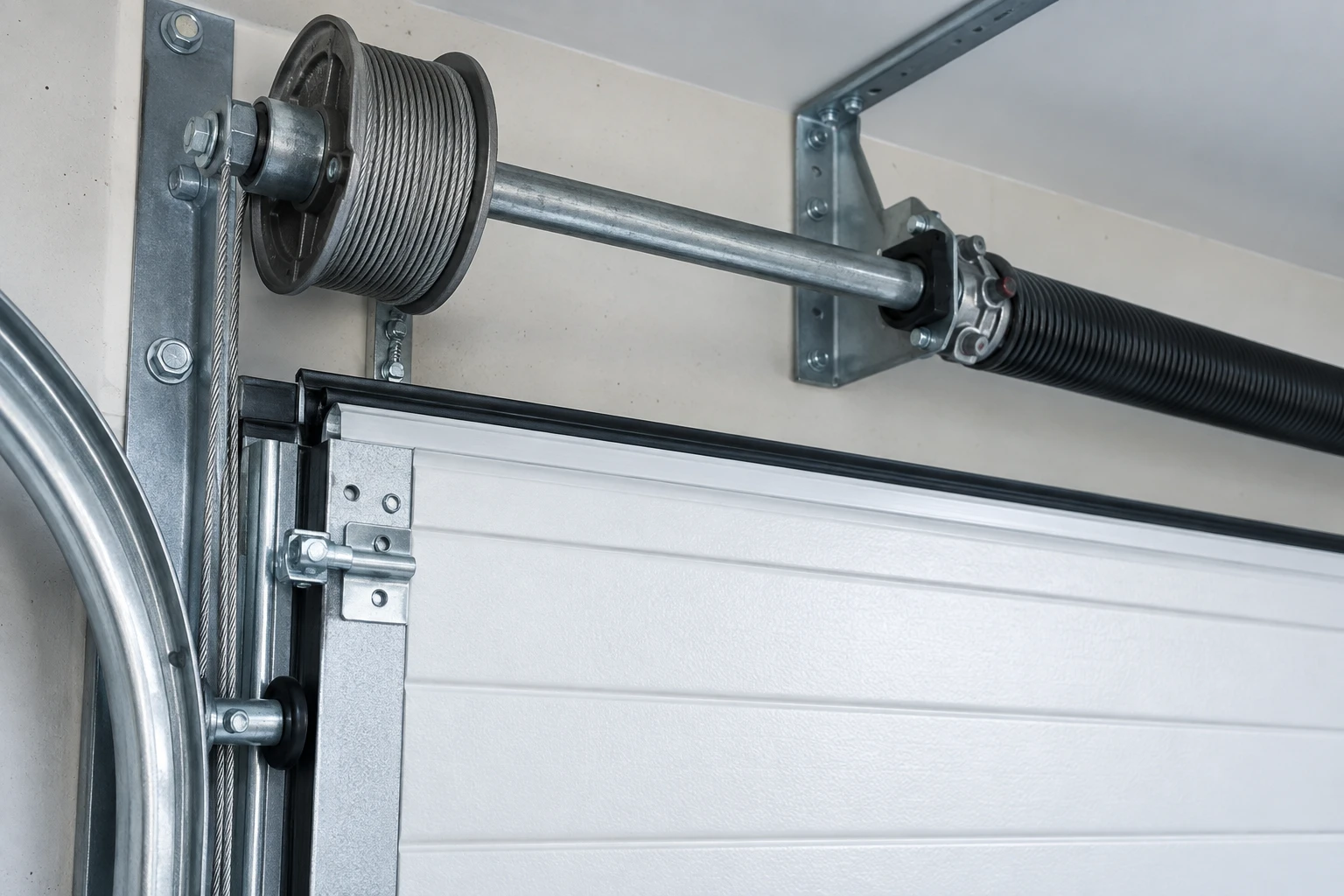
The lift cables are the link between the spring system and the door itself. On a torsion setup a steel cable runs from a fitting at the bottom bracket of each side of the door, up the side of the opening, and winds onto a grooved drum at either end of the shaft. As the spring unwinds it turns the shaft, the drums turn with it, and the cable wraps into the grooves and pulls that corner of the door upward. The two sides have to wind at exactly the same rate or the door goes up out of level. An extension system does the job with cables running over pulleys instead, but the requirement is identical. The cable carries load that the spring generates, and it is sized to that load. This is why the failure mode is so abrupt. A cable does not sag or slip gradually. It holds, and then it does not, and the corner it was holding drops.
What makes this different in Dallas Fort Worth
The single biggest local contributor across the metroplex is ground movement. The clay soils under Dallas, Garland, Mesquite, Rowlett and out through Rockwall and Forney swell in wet months and shrink hard in dry ones, and the slab and framing move with them. An opening that was square when the door went in stops being square. When the two sides of an opening are no longer the same height, the door reaches the floor on one side before the other, that side stops taking tension while the drum keeps turning, and the slack that creates is what lets a wrap jump the groove. Older garages in East Dallas and Oak Cliff with alley entry add a second factor, because the approach is tight and doors get clipped by mirrors and bumpers more often than owners admit. Newer construction north through Frisco, Prosper and Celina brings a different version of the same problem: heavy insulated doors on builder specification hardware, where the drums are working closer to their limit and have less margin for a slab that has shifted an inch.
Warning signs
The obvious one is a door sitting visibly crooked, with a wedge of light along the bottom on one side. Before that point there are quieter signs. A cable that has begun to fray shows broken filaments standing out from the strand, usually near the bottom fitting where water and grit collect. Rust staining down the inside of the jamb below the cable line points at the same place. A cable that has come loose but not fully unwrapped will hang slack against the track while the door is open. You may hear a slap or a snap from one side as the door starts to move, which is a wrap dropping into the wrong groove. A door that has begun to shudder or judder on one side as it travels, rather than moving smoothly, is often being pulled unevenly by a drum that has lost a wrap. And a door that will not seat flat on the floor, leaving a consistent gap at one end no matter how the opener limits are set, has a cable length difference rather than a limit problem.
What actually causes it
Cables fail at the point where they are wet longest, which is the bottom fitting sitting against a concrete floor. A worn bottom seal lets water track under the door and stand there, and the strand corrodes from the inside where you cannot see it. That is the ordinary end of a cable's life. The rest of the causes are about slack. Anything that lets the door reach the ground while the drum is still turning creates the slack that lets a wrap escape: an out of square opening, a floor that is no longer level, an opener travel limit set too far down, an obstruction under one side of the door, or a spring that has lost tension so the door lands harder and faster than it should. Drums matter too. A drum with a worn or damaged groove will not hold a wrap cleanly. A set screw that has loosened on the shaft lets one drum rotate independently of the other, which produces exactly the crooked door people describe. And a cable of the wrong length or diameter fitted during an earlier repair will fight the drum for the life of the installation.
What the visit looks like
Nothing gets operated and the door is not forced. The first job is to work out whether the door is off track, off cable, or both, because they need different handling. The door is supported and secured so that no stored energy in the spring can move it while hands are near the drums. If the door has come out of the track, the rollers are walked back into the track rather than levered, and each section is checked for the crease that happens when a door folds against a track edge. The bottom brackets are inspected before any cable is touched, since they sit under load and a corroded bracket is not safe to reuse. Cables are replaced in pairs, matched to the door height and drum size, and seated wrap by wrap so that both drums carry the same number of turns. Drum set screws are torqued onto a clean flat on the shaft. Then the spring tension is checked against the actual door rather than assumed, because a door that has been landing hard has often been running on a spring that had already weakened. The door is cycled by hand through full travel and checked for level at several heights before the opener is reconnected, and the opener limits and force settings are then reset to the corrected travel.
The parts that matter
The parts list is short and the sizing is not negotiable. Lift cables are specified by diameter, by length matched to door height, and by the fitting at each end. Drums are specified by the door height they are rated for, which is why a standard drum on a door taller than seven feet is a mistake that shows up as a cable coming off within months. Bottom brackets carry the cable fitting and are under constant tension, so they are replaced rather than reused when corroded. Above them sit the shaft, centre bearing plate and end bearings, and a seized bearing is a common hidden cause of uneven winding. The track itself is part of this repair more often than people expect: a bent vertical track, a flattened radius at the curve, or a loose track bracket will keep pulling the door out of line no matter how well the cables are fitted. Rollers get replaced at the same time in most cases, because a door that has been off track has usually damaged several stems. On extension systems the pulleys, pulley forks and safety containment cables are inspected as part of the same job.
Before you call, what to check
- Do not run the opener to straighten itThe instinct is to press the button and let the motor pull the door level. It does the opposite. The opener has no way to know the door is jammed, so it forces the high corner further while the low corner stays put, and the section between them folds. That fold is permanent, and it turns a two cable repair into a panel replacement.
- Look at the bottom corners, not the middleStand inside and look at the bottom bracket on each side of the door. That is where the cable attaches and it is where the failure will be visible. You are looking for a cable hanging loose, a cable with broken strands standing proud, or a bracket that has pulled away from the section. If you see rust running down the wall below the bracket, the cable has been wet for a long time.
- Clear the area under the door and leave it aloneA door held up by one cable is holding by something that was never designed to carry the whole load alone. It can let go without warning. Move vehicles out from under it if that can be done safely from the side, keep children and pets out of the garage, and do not park under a door that is sitting crooked, even overnight.
- Do not pull the release cord on a crooked doorThe red emergency release disconnects the trolley so the door can be moved by hand. On a door that is off cable or off track, releasing it removes the only thing currently holding the high side and the door can drop or twist further. If the door is already open and crooked, leave the opener engaged and leave the door open.
- Note whether it happened on the way up or the way downIt is worth remembering and worth mentioning. A cable that came off on the way down usually points at slack from the door landing before the drum stopped, which means limits, springs or a floor that is no longer level. A cable that failed on the way up points at the cable itself or at the drum. It changes what gets checked first.
Repair or replace
Repair
Cables and drums are consumable hardware and replacing them is straightforward on a door that is otherwise sound. The question worth asking is why they came off, because fitting new cables without answering that puts the same failure back on the calendar. If the cause was corrosion at the bottom fitting, the bottom seal and the floor drainage need attention at the same time or the new cable rusts the same way. If the cause was slack from an opening that has moved, the track needs shimming back to plumb and the opener limits reset, and that is part of the repair rather than an extra. If a drum groove is worn or a set screw has been chewing the shaft, replacing the pair of drums is cheap next to doing this again. On a door with one cable failed from age, the other is the same age and comes off too.
Replace
What moves this toward a new door is damage the cable failure caused rather than the cable itself. A door that came fully off track and folded across two or more sections is usually past economic repair, because replacement sections have to be sourced to match a profile that may no longer be made and the door will never sit quite as true again. Rust that has eaten through the bottom section around the bracket is structural, and a bracket bolted to compromised steel is not something to put back under tension. A vertical track that has been bent and straightened more than once has lost its shape and will keep pushing rollers out. And if the door has come off track repeatedly at the same corner while the opening itself has moved with the slab, the honest answer may be that the opening needs framing work before any door will run right in it.
What it costs
Nothing is quoted over the phone on a guess. What follows is what actually moves the number.
| Job | What it covers | What pushes it up |
|---|---|---|
| Lift cable replacement, pair | cables are always replaced as a matched pair | door height, cable diameter and fitting type, condition of the bottom brackets |
| Cable drum replacement | worn or damaged grooves will not hold a wrap | door height rating required, shaft condition, whether set screws have marked the shaft |
| Door reset onto track after coming off | walking rollers back and re aligning | how far the door travelled off track, number of sections affected, roller damage |
| Bottom bracket replacement | replaced rather than reused when corroded | one bracket or both, condition of the section steel behind it |
| Vertical track straightening or replacement | bent track keeps pushing rollers out | one side or both, whether the radius curve is affected, bracket condition |
| Bearing and shaft work found during a cable job | seized bearings cause uneven winding | number of bearings, centre plate condition, shaft straightness |
Need this looked at?
Describe what the door is doing and you will get a straight read on what is likely wrong, whether it is safe to leave until tomorrow, and what the repair involves.
Call (214) 271-8110Questions we get asked
My garage door is hanging crooked with a gap at one corner. Is it safe to leave it like that?
It is safer to leave it than to keep operating it, but it is not safe to be under it. One side is carrying load that was shared between two, and a door in that state can move without warning. Keep the area under and around it clear, do not park beneath it, and do not press the button again to see whether it will straighten out. If a vehicle is trapped inside, say so when you call, because the door can usually be secured and raised by hand on site before any parts work starts.
Can I put the cable back on the drum myself?
The drum is on a shaft under spring tension, and that tension is what makes this dangerous rather than fiddly. Winding a cable back on means working directly beside a component storing enough energy to break a hand. On top of that, getting the wrap count wrong on one side puts the door back out of level immediately, and set screws torqued onto a shaft that is already marked will slip again. It is a job that looks simple from the floor and is not.
Why did both cables need replacing when only one came off?
They are the same age, they have run the same number of cycles, and they have lived in the same damp corner of the same garage. A cable does not give much warning before it goes, so the strand that is still intact is not evidence that it is sound. Replacing the pair also means both sides start with identical length and identical wrap, which is what keeps the door level. Fitting one new cable against one aged cable is the most common reason a door comes back out of level within weeks.
The door goes up fine but lands with a bang and a gap on one side. Is that a cable problem?
It is usually the beginning of one. Landing hard means the door is arriving under its own weight rather than being lowered under control, which almost always means the spring has weakened. The bang creates slack in the cable at the moment of impact, and slack is what lets a wrap jump the groove. So the gap on one side is the symptom, the loose wrap is the mechanism, and the tired spring is the cause. Fixing only the cable leaves the cause in place.
How long should garage door cables last?
On a dry floor with a sound bottom seal, cables commonly outlast the first set of springs and often the second. What kills them early is standing water. A garage that takes water under the door in heavy Dallas rain, or a bottom seal that has hardened and cracked in the summer heat, keeps the lower few inches of cable wet, and that is where they part. If the floor slopes toward the door or the driveway drains back into the garage, the cables are on a much shorter clock than the specification suggests.
The opener struggles and the door shudders on one side. Cable or opener?
Disconnect the opener with the door fully closed and lift the door by hand. If it rises smoothly and evenly and holds where you leave it, the problem is in the opener. If it lifts unevenly, feels heavy, or drags on one side, the opener is only reporting a problem that lives in the cables, drums, springs or track. Testing it this way before anything is replaced avoids paying for a motor that was never at fault.
Does the ground movement in Dallas really cause this, or is that just something people say?
It is measurable rather than folklore. Expansive clay swells and shrinks with moisture, and the movement transfers into the slab and the framing around the opening. Once one side of the opening sits lower than the other, the door reaches the floor unevenly on every single cycle, and each of those cycles creates a moment of slack on the side that lands first. It is a slow mechanism, which is why it shows up as a cable that comes off after years rather than after a storm, and why the same houses on the same street tend to have the same problem.
The door came off track once and I got it back on. Should I still have it looked at?
Yes, for two reasons. The first is that the door almost certainly did not come off for no reason, and whatever caused it is still there. The second is that a door that has been off and put back is very often running on bent roller stems, a flattened section of track, or a bottom bracket that has been pulled. Those do not announce themselves. They wait, and then the door comes off again, usually harder, and usually with a folded section the second time.
Other garage door work we do
Brands we repair
Electric gates
Cities we cover
Match parts to the door: Garage Door Cable and Off Track Repair in Dallas Fort Worth in Dallas-Fort Worth
Every property adds a different operating pattern. For Garage Door Cable and Off Track Repair in Dallas Fort Worth in Dallas-Fort Worth, the local context includes a mix of property ages, operating patterns, weather exposure, shared access, and equipment histories. The working scope centers on inspection, diagnosis, scope, safe work, operational testing, and a documented handoff. Under match parts to the door, the review covers weight, height, track radius, headroom, shaft layout, manufacturer details, and compatible replacement hardware. A building owner may first report that the cable drum has been exposed to moisture, but that statement is a starting point rather than a diagnosis. The inspection should establish what changed, which parts still function, what can be tested safely, and what result the customer expects. This approach keeps safety, function, and cost in the same conversation. Conditions across Dallas-Fort Worth influence materials, access, weather exposure, and scheduling, so the final recommendation should follow the actual property. 24/7 Dallas Garage Door Repair explains the work, records important limitations, and asks the customer to verify the finished operation before the visit closes.
Good service starts by separating cause from coincidence. For Garage Door Cable and Off Track Repair in Dallas Fort Worth in Dallas-Fort Worth, the local context includes a mix of property ages, operating patterns, weather exposure, shared access, and equipment histories. The working scope centers on inspection, diagnosis, scope, safe work, operational testing, and a documented handoff. Under match parts to the door, the review covers weight, height, track radius, headroom, shaft layout, manufacturer details, and compatible replacement hardware. A homeowner may first report that the spring shaft shows uneven wear, but that statement is a starting point rather than a diagnosis. The inspection should establish what changed, which parts still function, what can be tested safely, and what result the customer expects. That distinction matters when several people share responsibility for the property. Conditions across Dallas-Fort Worth influence materials, access, weather exposure, and scheduling, so the final recommendation should follow the actual property. 24/7 Dallas Garage Door Repair explains the work, records important limitations, and asks the customer to verify the finished operation before the visit closes.
Complete the handoff: Garage Door Cable and Off Track Repair in Dallas Fort Worth in Dallas-Fort Worth
The safest next step comes from controlled testing. For Garage Door Cable and Off Track Repair in Dallas Fort Worth in Dallas-Fort Worth, the local context includes a mix of property ages, operating patterns, weather exposure, shared access, and equipment histories. The working scope centers on inspection, diagnosis, scope, safe work, operational testing, and a documented handoff. Under complete the handoff, the review covers manual release, remote controls, keypad access, safety tests, maintenance notes, and ownership of connected accounts. A homeowner may first report that the bottom fixture behaves differently under load, but that statement is a starting point rather than a diagnosis. The inspection should establish what changed, which parts still function, what can be tested safely, and what result the customer expects. A complete handoff shows what changed and how to verify it. Conditions across Dallas-Fort Worth influence materials, access, weather exposure, and scheduling, so the final recommendation should follow the actual property. 24/7 Dallas Garage Door Repair explains the work, records important limitations, and asks the customer to verify the finished operation before the visit closes.
The visible symptom is only the first clue. For Garage Door Cable and Off Track Repair in Dallas Fort Worth in Dallas-Fort Worth, the local context includes a mix of property ages, operating patterns, weather exposure, shared access, and equipment histories. The working scope centers on inspection, diagnosis, scope, safe work, operational testing, and a documented handoff. Under complete the handoff, the review covers manual release, remote controls, keypad access, safety tests, maintenance notes, and ownership of connected accounts. A installer may first report that the opener rail has an uncertain service history, but that statement is a starting point rather than a diagnosis. The inspection should establish what changed, which parts still function, what can be tested safely, and what result the customer expects. The result is easier to test and easier to document. Conditions across Dallas-Fort Worth influence materials, access, weather exposure, and scheduling, so the final recommendation should follow the actual property. 24/7 Dallas Garage Door Repair explains the work, records important limitations, and asks the customer to verify the finished operation before the visit closes.
A useful question before approving this step
Ask what observation supports the recommendation, which parts are included, which parts are outside the scope, how the result will be tested, and what documentation you will receive. Call (214) 271-8110 to describe the property and schedule work within Dallas-Fort Worth.
Check safety reversal: Garage Door Cable and Off Track Repair in Dallas Fort Worth in Dallas-Fort Worth
Small alignment and maintenance details often explain large symptoms. For Garage Door Cable and Off Track Repair in Dallas Fort Worth in Dallas-Fort Worth, the local context includes a mix of property ages, operating patterns, weather exposure, shared access, and equipment histories. The working scope centers on inspection, diagnosis, scope, safe work, operational testing, and a documented handoff. Under check safety reversal, the review covers photo-eye position, wiring, obstruction response, closing force, travel limits, and testing after adjustment. A building owner may first report that the photo-eye circuit needs a documented baseline, but that statement is a starting point rather than a diagnosis. The inspection should establish what changed, which parts still function, what can be tested safely, and what result the customer expects. That sequence keeps the recommendation tied to evidence. Conditions across Dallas-Fort Worth influence materials, access, weather exposure, and scheduling, so the final recommendation should follow the actual property. 24/7 Dallas Garage Door Repair explains the work, records important limitations, and asks the customer to verify the finished operation before the visit closes.
A reliable plan begins with a physical check. For Garage Door Cable and Off Track Repair in Dallas Fort Worth in Dallas-Fort Worth, the local context includes a mix of property ages, operating patterns, weather exposure, shared access, and equipment histories. The working scope centers on inspection, diagnosis, scope, safe work, operational testing, and a documented handoff. Under check safety reversal, the review covers photo-eye position, wiring, obstruction response, closing force, travel limits, and testing after adjustment. A technician may first report that the bottom fixture behaves differently under load, but that statement is a starting point rather than a diagnosis. The inspection should establish what changed, which parts still function, what can be tested safely, and what result the customer expects. This prevents one worn part from hiding a larger operating problem. Conditions across Dallas-Fort Worth influence materials, access, weather exposure, and scheduling, so the final recommendation should follow the actual property. 24/7 Dallas Garage Door Repair explains the work, records important limitations, and asks the customer to verify the finished operation before the visit closes.
Protect panels and hardware: Garage Door Cable and Off Track Repair in Dallas Fort Worth in Dallas-Fort Worth
A careful scope protects both the equipment and the customer. For Garage Door Cable and Off Track Repair in Dallas Fort Worth in Dallas-Fort Worth, the local context includes a mix of property ages, operating patterns, weather exposure, shared access, and equipment histories. The working scope centers on inspection, diagnosis, scope, safe work, operational testing, and a documented handoff. Under protect panels and hardware, the review covers cracks, loose hinges, roller stems, fasteners, struts, weather seal, and early signs of fatigue. A homeowner may first report that the sectional door serves several users, but that statement is a starting point rather than a diagnosis. The inspection should establish what changed, which parts still function, what can be tested safely, and what result the customer expects. It also gives the customer a clear way to compare the available options. Conditions across Dallas-Fort Worth influence materials, access, weather exposure, and scheduling, so the final recommendation should follow the actual property. 24/7 Dallas Garage Door Repair explains the work, records important limitations, and asks the customer to verify the finished operation before the visit closes.
The final test matters as much as the first inspection. For Garage Door Cable and Off Track Repair in Dallas Fort Worth in Dallas-Fort Worth, the local context includes a mix of property ages, operating patterns, weather exposure, shared access, and equipment histories. The working scope centers on inspection, diagnosis, scope, safe work, operational testing, and a documented handoff. Under protect panels and hardware, the review covers cracks, loose hinges, roller stems, fasteners, struts, weather seal, and early signs of fatigue. A property manager may first report that the cable drum has been exposed to moisture, but that statement is a starting point rather than a diagnosis. The inspection should establish what changed, which parts still function, what can be tested safely, and what result the customer expects. The technician can then explain what belongs in the current job and what can wait. Conditions across Dallas-Fort Worth influence materials, access, weather exposure, and scheduling, so the final recommendation should follow the actual property. 24/7 Dallas Garage Door Repair explains the work, records important limitations, and asks the customer to verify the finished operation before the visit closes.