Short answer
A damaged section is one of the few garage door problems where the right answer genuinely depends on the door rather than on the damage. Some sections can be swapped in an afternoon. Others belong to a profile that stopped being made a decade ago, and hunting one down costs more than a new door. The first thing worth establishing is not how bad it looks. It is whether the panel can still be sourced.
What the job actually is
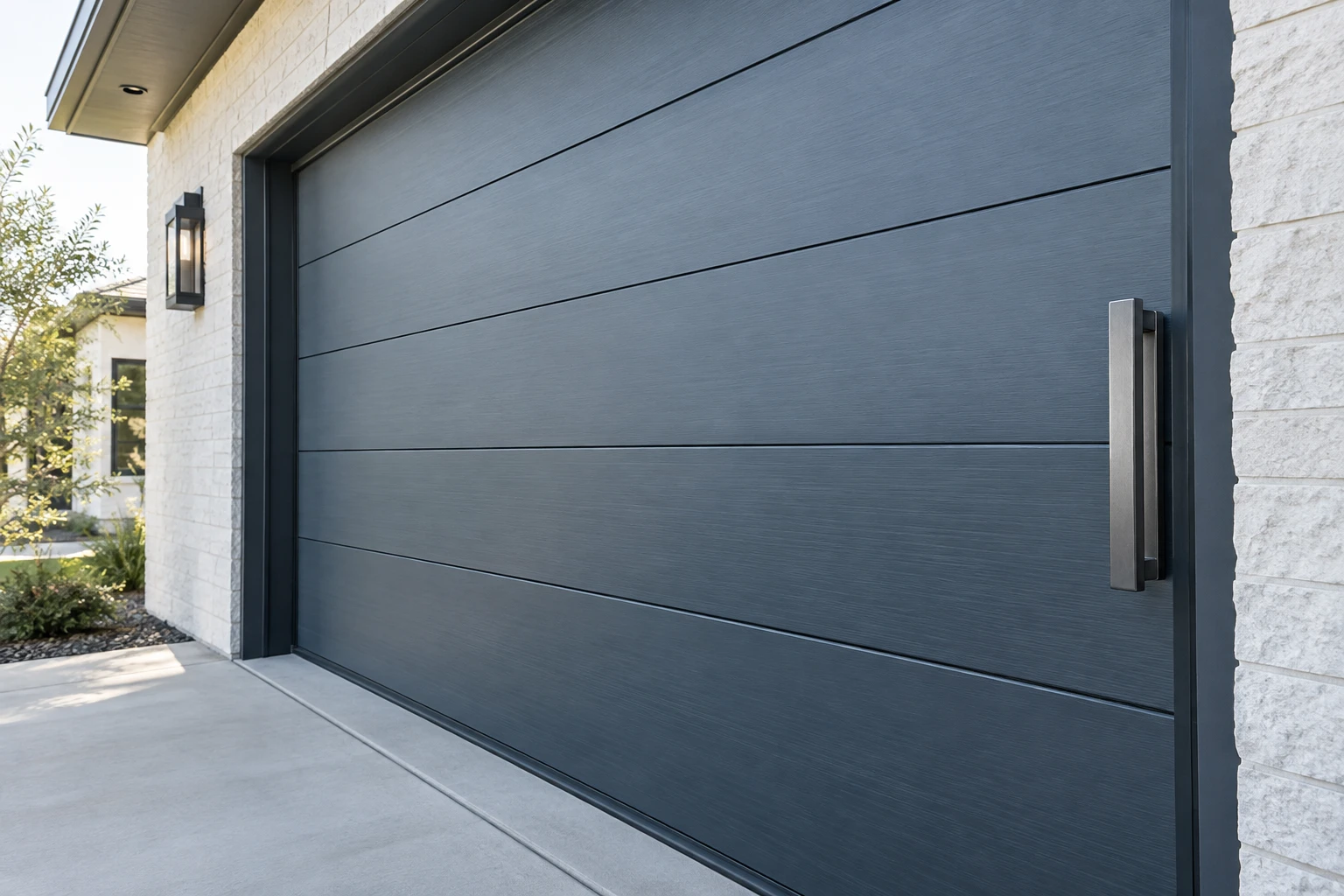
A sectional door is not one object. It is four, five or six horizontal panels bolted to each other through hinges, and each one is a self contained unit with its own end stiles, its own hinge positions and its own skin. That construction is what allows a single damaged panel to be replaced without touching the rest. It is also what makes matching so unforgiving. The replacement has to share the profile stamped into the steel, the gauge of that steel, the height of the section, the finish, the insulation construction if there is any, and the hinge positions along its top and bottom edges. Miss any one of those and the door either does not bolt together or does not sit flat. Panels are numbered from the bottom up, and position matters, because the bottom section carries the bottom brackets and the cable fittings and is built differently from the ones above it. The top section carries the opener bracket and is reinforced differently again.
What makes this different in Dallas Fort Worth
North Texas damages garage doors in ways that other regions do not, and hail is the reason. A single storm across Denton, Argyle, Wylie or Rockwall can dent every south and west facing door on a street in a few minutes, and because a garage door is a large flat sheet of thin steel it shows hail more clearly than a roof does. That produces a very specific local pattern: cosmetic damage across several panels at once, with no functional problem at all, and an insurance conversation attached to it. Vehicle impact is the other pattern, concentrated in the older alley entry garages of East Dallas, Oak Cliff and the parts of Garland and Mesquite built when cars were narrower. Then there is the sourcing problem, which is specific to the metroplex because of how fast it was built. The subdivisions that went up through Frisco, McKinney, Little Elm and Prosper in the two thousands were fitted with builder grade doors in profiles that manufacturers have since retired. Ten to twenty years later those doors need one panel, and the panel does not exist any more.
Warning signs
Most section damage announces itself visually and needs no diagnosis. What is worth looking at is whether the damage is cosmetic or structural, because they lead to completely different decisions. Cosmetic means dents in the face of the panel with the end stiles straight, the hinge lines flat and the door still running true. Structural means anything that has changed the shape of the section rather than the surface of it. Look along the bottom edge of a closed door from the side: a section that is bowed, so the middle stands proud of the ends, is no longer straight and will push its rollers out of the track. Look at the end stiles where the hinges bolt on, and at the steel around each fixing, for tearing or elongation. Rust is its own signal and it starts at the bottom section, where the seal has failed and water has stood against bare steel, and by the time it is visible from outside it has usually been working from the inside for a long time. Gaps opening between two sections along the hinge line, with the hinges themselves sound, means one of the two sections has deformed.
What actually causes it
Impact accounts for most of it, and the two sources are vehicles and weather. A car reversing into a closed door concentrates its force into a small area and typically folds one or two sections around the point of contact. Hail spreads much smaller impacts across the whole face and rarely affects function. The third cause is the door being operated while something was wrong elsewhere, and this is the one people are surprised by. A door with a broken spring, a cable off its drum, or a roller that has left the track will fold a section if the opener keeps pulling, because the motor applies force to a door that is no longer clear to move. That is why a fold in the middle of a door is so often the second failure rather than the first. Rust is the slow cause, and it is almost always the bottom section, driven by a failed bottom seal, a floor that drains toward the door, or a garage that stays damp. Fatigue around fixings is the quiet one, where years of a heavy door on light gauge steel gradually tear the metal around hinge screws until the panel can no longer hold them.
What the visit looks like
The first task is identification, and it happens before any quoting is possible. The manufacturer, the series, the profile, the section height, the gauge and the construction have to be established from what is actually on the door rather than from what it resembles, which usually means finding the label inside the end stile or the bottom section. Then availability is checked, because that answer determines everything that follows. If the section is available, the door is secured and the spring tension released in a controlled way before anything is unbolted, since the door has to be supported once it is opened up. The damaged section is unbolted from the hinges above and below, drawn out, and the replacement fitted with attention to hinge positions and fastener locations, using the correct numbered hinges rather than whatever came off. If the damaged section is the bottom one, the bottom brackets and cable fittings transfer across and are inspected rather than assumed. With the new section in, the door is checked for straightness across its width and for flatness against the floor, the spring is re tensioned to the door's actual weight, and the door is cycled by hand before the opener is reconnected and its limits reset.
The parts that matter
The section itself is the main part and the one that is either simple or impossible. Alongside it, the hinges either side of the replacement are commonly changed, because the old ones have been carrying a damaged panel and have usually taken side load. If the bottom section is involved, the bottom brackets, the bottom seal and its retainer are part of the job, and so is a fresh look at the lift cable fittings that anchor there. If the top section is involved, the opener bracket and the reinforcement strut behind it come into it, and a top section on a door driven by an opener normally needs a strut whether or not one was there before. Struts matter more than their price suggests: a horizontal strut across the back of a section is what stops a wide door bowing, and many builder grade doors were fitted with fewer than they needed. Where a matching section cannot be found, the alternatives are a compatible section from another series accepting a visible difference in profile, a full door in the same opening, or in some cases replacing several sections to restore a consistent appearance.
Before you call, what to check
- Find the label before you do anything elseOpen the door and look at the inside of the end stile, and along the inside of the bottom section, for a printed or stamped label. It carries the manufacturer and usually a series or model number. Photograph it. That single piece of information decides whether this is a panel swap or a new door conversation, and without it everything else is guesswork.
- Photograph the whole door, not just the damageA close up of a dent does not identify a profile. What identifies it is a straight on photograph of the full door from a few paces back in daylight, showing the pattern pressed into every section, plus a photo of the inside showing the construction and the hinge positions. Those three images answer most of the sourcing question before anyone drives out.
- Check whether the door still runs before you stop using itThere is a real difference between a door that is dented and a door that is bent. Run it once, watching from inside, and note whether it travels smoothly and seats flat. A door that is only cosmetically damaged can usually keep working while a section is sourced, which can take time. A door that catches, or that has a section bowing out of the track, should be left closed.
- Do not try to hammer a dent outGarage door steel is thin and it is formed, not flat, and the shape is what gives it stiffness. Working a dent from behind stretches the metal, and stretched metal will not go back to the original plane. What you get is a bulge in place of a dent and a panel that no longer sits true. It also removes the option of an insurance assessment on a panel in its original damaged state.
- If a car hit the door, check the track and the bottom bracket tooImpact travels. A section that has taken a hit from a vehicle has usually pushed the vertical track back at the same height, and often pulled a hinge or bent a roller stem. Replacing the panel and leaving a bent track means the new panel starts binding immediately. Look along the track from below to see whether it is still straight.
Repair or replace
Repair
Replacing a section is the right call when the door is otherwise sound and the panel can be sourced in a genuine match. That is most common on doors from the last several years, on doors from manufacturers with long production runs, and on doors where the damage is confined to one section. It is also the right call where matching matters less than function, such as a detached garage or a rear alley door, in which case a compatible section that is close rather than identical does the job at much lower cost. If only the bottom section has rusted and the rest of the door is healthy, replacing it along with the seal and the brackets is a genuinely economical repair, and it removes the cause rather than the symptom.
Replace
The economics turn at the point where sourcing becomes the expensive part. A discontinued profile means either a long search, a premium price, or a visible mismatch, and once the cost of one panel approaches half the cost of a door there is little argument for it. Two or more damaged sections almost always crosses that line, because the labour is nearly the same as an installation and the parts are most of the cost of a new door. A door that has folded across its width after coming off track will never sit quite true again even rebuilt. Rust that has gone through the bottom section and up into the second is structural. And there is a case that has nothing to do with damage: if the door is old enough that its sections are single skin steel with no insulation, a replacement is an opportunity to fix the fact that a large uninsulated panel on a west facing Texas garage is a heat problem as well as a door.
What it costs
Nothing is quoted over the phone on a guess. What follows is what actually moves the number.
| Job | What it covers | What pushes it up |
|---|---|---|
| Single section replacement, matching profile available | the straightforward case | section position, door width, whether hinges and struts are replaced with it |
| Bottom section replacement | includes brackets, seal and cable fittings | door width, extent of rust in surrounding steel, bracket condition |
| Top section replacement | carries the opener bracket and needs a strut | door width, strut requirement, opener bracket condition |
| Multiple section replacement | approaches installation labour | number of sections, availability of a matching profile, door construction |
| Compatible section where the original is discontinued | function restored, appearance not identical | how close a match can be sourced, door width and construction |
| Strut and reinforcement fitting | stops wide sections bowing | door width, number of struts required, section gauge |
Need this looked at?
Describe what the door is doing and you will get a straight read on what is likely wrong, whether it is safe to leave until tomorrow, and what the repair involves.
Call (214) 271-8110Questions we get asked
Can you replace just the one damaged panel on my garage door?
Often, but it depends entirely on whether that panel can still be sourced. Section replacement is a normal repair when the door is recent enough that the profile is still in production, and it is straightforward work on a sound door. The difficulty is that manufacturers retire profiles, and a builder grade door fitted to a subdivision fifteen years ago frequently belongs to a series that no longer exists. That is why the first step is finding the label on the door rather than assessing the dent.
My door was dented by hail but it still works. Do I have to do anything?
Not for the door's sake, if the damage is genuinely cosmetic and the sections are still straight. Hail spreads small impacts across the face and rarely changes the shape of a panel or affects how it runs. Whether to do something about it is usually an insurance and appearance question rather than a mechanical one. What is worth doing is checking that the dents really are surface only, by looking along the door from the side to confirm no section is bowed, and checking that no dent has landed on an end stile or a hinge line.
Will a new section match the rest of my door?
If the profile is still made, yes in shape, and usually close in colour with the caveat that the existing door has been fading in Texas sun for years while the new one has not. That difference is most visible on darker colours and on south and west facing doors, and it evens out somewhat over the following year. If the profile is discontinued, a compatible section restores function but the pattern pressed into the steel will not line up with the others, and that is visible from the street.
How do I know whether it is a panel problem or something else?
Look at whether the damage explains the behaviour. A dent that does not affect travel is a panel issue and nothing more. A door that binds, catches or sits crooked has a shape problem, and shape problems come from bowed sections, bent track or a hinge that has torn out, which are different repairs. The case that catches people out is a folded section caused by the opener forcing a door that had already failed somewhere else, because there the panel is the consequence and the spring or cable is the cause.
The bottom of my door has rusted through. Is that just the one section?
It is worth checking rather than assuming, because the bottom section rusts for a reason and that reason is still there. Water standing against the door, from a floor that drains inward or a bottom seal that has hardened and cracked in the heat, works upward. Look at the inside face of the second section along its lower edge, and at the end stiles, before deciding. If it is confined to the bottom section, replacing it together with the seal and the brackets is a good repair. If the second section has started, the arithmetic changes.
A car reversed into the door. Is it safe to keep using it?
Look before deciding. If the impact only dented the face and the door still runs smoothly and seats flat, it can usually keep working while a section is arranged. If any section is bowed, if the door catches, or if the vertical track behind the impact point has been pushed out of line, stop using it, because operating a door with a bent section pushes rollers out of the track and turns one damaged panel into several. Vehicle impacts almost always affect the track as well as the panel, so the track is worth a look from below.
Is it cheaper to replace a panel or the whole door?
One panel on a current profile is clearly cheaper. Two panels is usually close enough that the new door wins, because most of the labour in a door replacement is in the same disassembly the panel work requires, and the parts cost of two sections is a large fraction of a complete door. A discontinued profile shifts the balance further, since the search itself has a cost. As a rough guide, once the panel work passes about half the price of a new door of similar specification, the new door is the better value, and it comes with new hardware, a new seal and a fresh spring calculation rather than aged versions of all three.
My door has a section bowing outward in the middle. Can that be fixed?
Sometimes, and the fix is usually a strut rather than a new section. A horizontal strut bolted across the back of a section is what gives a wide door its rigidity, and many builder grade doors were fitted with the minimum. If the section has bowed but not creased, adding or replacing struts can pull it back straight and keep it there. If the steel has taken a permanent set, or if the bow is severe enough that the rollers are being pushed toward the edge of the track, the section itself has to be replaced because a bowed section will keep leaving the track no matter how well everything else is set.
Other garage door work we do
Brands we repair
Electric gates
Cities we cover
Match parts to the door: Garage Door Panel and Section Replacement in Dallas Fort Worth in Dallas-Fort Worth
The most useful decision follows the system, not a sales package. For Garage Door Panel and Section Replacement in Dallas Fort Worth in Dallas-Fort Worth, the local context includes a mix of property ages, operating patterns, weather exposure, shared access, and equipment histories. The working scope centers on inspection, diagnosis, scope, safe work, operational testing, and a documented handoff. Under match parts to the door, the review covers weight, height, track radius, headroom, shaft layout, manufacturer details, and compatible replacement hardware. A property manager may first report that the cable drum has been exposed to moisture, but that statement is a starting point rather than a diagnosis. The inspection should establish what changed, which parts still function, what can be tested safely, and what result the customer expects. A written scope also reduces surprises after work begins. Conditions across Dallas-Fort Worth influence materials, access, weather exposure, and scheduling, so the final recommendation should follow the actual property. 24/7 Dallas Garage Door Repair explains the work, records important limitations, and asks the customer to verify the finished operation before the visit closes.
Clear documentation makes a technical job easier to judge. For Garage Door Panel and Section Replacement in Dallas Fort Worth in Dallas-Fort Worth, the local context includes a mix of property ages, operating patterns, weather exposure, shared access, and equipment histories. The working scope centers on inspection, diagnosis, scope, safe work, operational testing, and a documented handoff. Under match parts to the door, the review covers weight, height, track radius, headroom, shaft layout, manufacturer details, and compatible replacement hardware. A technician may first report that the bottom fixture behaves differently under load, but that statement is a starting point rather than a diagnosis. The inspection should establish what changed, which parts still function, what can be tested safely, and what result the customer expects. The same check helps rule out work that would not solve the complaint. Conditions across Dallas-Fort Worth influence materials, access, weather exposure, and scheduling, so the final recommendation should follow the actual property. 24/7 Dallas Garage Door Repair explains the work, records important limitations, and asks the customer to verify the finished operation before the visit closes.
Complete the handoff: Garage Door Panel and Section Replacement in Dallas Fort Worth in Dallas-Fort Worth
Clear documentation makes a technical job easier to judge. For Garage Door Panel and Section Replacement in Dallas Fort Worth in Dallas-Fort Worth, the local context includes a mix of property ages, operating patterns, weather exposure, shared access, and equipment histories. The working scope centers on inspection, diagnosis, scope, safe work, operational testing, and a documented handoff. Under complete the handoff, the review covers manual release, remote controls, keypad access, safety tests, maintenance notes, and ownership of connected accounts. A technician may first report that the spring shaft shows uneven wear, but that statement is a starting point rather than a diagnosis. The inspection should establish what changed, which parts still function, what can be tested safely, and what result the customer expects. The same check helps rule out work that would not solve the complaint. Conditions across Dallas-Fort Worth influence materials, access, weather exposure, and scheduling, so the final recommendation should follow the actual property. 24/7 Dallas Garage Door Repair explains the work, records important limitations, and asks the customer to verify the finished operation before the visit closes.
The most useful decision follows the system, not a sales package. For Garage Door Panel and Section Replacement in Dallas Fort Worth in Dallas-Fort Worth, the local context includes a mix of property ages, operating patterns, weather exposure, shared access, and equipment histories. The working scope centers on inspection, diagnosis, scope, safe work, operational testing, and a documented handoff. Under complete the handoff, the review covers manual release, remote controls, keypad access, safety tests, maintenance notes, and ownership of connected accounts. A installer may first report that the cable drum has been exposed to moisture, but that statement is a starting point rather than a diagnosis. The inspection should establish what changed, which parts still function, what can be tested safely, and what result the customer expects. A written scope also reduces surprises after work begins. Conditions across Dallas-Fort Worth influence materials, access, weather exposure, and scheduling, so the final recommendation should follow the actual property. 24/7 Dallas Garage Door Repair explains the work, records important limitations, and asks the customer to verify the finished operation before the visit closes.
A useful question before approving this step
Ask what observation supports the recommendation, which parts are included, which parts are outside the scope, how the result will be tested, and what documentation you will receive. Call (214) 271-8110 to describe the property and schedule work within Dallas-Fort Worth.
Check safety reversal: Garage Door Panel and Section Replacement in Dallas Fort Worth in Dallas-Fort Worth
Every property adds a different operating pattern. For Garage Door Panel and Section Replacement in Dallas Fort Worth in Dallas-Fort Worth, the local context includes a mix of property ages, operating patterns, weather exposure, shared access, and equipment histories. The working scope centers on inspection, diagnosis, scope, safe work, operational testing, and a documented handoff. Under check safety reversal, the review covers photo-eye position, wiring, obstruction response, closing force, travel limits, and testing after adjustment. A installer may first report that the opener rail has an uncertain service history, but that statement is a starting point rather than a diagnosis. The inspection should establish what changed, which parts still function, what can be tested safely, and what result the customer expects. This approach keeps safety, function, and cost in the same conversation. Conditions across Dallas-Fort Worth influence materials, access, weather exposure, and scheduling, so the final recommendation should follow the actual property. 24/7 Dallas Garage Door Repair explains the work, records important limitations, and asks the customer to verify the finished operation before the visit closes.
Good service starts by separating cause from coincidence. For Garage Door Panel and Section Replacement in Dallas Fort Worth in Dallas-Fort Worth, the local context includes a mix of property ages, operating patterns, weather exposure, shared access, and equipment histories. The working scope centers on inspection, diagnosis, scope, safe work, operational testing, and a documented handoff. Under check safety reversal, the review covers photo-eye position, wiring, obstruction response, closing force, travel limits, and testing after adjustment. A warehouse lead may first report that the sectional door serves several users, but that statement is a starting point rather than a diagnosis. The inspection should establish what changed, which parts still function, what can be tested safely, and what result the customer expects. That distinction matters when several people share responsibility for the property. Conditions across Dallas-Fort Worth influence materials, access, weather exposure, and scheduling, so the final recommendation should follow the actual property. 24/7 Dallas Garage Door Repair explains the work, records important limitations, and asks the customer to verify the finished operation before the visit closes.
Protect panels and hardware: Garage Door Panel and Section Replacement in Dallas Fort Worth in Dallas-Fort Worth
The safest next step comes from controlled testing. For Garage Door Panel and Section Replacement in Dallas Fort Worth in Dallas-Fort Worth, the local context includes a mix of property ages, operating patterns, weather exposure, shared access, and equipment histories. The working scope centers on inspection, diagnosis, scope, safe work, operational testing, and a documented handoff. Under protect panels and hardware, the review covers cracks, loose hinges, roller stems, fasteners, struts, weather seal, and early signs of fatigue. A warehouse lead may first report that the bottom fixture behaves differently under load, but that statement is a starting point rather than a diagnosis. The inspection should establish what changed, which parts still function, what can be tested safely, and what result the customer expects. A complete handoff shows what changed and how to verify it. Conditions across Dallas-Fort Worth influence materials, access, weather exposure, and scheduling, so the final recommendation should follow the actual property. 24/7 Dallas Garage Door Repair explains the work, records important limitations, and asks the customer to verify the finished operation before the visit closes.
The visible symptom is only the first clue. For Garage Door Panel and Section Replacement in Dallas Fort Worth in Dallas-Fort Worth, the local context includes a mix of property ages, operating patterns, weather exposure, shared access, and equipment histories. The working scope centers on inspection, diagnosis, scope, safe work, operational testing, and a documented handoff. Under protect panels and hardware, the review covers cracks, loose hinges, roller stems, fasteners, struts, weather seal, and early signs of fatigue. A installer may first report that the opener rail has an uncertain service history, but that statement is a starting point rather than a diagnosis. The inspection should establish what changed, which parts still function, what can be tested safely, and what result the customer expects. The result is easier to test and easier to document. Conditions across Dallas-Fort Worth influence materials, access, weather exposure, and scheduling, so the final recommendation should follow the actual property. 24/7 Dallas Garage Door Repair explains the work, records important limitations, and asks the customer to verify the finished operation before the visit closes.