Short answer
If a Saginaw garage door refuses to close from the remote but closes fine when you hold the wall button down, the problem is almost never the opener. Holding that button overrides the safety sensors, which is exactly what is failing. In a city with two flour mills and active grain elevators, a fine even film settles on both sensor lenses and weakens the beam without ever looking like dirt. Wipe both lenses with a dry cloth before you call anyone.
The housing in Saginaw and what it means for your door
Saginaw covers about seven and a half square miles and holds close to twenty four thousand residents, but its housing sits alongside a genuinely industrial core rather than on the far edge of one. Residential development runs in bands out from the rail corridor, with older modest homes closer to the tracks and mills and newer subdivisions pushing north and west. The older sections have single story homes on regular lots with attached two car garages and straightforward drives. Newer neighborhoods off Bailey Boswell Road and toward the northern edge bring larger brick homes, wider openings, and insulated doors installed during original construction. What ties the whole city together is proximity to working rail and heavy industry, which affects a garage door on a quiet residential street more than most homeowners expect.
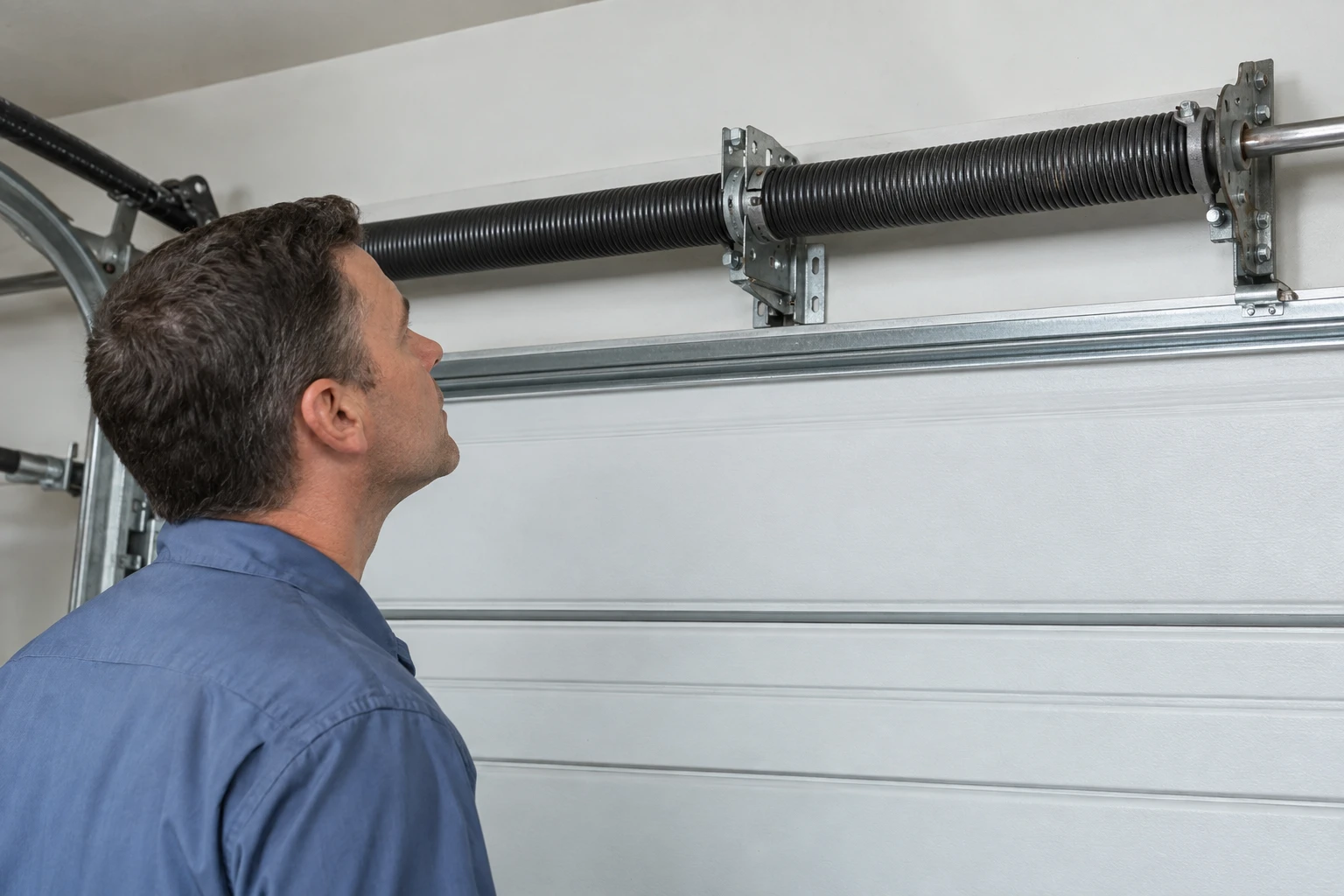
Saginaw doors run from older single skin steel near the rail corridor to modern insulated raised panel doors in the northern subdivisions. Sixteen foot doubles predominate, with torsion springs above the opening and a mix of chain drive and belt drive openers. Because of the dust, photo eye condition matters more here than almost anywhere else in the metroplex, and sensor brackets deserve attention as much as the lenses themselves. Insulated doors are worth more in this city than the energy argument alone suggests, because a sealed door keeps more airborne dust out of the garage. Weather seals, both bottom and perimeter, do real work here. Track and fastener condition should be checked on a shorter interval than a homeowner would need in a quieter suburb.
We work across Saginaw Boulevard, Blue Mound Road, Bailey Boswell Road, Longhorn Road and McLeroy Boulevard, and the practical difference between those areas is larger than the map suggests. Saginaw has a population of about 23,890, and the garage doors in it range across several decades of construction standards.
What causes garage door problems in Saginaw
Two active railroad lines run through the middle of Saginaw, one operated by Union Pacific and one by BNSF, and the city carries a heavier industrial base than suburbs of comparable size, including two large flour mills and the grain elevators that define its skyline. Grain handling produces airborne dust, and rail traffic produces continuous low frequency vibration that travels through ground and structure. Both reach residential garages. Add the Tarrant County clay that moves seasonally, the summer heat, and the wind driven storms that cross open ground north of Fort Worth, and Saginaw doors face a combination of stresses that lakefront or purely residential suburbs do not.
What we get called out for most in Saginaw
The most distinctive Saginaw call is a door that reverses for no visible reason, where the cause turns out to be film on the photo eye lenses rather than any mechanical fault. Fine airborne dust settles on the sensors gradually and evenly, so nothing looks dirty until a lens is wiped. The second most common is fasteners working loose, showing up as a door that has developed a rattle or a track bracket that no longer sits tight against the jamb, on a house where nothing was ever hit or overloaded. Vibration does that over years.
Saginaw took its present name in 1882 when Jarvis J. Green renamed it after Saginaw Street in Pontiac, Michigan, a word that comes from the Ojibwe language and means to flow out. The rail lines that gave the town its reason to exist still run through its center, and the grain elevators beside them are the single most important local fact for anyone maintaining machinery in this city.
Before you call, five things worth checking
- Wipe the two photo eyes firstThey sit about six inches off the floor on each side of the opening, facing each other. Use a dry soft cloth on both lenses, not a wet one and not a cleaning spray, since residue attracts more of the same dust. Look at the small indicator light on each unit afterwards. Most brands show a steady light when the beam is clear and a blinking or dark light when it is broken. In Saginaw this one step resolves more calls than any other single check.
- Check that the sensor brackets still face each otherRail traffic through the middle of this city transmits low frequency vibration through the ground continuously, and over years that shifts brackets a few degrees at a time. Two sensors that no longer aim directly at one another will pass the beam intermittently, which produces a door that closes some days and not others. Sight along each bracket from behind. They should point straight across the opening at the same height, not slightly up, down or off to one side.
- Run your hand along the bottom of the trackGrain dust and road grit collect in the lower few feet of the vertical track where rollers pass most often, and once that mixes with old grease it behaves like grinding paste. Feel for build up and scrape it out with a dry rag or a plastic scraper. Do not add fresh lubricant on top of it. Clean it out first, then lubricate the roller bearings themselves rather than the track channel.
- Push on each track bracket and see if it movesVibration works lag screws loose in a way no impact ever does. Put a hand on each bracket where the vertical track fastens to the jamb and push firmly. Any movement, any gap opening between bracket and wood, means the fastener has backed out or the hole has widened. This is the single most common Saginaw finding on a door that has developed a rattle nobody can explain.
- Look at the bottom section for corrosionDust and moisture together are what start rust, and the bottom section sits where both collect. Check the inside face of the lowest panel and the two bottom brackets. Surface discolouration is normal. Flaking, pitting or metal that gives under thumb pressure is structural, and that is the one finding that turns a repair conversation into a replacement conversation.
Getting to your door in Saginaw
Driveways in Saginaw are generally standard suburban width and straightforward to work from, in both the older and newer sections. The real access variable is rail. Two active lines cross the city, and a train at a grade crossing can hold traffic for several minutes with no way around it. Saginaw Boulevard and Blue Mound Road carry the local traffic and see heavy truck movement serving the mills and rail served industry, which slows things at shift changes. Clearing the driveway before a visit helps as it does anywhere. Arrival depends on distance, traffic, and whether a crossing is blocked at the time.
When garage doors fail in Saginaw
When Saginaw doors need attention Saginaw's calendar is driven as much by grain and rail as by weather. Harvest periods increase activity at the mills and elevators, and airborne dust rises with it, which is when sensor related reversals cluster. Summer heat bakes that dust onto lenses and into grease, turning ordinary lubricant into an abrasive paste on rollers and track. Spring storms wash some of it down but drive moisture under bottom seals at the same time, and dust plus moisture on bare steel is how corrosion starts on lower hinges and track. Winter finds the springs. The one maintenance item worth doing more often here than the regional norm is cleaning the photo eye lenses and checking that their brackets have not shifted, because vibration and dust work against them continuously.
What drives the price of a Saginaw job
What moves the number on a Saginaw job Many Saginaw calls resolve into inexpensive work, because a dust related sensor fault is cleaning and alignment rather than parts. What raises the number is what vibration has done over time to things nobody inspected. Loose track brackets that have worked at their fasteners can elongate the holes in the jamb, and a bracket cannot be made tight again by simply turning the screw harder. Bearings and rollers that have run in dust contaminated grease wear faster than their rating suggests, so a set may need renewing sooner than the calendar implies. Corrosion at the bottom section, where dust and moisture meet, is the finding that changes a repair into a replacement. A good estimate here should say plainly which items are consumable maintenance, which are wear, and which are structural.
What we see most in Saginaw
Airborne dust and why the sensors fail first The photo eyes near the floor of a garage door work by shining a beam from one side to the other and reversing the door if that beam is broken. They do not need to be blocked to fail. A thin, even film across both lenses weakens the beam until the receiver reads it as interrupted, and the door refuses to close or reverses part way. In a city with two flour mills and active grain elevators, that film builds continuously and evenly, which is exactly why it goes unnoticed. Nothing looks dirty. The tell is that the door closes fine when someone holds the wall button down, because that overrides the sensor, and refuses to close from the remote. The fix is usually nothing more than wiping both lenses with a dry soft cloth and confirming the brackets still aim at each other. In Saginaw this belongs on a routine schedule rather than waiting for a failure, and if cleaning does not solve it, the wiring and bracket alignment are the next things to check before anything is replaced.
Working on doors in Saginaw
What rail vibration does to fasteners over years A garage door assembly is held together by lag screws into jamb lumber, track bolts, hinge fasteners, and the bracket that ties the opener arm to the top section. All of them are designed to resist the loads of a door moving up and down. None of them are designed for continuous low frequency vibration from outside the structure. In Saginaw, freight movement on two active lines transmits exactly that, day after day, for the life of a house. The effect is slow and cumulative. Lag screws back out fractionally, track brackets shift, hinge fasteners loosen, and the opener's top bracket works at its mounting until the sections around it begin to flex. Owners usually notice a rattle first and assume it is the opener. The correct response is a systematic fastener check, and where a hole has elongated, moving to sound material or proper backing rather than driving a larger screw into damaged wood. On a house near the corridor this is worth doing annually.
Repair or replace, and how to tell
Repair it
On a Saginaw door the case for repair is strong whenever the sections are sound, because almost everything that fails here is hardware rather than the door. Sensors, brackets, fasteners, rollers, bearings and springs are all replaceable, and the local causes, dust and vibration, attack exactly those parts and leave the panels alone. A door that has developed a rattle, a reversal problem or a grinding noise is usually telling you that its hardware has been worked loose or worn out by conditions, not that it has reached the end of its life. Correcting the mounting properly, moving to sound material where a screw hole has widened, buys years rather than months.
Replace it
Replacement makes sense when corrosion has reached the bottom section, because that is where dust and moisture combine and it cannot be patched. It also makes sense on a single skin door in this city, since an insulated sectional is built as a sealed panel and, combined with good perimeter and bottom seals, keeps noticeably more airborne dust out of the garage entirely. That is a stronger argument here than the energy saving is. The trade is weight, and a heavier door means the springs have to be recalculated rather than reused.
What a Saginaw job actually costs
Every job is quoted after the door is looked at, never over the phone on a guess. What follows is what actually moves the number on a Saginaw job.
| Job | What it covers | What pushes it up |
|---|---|---|
| Sensor cleaning and realignment | the most common Saginaw call, often resolved on the visit | whether brackets have shifted, whether wiring has been damaged by vibration, sensor age |
| Fastener and bracket correction | going through the assembly where vibration has worked screws loose | how many holes have elongated, whether jamb wood is sound, backing needed |
| Roller and bearing renewal | full set, common where dust has entered the bearings | roller grade chosen, sealed or unsealed bearings, whether track also needs cleaning |
| Torsion spring replacement | pair on a standard double door | door weight, cycle rating chosen, whether corrosion has reached cables and drums |
| Bottom seal and threshold | the part doing the most work against dust and water here | seal profile needed, whether the slab is even, threshold strip required |
| Insulated door replacement | sealed panel construction, keeps dust out | door size, insulation type, whether springs and opener need matching to the new weight |
Garage door problem in Saginaw?
Describe what the door is doing and you will get an honest read on whether it needs a visit to Saginaw today, whether it is safe to leave until tomorrow, and roughly what is likely to be wrong with it.
Call (214) 271-8110Common questions from Saginaw
My Saginaw garage door will not close from the remote but closes if I hold the wall button. Why?
That specific combination almost always points at the photo eyes near the floor. Holding the wall button overrides the sensors, which is why that works while the remote does not. In Saginaw the usual cause is not an obstruction but a fine even film of airborne dust on both lenses, which weakens the beam without looking dirty. Wipe both lenses with a dry soft cloth and check that the brackets still face each other squarely. If it still will not close, the wiring or the bracket alignment is the next thing to look at, not the opener.
My garage door has developed a rattle and nothing has hit it. What causes that?
Continuous vibration from nearby rail traffic works fasteners loose over years. Lag screws holding track brackets to the jamb back out fractionally, hinge fasteners loosen, and the bracket connecting the opener arm to the top section works at its mounting. None of this requires an impact. A systematic check of every fastener on the assembly usually finds it. Where a screw hole in the jamb has elongated, the fix is proper backing or sound material rather than a larger screw, because a bigger fastener in damaged wood does not hold for long.
Is an insulated garage door worth it in Saginaw?
There is a stronger argument here than the energy savings alone. An insulated sectional door is built as a sealed panel rather than a single skin, and combined with sound perimeter and bottom seals it keeps noticeably more airborne dust out of the garage. In a city with active grain handling that matters for anything stored inside as well as for the door hardware itself. Insulated doors are also heavier and stiffer, which reduces flex and noise. The trade is that the added weight has to be matched with correctly sized springs, which is not optional.
How often should I have my Saginaw garage door serviced?
More often than the regional default, and for specific reasons. Wipe the photo eye lenses and check their alignment on a routine basis rather than waiting for a fault, because dust builds continuously. Check fasteners across the track brackets, hinges, and opener bracket at least annually, since vibration works them loose. Inspect the bottom section and lower hinges for corrosion where dust and moisture collect. Springs, rollers, and bearings follow the usual cycle based schedule, but in dust contaminated grease they can reach the end of their useful life sooner than the rating suggests.
Why does dust affect my garage door more in Saginaw than where I used to live?
Because of what is in the air here specifically. Two active railroad lines run through the middle of the city and it carries a heavier industrial base than most suburbs its size, including two large flour mills and the grain elevators beside them. Grain handling puts fine particulate into the air continuously, and it settles evenly rather than in visible clumps. That is why photo eye lenses fail here without ever looking dirty, and why grease in a track turns abrasive faster than it would a few miles away.
Can rail vibration really damage a garage door?
Not damage exactly, but it loosens things, and loose is how damage starts. Freight moving on two active lines transmits low frequency energy through the ground into the structure, day after day, for the life of a house. Lag screws holding track brackets back out a fraction at a time, hinge fasteners loosen, and the bracket tying the opener arm to the top section works at its mounting until the panel around it begins to flex. No impact is involved. On a home near the corridor a fastener check once a year handles it completely.
Garage door services we provide in Saginaw
Brands we repair
Electric gates in Saginaw
Explain the quote: Garage Door Repair in Saginaw, Texas in Dallas-Fort Worth
The most useful decision follows the system, not a sales package. For Garage Door Repair in Saginaw, Texas in Dallas-Fort Worth, the local context includes a mix of property ages, operating patterns, weather exposure, shared access, and equipment histories. The working scope centers on inspection, diagnosis, scope, safe work, operational testing, and a documented handoff. Under explain the quote, the review covers diagnosis, parts, labor, optional work, approval, testing, and what would change the scope. A property manager may first report that the photo-eye circuit needs a documented baseline, but that statement is a starting point rather than a diagnosis. The inspection should establish what changed, which parts still function, what can be tested safely, and what result the customer expects. A written scope also reduces surprises after work begins. Conditions across Dallas-Fort Worth influence materials, access, weather exposure, and scheduling, so the final recommendation should follow the actual property. 24/7 Dallas Garage Door Repair explains the work, records important limitations, and asks the customer to verify the finished operation before the visit closes.
Clear documentation makes a technical job easier to judge. For Garage Door Repair in Saginaw, Texas in Dallas-Fort Worth, the local context includes a mix of property ages, operating patterns, weather exposure, shared access, and equipment histories. The working scope centers on inspection, diagnosis, scope, safe work, operational testing, and a documented handoff. Under explain the quote, the review covers diagnosis, parts, labor, optional work, approval, testing, and what would change the scope. A warehouse lead may first report that the bottom fixture behaves differently under load, but that statement is a starting point rather than a diagnosis. The inspection should establish what changed, which parts still function, what can be tested safely, and what result the customer expects. The same check helps rule out work that would not solve the complaint. Conditions across Dallas-Fort Worth influence materials, access, weather exposure, and scheduling, so the final recommendation should follow the actual property. 24/7 Dallas Garage Door Repair explains the work, records important limitations, and asks the customer to verify the finished operation before the visit closes.
Trace uneven movement: Garage Door Repair in Saginaw, Texas in Dallas-Fort Worth
Clear documentation makes a technical job easier to judge. For Garage Door Repair in Saginaw, Texas in Dallas-Fort Worth, the local context includes a mix of property ages, operating patterns, weather exposure, shared access, and equipment histories. The working scope centers on inspection, diagnosis, scope, safe work, operational testing, and a documented handoff. Under trace uneven movement, the review covers cable seating, drums, bottom fixtures, track spacing, rollers, and obstructions around the opening. A technician may first report that the spring shaft shows uneven wear, but that statement is a starting point rather than a diagnosis. The inspection should establish what changed, which parts still function, what can be tested safely, and what result the customer expects. The same check helps rule out work that would not solve the complaint. Conditions across Dallas-Fort Worth influence materials, access, weather exposure, and scheduling, so the final recommendation should follow the actual property. 24/7 Dallas Garage Door Repair explains the work, records important limitations, and asks the customer to verify the finished operation before the visit closes.
The most useful decision follows the system, not a sales package. For Garage Door Repair in Saginaw, Texas in Dallas-Fort Worth, the local context includes a mix of property ages, operating patterns, weather exposure, shared access, and equipment histories. The working scope centers on inspection, diagnosis, scope, safe work, operational testing, and a documented handoff. Under trace uneven movement, the review covers cable seating, drums, bottom fixtures, track spacing, rollers, and obstructions around the opening. A installer may first report that the opener rail has an uncertain service history, but that statement is a starting point rather than a diagnosis. The inspection should establish what changed, which parts still function, what can be tested safely, and what result the customer expects. A written scope also reduces surprises after work begins. Conditions across Dallas-Fort Worth influence materials, access, weather exposure, and scheduling, so the final recommendation should follow the actual property. 24/7 Dallas Garage Door Repair explains the work, records important limitations, and asks the customer to verify the finished operation before the visit closes.
A useful question before approving this step
Ask what observation supports the recommendation, which parts are included, which parts are outside the scope, how the result will be tested, and what documentation you will receive. Call (214) 271-8110 to describe the property and schedule work within Dallas-Fort Worth.
Review everyday use: Garage Door Repair in Saginaw, Texas in Dallas-Fort Worth
Every property adds a different operating pattern. For Garage Door Repair in Saginaw, Texas in Dallas-Fort Worth, the local context includes a mix of property ages, operating patterns, weather exposure, shared access, and equipment histories. The working scope centers on inspection, diagnosis, scope, safe work, operational testing, and a documented handoff. Under review everyday use, the review covers vehicles, storage, children, pets, deliveries, work schedules, noise, and the need for backup entry. A installer may first report that the cable drum has been exposed to moisture, but that statement is a starting point rather than a diagnosis. The inspection should establish what changed, which parts still function, what can be tested safely, and what result the customer expects. This approach keeps safety, function, and cost in the same conversation. Conditions across Dallas-Fort Worth influence materials, access, weather exposure, and scheduling, so the final recommendation should follow the actual property. 24/7 Dallas Garage Door Repair explains the work, records important limitations, and asks the customer to verify the finished operation before the visit closes.
Good service starts by separating cause from coincidence. For Garage Door Repair in Saginaw, Texas in Dallas-Fort Worth, the local context includes a mix of property ages, operating patterns, weather exposure, shared access, and equipment histories. The working scope centers on inspection, diagnosis, scope, safe work, operational testing, and a documented handoff. Under review everyday use, the review covers vehicles, storage, children, pets, deliveries, work schedules, noise, and the need for backup entry. A technician may first report that the bottom fixture behaves differently under load, but that statement is a starting point rather than a diagnosis. The inspection should establish what changed, which parts still function, what can be tested safely, and what result the customer expects. That distinction matters when several people share responsibility for the property. Conditions across Dallas-Fort Worth influence materials, access, weather exposure, and scheduling, so the final recommendation should follow the actual property. 24/7 Dallas Garage Door Repair explains the work, records important limitations, and asks the customer to verify the finished operation before the visit closes.
Separate door and opener: Garage Door Repair in Saginaw, Texas in Dallas-Fort Worth
The safest next step comes from controlled testing. For Garage Door Repair in Saginaw, Texas in Dallas-Fort Worth, the local context includes a mix of property ages, operating patterns, weather exposure, shared access, and equipment histories. The working scope centers on inspection, diagnosis, scope, safe work, operational testing, and a documented handoff. Under separate door and opener, the review covers manual movement, trolley release, motor effort, travel settings, force settings, and the symptom that started the call. A technician may first report that the bottom fixture behaves differently under load, but that statement is a starting point rather than a diagnosis. The inspection should establish what changed, which parts still function, what can be tested safely, and what result the customer expects. A complete handoff shows what changed and how to verify it. Conditions across Dallas-Fort Worth influence materials, access, weather exposure, and scheduling, so the final recommendation should follow the actual property. 24/7 Dallas Garage Door Repair explains the work, records important limitations, and asks the customer to verify the finished operation before the visit closes.
The visible symptom is only the first clue. For Garage Door Repair in Saginaw, Texas in Dallas-Fort Worth, the local context includes a mix of property ages, operating patterns, weather exposure, shared access, and equipment histories. The working scope centers on inspection, diagnosis, scope, safe work, operational testing, and a documented handoff. Under separate door and opener, the review covers manual movement, trolley release, motor effort, travel settings, force settings, and the symptom that started the call. A property manager may first report that the cable drum has been exposed to moisture, but that statement is a starting point rather than a diagnosis. The inspection should establish what changed, which parts still function, what can be tested safely, and what result the customer expects. The result is easier to test and easier to document. Conditions across Dallas-Fort Worth influence materials, access, weather exposure, and scheduling, so the final recommendation should follow the actual property. 24/7 Dallas Garage Door Repair explains the work, records important limitations, and asks the customer to verify the finished operation before the visit closes.