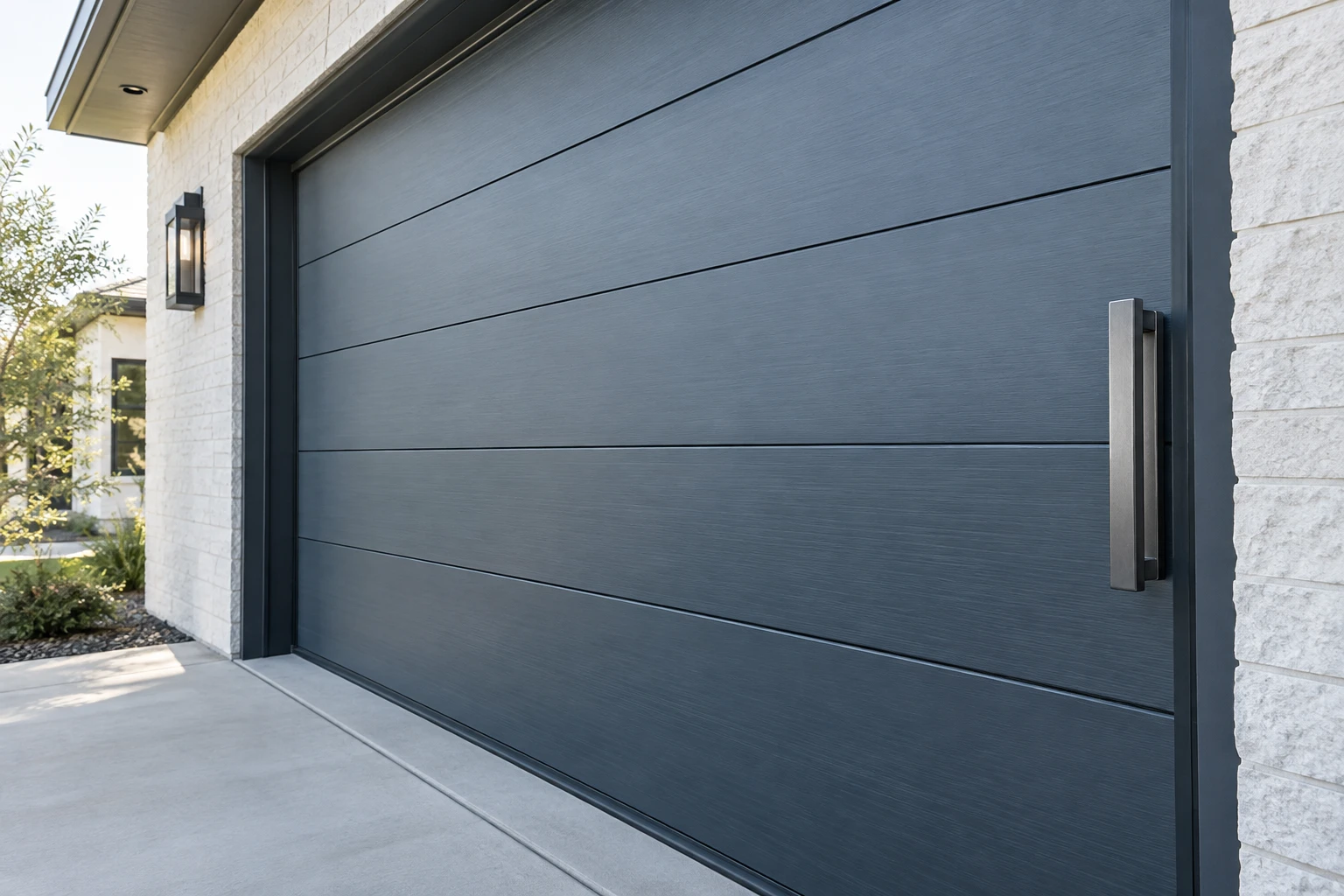
The housing in Highland Village and what it means for your door
Highland Village sits on the southern side of the western branch of Lewisville Lake, and water accounts for about fourteen percent of its six and a half square miles, which is a higher share than any other city in this service area. That shoreline shapes the housing. Lots follow the terrain down toward the water rather than sitting on a flat grid, so driveways frequently run on a grade and garages sit above or below street level. Homes are large, predominantly two story brick, with three car garages common and a taller or deeper bay often added for a boat or a trailer. Mature tree canopy covers much of the older residential area. The city held only 516 residents in 1970 and grew through the decades after the airport opened, so almost everything here is 1980s construction or later.
Doors here are modern insulated sectionals, mostly on sixteen foot double openings with one or two additional single bays. What sets the city apart is the frequency of oversized bays. A boat or RV bay can run considerably taller than a standard residential door, and taller means heavier, which means a different spring calculation, larger drums, and longer cables than the doors beside it. Torsion springs above the opening are universal. Openers are mostly belt drive, with wall mounted jackshaft units appearing on the taller bays where headroom is limited by the framing. Bottom seals matter more here than in most cities because of the grade and the water, and a seal profile suited to an uneven or sloped threshold is not the same part as a standard one.
We work across Highland Village Road, Briarhill Boulevard, Chinn Chapel Road, Village Parkway and the Lewisville Lake shoreline, and the practical difference between those areas is larger than the map suggests. Highland Village has a population of about 15,899, and the garage doors in it range across several decades of construction standards.
What causes garage door problems in Highland Village
The lake raises humidity across the whole city through the warm months, and homes closest to the shoreline stay damp longer after rain. Heavy tree canopy compounds that by keeping garages shaded well into the afternoon, so a north facing garage under mature trees can stay wet when the rest of the street has dried. Sloped lots mean water runs toward some garage openings rather than away from them, and the grade of a driveway changes how a door meets the floor at the threshold. Denton County ground moves seasonally like the rest of the region, and on a graded lot that movement shows up faster at the apron.
What we get called out for most in Highland Village
The most frequent Highland Village call involves the bottom of the door rather than the top. Sloped driveways send water toward the threshold, and a bottom seal that has hardened or compressed stops holding it out. Owners notice water inside the garage before they notice anything wrong with the door. The second common call is a boat or trailer bay, which is usually the tallest and heaviest door on the property, often fitted with hardware sized for the standard bays beside it rather than for its own weight.
Highland Village incorporated in February 1963 and stayed tiny for another decade, holding just over five hundred people in 1970. The growth came after Dallas Fort Worth International Airport opened, which is why a lakeside city with a long shoreline has housing that is almost entirely modern.
Getting to your door in Highland Village
Driveways in Highland Village are long and frequently on a grade, and a sloped approach can be a real consideration for a service vehicle in wet weather. Mature trees overhang many drives, so low limbs matter more than width. Shoreline properties can have limited turning room. Highland Village Road and Village Parkway carry the local traffic, and Interstate 35E to the west congests at commuter peaks. Boats, trailers, and lake equipment often occupy driveway space, so clearing them before a visit makes a real difference on a property with a boat bay. Arrival depends on distance and traffic.
When garage doors fail in Highland Village
When Highland Village doors need attention Water drives the calendar here. Spring storms combine with sloped driveways to push water toward thresholds, and that is when bottom seal failures show up. The same rain in a flat suburb runs off harmlessly. Summer humidity off the lake keeps shaded garages under tree canopy damp for long stretches, which reaches the lowest hinges, the bottom brackets, and the ends of the track before it reaches anything else, so corrosion here starts at the floor and works upward. Autumn brings heavy leaf fall from the mature canopy directly into tracks and across sensor lenses. Winter cold finds springs at the end of their life as it does everywhere, and finds them soonest on the boat bay that has been carrying the most weight.
What drives the price of a Highland Village job
What moves the number on a Highland Village job Two things drive the number. The first is whether the job involves an oversized bay, because a taller boat or RV door needs heavier springs, larger drums, and longer cables than the standard bays on the same house, and those are different parts at a different price. The second is water. A bottom seal on a sloped or uneven threshold is a specific profile rather than a stock strip, and where water has already reached the lower hardware, corroded hinges, brackets, and track ends may need replacing alongside it. Long sloped driveways and shoreline access add setup time. A fair estimate should say plainly which bay it is pricing, because quoting an oversized door on standard assumptions produces a number that changes on site.
What we see most in Highland Village
Sloped driveways and the bottom of the door On a flat lot, a garage door threshold is a simple line where the door meets the slab. On a graded lot running toward the lake, it is a low point that water actively moves toward. The bottom seal is the only thing standing between that water and the garage floor, and seals harden, compress, and lose their shape over years of sun and temperature swing long before they look worn out. The first sign is usually water inside rather than a visible problem with the seal. What compounds it here is that a sloped approach rarely meets the slab perfectly evenly, so the seal has to bridge a gap that varies across the width of the door. A standard flat seal cannot do that well. The right answer is a seal profile suited to an uneven threshold, sometimes combined with a threshold strip bonded to the slab, and it is worth checking the lower hinges, bottom brackets, and the bottom of the vertical track at the same visit, because those are where water that has been getting in has already been sitting.
Working on doors in Highland Village
The boat bay is not a bigger version of the other doors A tall bay built for a boat, an RV, or a trailer looks like the doors beside it and behaves nothing like them. Height adds weight quickly, and weight is what the counterbalance system has to answer, so a taller door needs a different spring wire diameter, a different length, often a larger drum, and longer cables. The common problem on Highland Village properties is that all the bays on a house were treated as one job at some point and the tall door received hardware sized for the standard ones. That door still operates. It runs outside what those parts were rated for, so its springs reach their cycle limit early, its cables fatigue where they wrap the drum, and eventually something gives under a load it was never sized for. The correct approach is to weigh or calculate that door on its own, size its springs and drums to that figure, and confirm the track and jamb attachment can carry it. It is a separate job from servicing the standard bays and should be quoted as one.
Garage door problem in Highland Village?
Describe what the door is doing and you will get an honest read on whether it needs a visit to Highland Village today, whether it is safe to leave until tomorrow, and roughly what is likely to be wrong with it.
Call (214) 271-8110Common questions from Highland Village
Water keeps getting into my Highland Village garage. Is the door the problem?
Usually the bottom seal rather than the door. On a sloped lot the driveway sends water toward the threshold instead of away from it, and a seal that has hardened or compressed stops holding it back long before it looks worn. A sloped approach also rarely meets the slab evenly, so the seal has to bridge a gap that varies across the width. A profile suited to an uneven threshold, sometimes with a bonded threshold strip, is the answer. Have the lower hinges and the bottom of the track checked at the same time.
My boat bay door broke and the other two are fine. Why that one?
Because it is taller and therefore much heavier, and it may have been fitted with hardware sized for the standard bays. A taller door needs a different spring wire diameter and length, often a larger drum, and longer cables. Fitted with standard parts it still operates, but it runs outside their rating, so the springs reach their cycle limit early and the cables fatigue where they wrap the drum. That door should be weighed or calculated on its own and its components sized to that figure, separately from the bays beside it.
My garage is under heavy tree cover and the hardware is rusting. What can I do?
Shade plus lake humidity keeps a garage damp long after the rest of the street has dried, and that reaches the lowest hardware first. The lower hinges, bottom brackets, and the bottom few feet of vertical track are where it starts. Keep leaf litter out of the track, since it holds moisture directly against steel, and check that the bottom seal is still keeping water out. Where hardware already shows real corrosion rather than surface rust, replacing it is better than running it, because a corroded spring can lose tension unevenly.
Leaves keep making my garage door reverse. Is something broken?
Probably not. Heavy canopy drops litter directly into the track and onto the photo eye lenses near the floor, and either can stop the door closing. Debris in the track makes a roller ride unevenly, and material on a lens weakens the sensor beam until the receiver reads it as blocked. Clear the track, wipe both lenses with a dry cloth, and check the brackets still face each other. In autumn here that is worth doing more often than the once a year a household elsewhere would need.
Garage door services we provide in Highland Village
Brands we repair
Electric gates in Highland Village
Review everyday use: Garage Door Repair in Highland Village, Texas in Dallas-Fort Worth
Every property adds a different operating pattern. For Garage Door Repair in Highland Village, Texas in Dallas-Fort Worth, the local context includes a mix of property ages, operating patterns, weather exposure, shared access, and equipment histories. The working scope centers on inspection, diagnosis, scope, safe work, operational testing, and a documented handoff. Under review everyday use, the review covers vehicles, storage, children, pets, deliveries, work schedules, noise, and the need for backup entry. A property manager may first report that the opener rail has an uncertain service history, but that statement is a starting point rather than a diagnosis. The inspection should establish what changed, which parts still function, what can be tested safely, and what result the customer expects. This approach keeps safety, function, and cost in the same conversation. Conditions across Dallas-Fort Worth influence materials, access, weather exposure, and scheduling, so the final recommendation should follow the actual property. 24/7 Dallas Garage Door Repair explains the work, records important limitations, and asks the customer to verify the finished operation before the visit closes.
The safest next step comes from controlled testing. For Garage Door Repair in Highland Village, Texas in Dallas-Fort Worth, the local context includes a mix of property ages, operating patterns, weather exposure, shared access, and equipment histories. The working scope centers on inspection, diagnosis, scope, safe work, operational testing, and a documented handoff. Under review everyday use, the review covers vehicles, storage, children, pets, deliveries, work schedules, noise, and the need for backup entry. A homeowner may first report that the sectional door serves several users, but that statement is a starting point rather than a diagnosis. The inspection should establish what changed, which parts still function, what can be tested safely, and what result the customer expects. A complete handoff shows what changed and how to verify it. Conditions across Dallas-Fort Worth influence materials, access, weather exposure, and scheduling, so the final recommendation should follow the actual property. 24/7 Dallas Garage Door Repair explains the work, records important limitations, and asks the customer to verify the finished operation before the visit closes.
Separate door and opener: Garage Door Repair in Highland Village, Texas in Dallas-Fort Worth
The safest next step comes from controlled testing. For Garage Door Repair in Highland Village, Texas in Dallas-Fort Worth, the local context includes a mix of property ages, operating patterns, weather exposure, shared access, and equipment histories. The working scope centers on inspection, diagnosis, scope, safe work, operational testing, and a documented handoff. Under separate door and opener, the review covers manual movement, trolley release, motor effort, travel settings, force settings, and the symptom that started the call. A homeowner may first report that the sectional door serves several users, but that statement is a starting point rather than a diagnosis. The inspection should establish what changed, which parts still function, what can be tested safely, and what result the customer expects. A complete handoff shows what changed and how to verify it. Conditions across Dallas-Fort Worth influence materials, access, weather exposure, and scheduling, so the final recommendation should follow the actual property. 24/7 Dallas Garage Door Repair explains the work, records important limitations, and asks the customer to verify the finished operation before the visit closes.
Every property adds a different operating pattern. For Garage Door Repair in Highland Village, Texas in Dallas-Fort Worth, the local context includes a mix of property ages, operating patterns, weather exposure, shared access, and equipment histories. The working scope centers on inspection, diagnosis, scope, safe work, operational testing, and a documented handoff. Under separate door and opener, the review covers manual movement, trolley release, motor effort, travel settings, force settings, and the symptom that started the call. A building owner may first report that the opener rail has an uncertain service history, but that statement is a starting point rather than a diagnosis. The inspection should establish what changed, which parts still function, what can be tested safely, and what result the customer expects. This approach keeps safety, function, and cost in the same conversation. Conditions across Dallas-Fort Worth influence materials, access, weather exposure, and scheduling, so the final recommendation should follow the actual property. 24/7 Dallas Garage Door Repair explains the work, records important limitations, and asks the customer to verify the finished operation before the visit closes.
A useful question before approving this step
Ask what observation supports the recommendation, which parts are included, which parts are outside the scope, how the result will be tested, and what documentation you will receive. Call (214) 271-8110 to describe the property and schedule work within Dallas-Fort Worth.
Match parts to the door: Garage Door Repair in Highland Village, Texas in Dallas-Fort Worth
The most useful decision follows the system, not a sales package. For Garage Door Repair in Highland Village, Texas in Dallas-Fort Worth, the local context includes a mix of property ages, operating patterns, weather exposure, shared access, and equipment histories. The working scope centers on inspection, diagnosis, scope, safe work, operational testing, and a documented handoff. Under match parts to the door, the review covers weight, height, track radius, headroom, shaft layout, manufacturer details, and compatible replacement hardware. A building owner may first report that the cable drum has been exposed to moisture, but that statement is a starting point rather than a diagnosis. The inspection should establish what changed, which parts still function, what can be tested safely, and what result the customer expects. A written scope also reduces surprises after work begins. Conditions across Dallas-Fort Worth influence materials, access, weather exposure, and scheduling, so the final recommendation should follow the actual property. 24/7 Dallas Garage Door Repair explains the work, records important limitations, and asks the customer to verify the finished operation before the visit closes.
A careful scope protects both the equipment and the customer. For Garage Door Repair in Highland Village, Texas in Dallas-Fort Worth, the local context includes a mix of property ages, operating patterns, weather exposure, shared access, and equipment histories. The working scope centers on inspection, diagnosis, scope, safe work, operational testing, and a documented handoff. Under match parts to the door, the review covers weight, height, track radius, headroom, shaft layout, manufacturer details, and compatible replacement hardware. A technician may first report that the sectional door serves several users, but that statement is a starting point rather than a diagnosis. The inspection should establish what changed, which parts still function, what can be tested safely, and what result the customer expects. It also gives the customer a clear way to compare the available options. Conditions across Dallas-Fort Worth influence materials, access, weather exposure, and scheduling, so the final recommendation should follow the actual property. 24/7 Dallas Garage Door Repair explains the work, records important limitations, and asks the customer to verify the finished operation before the visit closes.
Complete the handoff: Garage Door Repair in Highland Village, Texas in Dallas-Fort Worth
Clear documentation makes a technical job easier to judge. For Garage Door Repair in Highland Village, Texas in Dallas-Fort Worth, the local context includes a mix of property ages, operating patterns, weather exposure, shared access, and equipment histories. The working scope centers on inspection, diagnosis, scope, safe work, operational testing, and a documented handoff. Under complete the handoff, the review covers manual release, remote controls, keypad access, safety tests, maintenance notes, and ownership of connected accounts. A homeowner may first report that the bottom fixture behaves differently under load, but that statement is a starting point rather than a diagnosis. The inspection should establish what changed, which parts still function, what can be tested safely, and what result the customer expects. The same check helps rule out work that would not solve the complaint. Conditions across Dallas-Fort Worth influence materials, access, weather exposure, and scheduling, so the final recommendation should follow the actual property. 24/7 Dallas Garage Door Repair explains the work, records important limitations, and asks the customer to verify the finished operation before the visit closes.
Small alignment and maintenance details often explain large symptoms. For Garage Door Repair in Highland Village, Texas in Dallas-Fort Worth, the local context includes a mix of property ages, operating patterns, weather exposure, shared access, and equipment histories. The working scope centers on inspection, diagnosis, scope, safe work, operational testing, and a documented handoff. Under complete the handoff, the review covers manual release, remote controls, keypad access, safety tests, maintenance notes, and ownership of connected accounts. A building owner may first report that the cable drum has been exposed to moisture, but that statement is a starting point rather than a diagnosis. The inspection should establish what changed, which parts still function, what can be tested safely, and what result the customer expects. That sequence keeps the recommendation tied to evidence. Conditions across Dallas-Fort Worth influence materials, access, weather exposure, and scheduling, so the final recommendation should follow the actual property. 24/7 Dallas Garage Door Repair explains the work, records important limitations, and asks the customer to verify the finished operation before the visit closes.
Check safety reversal: Garage Door Repair in Highland Village, Texas in Dallas-Fort Worth
The final test matters as much as the first inspection. For Garage Door Repair in Highland Village, Texas in Dallas-Fort Worth, the local context includes a mix of property ages, operating patterns, weather exposure, shared access, and equipment histories. The working scope centers on inspection, diagnosis, scope, safe work, operational testing, and a documented handoff. Under check safety reversal, the review covers photo-eye position, wiring, obstruction response, closing force, travel limits, and testing after adjustment. A property manager may first report that the photo-eye circuit needs a documented baseline, but that statement is a starting point rather than a diagnosis. The inspection should establish what changed, which parts still function, what can be tested safely, and what result the customer expects. The technician can then explain what belongs in the current job and what can wait. Conditions across Dallas-Fort Worth influence materials, access, weather exposure, and scheduling, so the final recommendation should follow the actual property. 24/7 Dallas Garage Door Repair explains the work, records important limitations, and asks the customer to verify the finished operation before the visit closes.
Good service starts by separating cause from coincidence. For Garage Door Repair in Highland Village, Texas in Dallas-Fort Worth, the local context includes a mix of property ages, operating patterns, weather exposure, shared access, and equipment histories. The working scope centers on inspection, diagnosis, scope, safe work, operational testing, and a documented handoff. Under check safety reversal, the review covers photo-eye position, wiring, obstruction response, closing force, travel limits, and testing after adjustment. A warehouse lead may first report that the sectional door serves several users, but that statement is a starting point rather than a diagnosis. The inspection should establish what changed, which parts still function, what can be tested safely, and what result the customer expects. That distinction matters when several people share responsibility for the property. Conditions across Dallas-Fort Worth influence materials, access, weather exposure, and scheduling, so the final recommendation should follow the actual property. 24/7 Dallas Garage Door Repair explains the work, records important limitations, and asks the customer to verify the finished operation before the visit closes.
A useful question before approving this step
Ask what observation supports the recommendation, which parts are included, which parts are outside the scope, how the result will be tested, and what documentation you will receive. Call (214) 271-8110 to describe the property and schedule work within Dallas-Fort Worth.
Protect panels and hardware: Garage Door Repair in Highland Village, Texas in Dallas-Fort Worth
A reliable plan begins with a physical check. For Garage Door Repair in Highland Village, Texas in Dallas-Fort Worth, the local context includes a mix of property ages, operating patterns, weather exposure, shared access, and equipment histories. The working scope centers on inspection, diagnosis, scope, safe work, operational testing, and a documented handoff. Under protect panels and hardware, the review covers cracks, loose hinges, roller stems, fasteners, struts, weather seal, and early signs of fatigue. A technician may first report that the sectional door serves several users, but that statement is a starting point rather than a diagnosis. The inspection should establish what changed, which parts still function, what can be tested safely, and what result the customer expects. This prevents one worn part from hiding a larger operating problem. Conditions across Dallas-Fort Worth influence materials, access, weather exposure, and scheduling, so the final recommendation should follow the actual property. 24/7 Dallas Garage Door Repair explains the work, records important limitations, and asks the customer to verify the finished operation before the visit closes.
The visible symptom is only the first clue. For Garage Door Repair in Highland Village, Texas in Dallas-Fort Worth, the local context includes a mix of property ages, operating patterns, weather exposure, shared access, and equipment histories. The working scope centers on inspection, diagnosis, scope, safe work, operational testing, and a documented handoff. Under protect panels and hardware, the review covers cracks, loose hinges, roller stems, fasteners, struts, weather seal, and early signs of fatigue. A property manager may first report that the photo-eye circuit needs a documented baseline, but that statement is a starting point rather than a diagnosis. The inspection should establish what changed, which parts still function, what can be tested safely, and what result the customer expects. The result is easier to test and easier to document. Conditions across Dallas-Fort Worth influence materials, access, weather exposure, and scheduling, so the final recommendation should follow the actual property. 24/7 Dallas Garage Door Repair explains the work, records important limitations, and asks the customer to verify the finished operation before the visit closes.
Treat spring tension with respect: Garage Door Repair in Highland Village, Texas in Dallas-Fort Worth
Small alignment and maintenance details often explain large symptoms. For Garage Door Repair in Highland Village, Texas in Dallas-Fort Worth, the local context includes a mix of property ages, operating patterns, weather exposure, shared access, and equipment histories. The working scope centers on inspection, diagnosis, scope, safe work, operational testing, and a documented handoff. Under treat spring tension with respect, the review covers door weight, spring size, shaft condition, winding hardware, cable position, and safe control of stored energy. A installer may first report that the photo-eye circuit needs a documented baseline, but that statement is a starting point rather than a diagnosis. The inspection should establish what changed, which parts still function, what can be tested safely, and what result the customer expects. That sequence keeps the recommendation tied to evidence. Conditions across Dallas-Fort Worth influence materials, access, weather exposure, and scheduling, so the final recommendation should follow the actual property. 24/7 Dallas Garage Door Repair explains the work, records important limitations, and asks the customer to verify the finished operation before the visit closes.
Clear documentation makes a technical job easier to judge. For Garage Door Repair in Highland Village, Texas in Dallas-Fort Worth, the local context includes a mix of property ages, operating patterns, weather exposure, shared access, and equipment histories. The working scope centers on inspection, diagnosis, scope, safe work, operational testing, and a documented handoff. Under treat spring tension with respect, the review covers door weight, spring size, shaft condition, winding hardware, cable position, and safe control of stored energy. A warehouse lead may first report that the spring shaft shows uneven wear, but that statement is a starting point rather than a diagnosis. The inspection should establish what changed, which parts still function, what can be tested safely, and what result the customer expects. The same check helps rule out work that would not solve the complaint. Conditions across Dallas-Fort Worth influence materials, access, weather exposure, and scheduling, so the final recommendation should follow the actual property. 24/7 Dallas Garage Door Repair explains the work, records important limitations, and asks the customer to verify the finished operation before the visit closes.